

Medically reviewed by Kerry Andrek, Clinical Director
If you’ve ever wondered why you become angry during conflict, feel an overwhelming urge to leave stressful situations, completely shut down, or automatically put everyone else’s needs before your own, you’re not alone. Understanding the types of trauma responses can help explain these experiences in a way that replaces self-criticism with self-understanding.
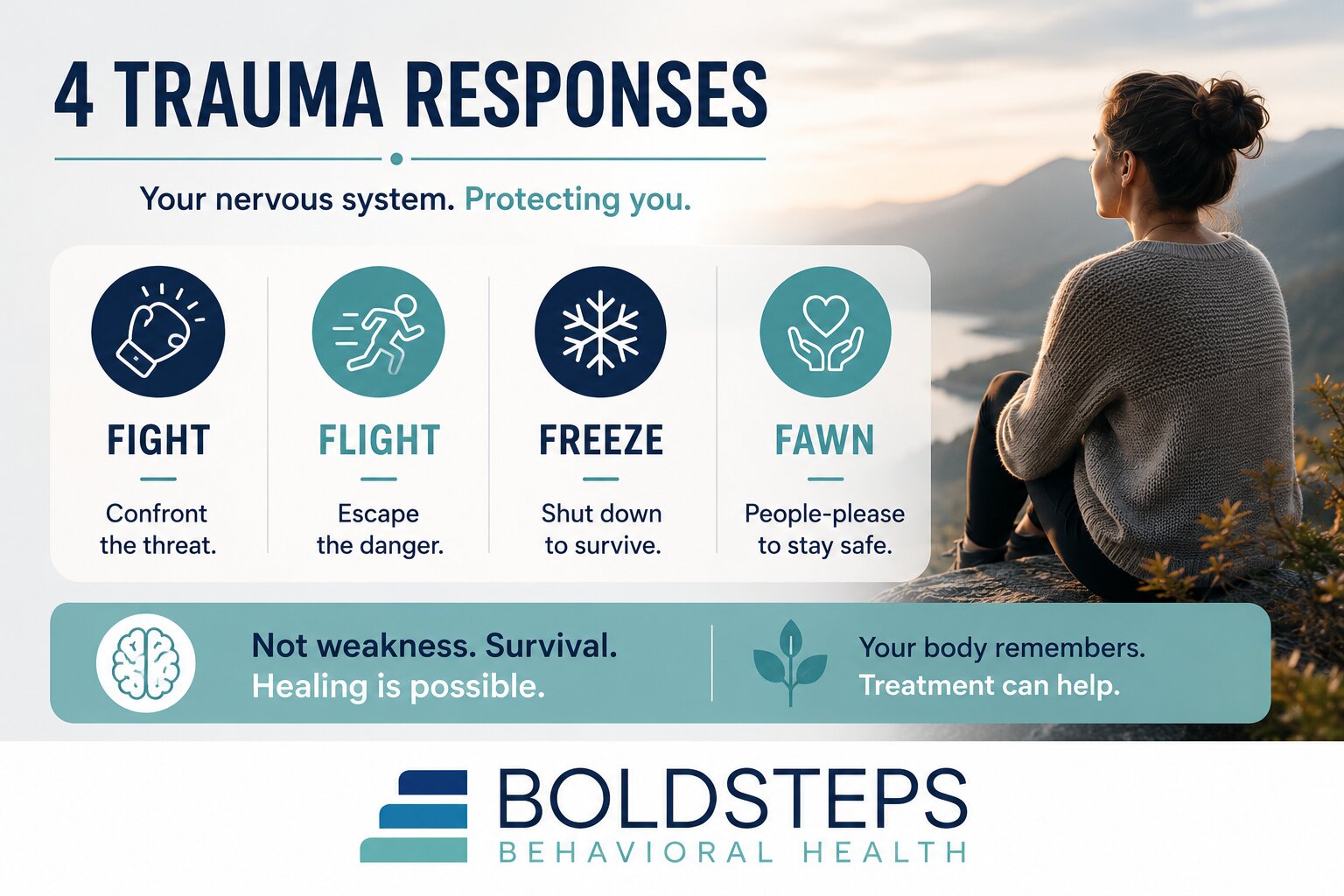
If you’re exploring support, learning more about trauma therapy can provide a helpful overview of treatment options. One of the most important things to know is this: fight, flight, freeze, and fawn are not signs of weakness. They are your nervous system doing exactly what it was designed to do—protect you when it senses danger.
The challenge is that after trauma, your nervous system may continue using these survival strategies long after the threat has passed. What once kept you safe can begin affecting relationships, work, and daily life.
The encouraging news is that these responses are not permanent. With the right support, your nervous system can learn that it is safe again.
What Is a Trauma Response?
A trauma response is an automatic neurological reaction to a perceived threat. It isn’t something you consciously choose or decide to do.
Imagine your nervous system as your body’s smoke detector. When functioning well, it alerts you to real danger. After trauma, however, that smoke detector can become overly sensitive. Instead of reacting only to actual fires, it may sound the alarm when someone raises their voice, when conflict begins, or even when a situation merely reminds your brain of a past experience.
This happens because the brain prioritizes survival over conscious decision-making during perceived danger.
Different people can experience the same event and develop different trauma responses because every nervous system is shaped by factors such as:
- Previous life experiences
- Childhood environment
- Genetics
- Available support after trauma
- The duration and intensity of the traumatic experience
You may have heard of Polyvagal Theory, which helps explain why our nervous systems shift between feeling safe, mobilizing for action, or shutting down during overwhelming situations. While the science continues to evolve, the basic idea is helpful: your body constantly scans for signs of safety or danger, often before you’re consciously aware of it.
That is why trauma responses often feel automatic.
The 4 Trauma Responses: Fight, Flight, Freeze, and Fawn
The most widely recognized trauma responses are known as fight, flight, freeze, and fawn. Each represents a different survival strategy.
You aren’t limited to only one. Many people experience several depending on the situation.
Fight Response
The fight response prepares your body to confront danger.
When activated, your nervous system increases energy, adrenaline, and alertness so you can defend yourself.
In everyday life, the fight response may look like:
- Becoming easily irritated
- Feeling defensive during conversations
- Arguing before hearing the whole story
- Reacting strongly to criticism
- Needing to feel in control
- Experiencing frequent frustration or anger
People with a strong fight response are often misunderstood as aggressive. In reality, their nervous system may simply be trying to prevent them from being hurt again.
Flight Response
The flight response prepares you to escape danger.
Instead of confronting a threat, your body encourages movement away from it.
Daily examples include:
- Staying constantly busy
- Overworking
- Difficulty relaxing
- Feeling restless
- Avoiding difficult conversations
- Excessive planning or perfectionism
- Hypervigilance
Some people physically leave stressful situations.
Others emotionally “run” by staying busy enough that uncomfortable feelings never have a chance to surface.
Freeze Response
The freeze response occurs when your nervous system decides that fighting or escaping doesn’t seem possible.
Instead of mobilizing, your body slows down.
People often describe freeze as:
- Going blank during conflict
- Feeling emotionally numb
- Dissociating
- Struggling to make decisions
- Feeling disconnected from their surroundings
- Being unable to speak even when they want to
Many people who experience a freeze response later blame themselves.
“I should have said something.”
“I don’t know why I couldn’t move.”
But freeze is not a conscious decision. It is one of the body’s oldest survival strategies.
Fawn Response
The fawn response trauma experts describe is less widely known but incredibly common.
Coined by trauma therapist Pete Walker, the fawn response involves staying safe by pleasing other people.
Rather than fighting, fleeing, or freezing, the nervous system attempts to reduce danger by maintaining connection and avoiding conflict.
In daily life, this may look like:
- Saying yes when you want to say no
- Apologizing excessively
- Taking responsibility for other people’s emotions
- Avoiding disagreement
- Ignoring your own needs
- Feeling guilty for setting boundaries
- Constantly seeking approval
Many people don’t realize they’re fawning because these behaviors are often praised as kindness or selflessness.
The difference is motivation.
Healthy kindness comes from choice.
Fawning comes from survival.
Beyond the 4: Understanding Fawn and Flop
Although fight, flight, freeze, and fawn receive the most attention, some trauma professionals also describe a fifth response called flop.
Looking More Closely at Fawning
Among all the trauma responses, fawning is perhaps the least understood.
Someone who fawns may:
- Agree even when they disagree
- Laugh off disrespect
- Prioritize everyone else’s comfort
- Minimize their own pain
- Become the emotional caretaker in every relationship
Over time, this survival strategy can make it difficult to recognize your own wants and needs.
You may find yourself asking:
“What do I actually want?”
“What do I think?”
Those questions can feel surprisingly difficult after years of automatically adapting to everyone around you.
Recognizing fawning isn’t about blaming yourself.
It’s about understanding that these patterns often developed because they once helped you survive emotionally or physically.
What Is the Flop Response?
The flop response is discussed less often but can help explain experiences that go beyond freezing.
Instead of simply becoming still, the nervous system shifts into profound collapse.
Someone experiencing flop may feel:
- Completely disconnected
- Physically limp
- Emotionally absent
- Unable to respond
- Detached from reality
Not every trauma professional uses this term, but many people find it helpful because it describes experiences that don’t fully fit within the traditional freeze response.
What’s Happening in Your Nervous System?
Understanding the trauma response nervous system doesn’t require a neuroscience degree.
One helpful concept is the window of tolerance.
Imagine your emotional capacity as a window.
When you’re inside that window, you can:
- Think clearly
- Solve problems
- Regulate emotions
- Connect with other people
- Recover from stress
After trauma, that window often becomes much smaller.
It takes less stress to push your nervous system outside its comfortable range.
Hyperarousal
Above your window of tolerance is hyperarousal.
This is where fight, flight, and often fawn responses tend to occur.
You may experience:
- Racing thoughts
- Anxiety
- Irritability
- Panic
- Restlessness
- Hypervigilance
Your nervous system believes it must stay alert because danger feels close.
Hypoarousal
Below your window is hypoarousal.
This is where freeze and flop responses become more likely.
People often experience:
- Emotional numbness
- Fatigue
- Dissociation
- Feeling disconnected
- Difficulty speaking
- Lack of motivation
Rather than preparing for action, your nervous system conserves energy by shutting down.
Why Trauma Narrows the Window
Repeated trauma teaches the nervous system that the world is unpredictable.
As a result, it becomes quicker to enter survival mode.
The encouraging part is that healing works in the opposite direction.
With consistent support, your nervous system gradually learns that it no longer needs to react to every reminder as though it were immediate danger.
Over time, your window of tolerance can widen, allowing you to handle stress with greater flexibility and resilience.
Healing From Trauma Responses
Many people worry that because they’ve reacted the same way for years, they’ll never change.
Fortunately, trauma responses are not fixed personality traits.
The brain and nervous system remain capable of learning throughout adulthood.
Healing often focuses on helping your body recognize safety again rather than simply trying to “think differently.”
Evidence-based treatments that may help include:
- EMDR (Eye Movement Desensitization and Reprocessing)
- Trauma-focused cognitive behavioral therapy (TF-CBT)
- Somatic therapies that emphasize the connection between the body and nervous system
- Mindfulness and grounding techniques
- Skills for emotional regulation and healthy boundaries
Progress rarely happens overnight.
Instead, many people notice small but meaningful changes.
Perhaps you pause before reacting.
Maybe you set one boundary instead of saying yes automatically.
You recover more quickly after stress.
These moments are signs that your nervous system is learning new patterns. If you’re in Rockingham, Merrimack, Hillsborough, Nashua or Essex County, our nearby centers are here to provide easy access to care.
If trauma responses are affecting your relationships, work, or emotional well-being, compassionate treatment can help. Learn more about trauma therapy or call (603) 915-4223 to speak with the team at Bold Steps NH about your options.
Frequently Asked Questions
What are the 4 trauma responses?
The four primary trauma responses are fight, flight, freeze, and fawn. They are automatic survival strategies your nervous system uses when it perceives danger. Different people may rely on different responses depending on their life experiences and the situation.
What is the fawn response?
The fawn response is a trauma survival pattern in which someone attempts to stay safe by pleasing others, avoiding conflict, and prioritizing other people’s emotional needs over their own. It often develops after repeated experiences where maintaining relationships felt necessary for safety.
Can trauma responses be changed?
Yes. Trauma responses can become less automatic with appropriate treatment and support. Therapies such as EMDR, trauma-focused CBT, and somatic approaches can help your nervous system recognize safety, improve emotional regulation, and expand your window of tolerance over time.