

Clinically reviewed by Kerry Andrek, Clinical Director
I knew how the relationship was going to end. I also knew I wasn’t going to leave.
That was the part I couldn’t explain. The bad moments were bad. The good moments were so good they made the bad moments feel like I was misremembering. I knew what people would say if I told them. I knew what I would say, if a friend described someone else’s relationship the same way. And I stayed.
It took me a long time to learn the name for that pattern. It’s called a trauma bond, and once you see it, you cannot unsee it. Not just in yourself — in other relationships, on TV, in family dynamics, in friendships that have gone sideways.
Here are the signs.
What a Trauma Bond Actually Is
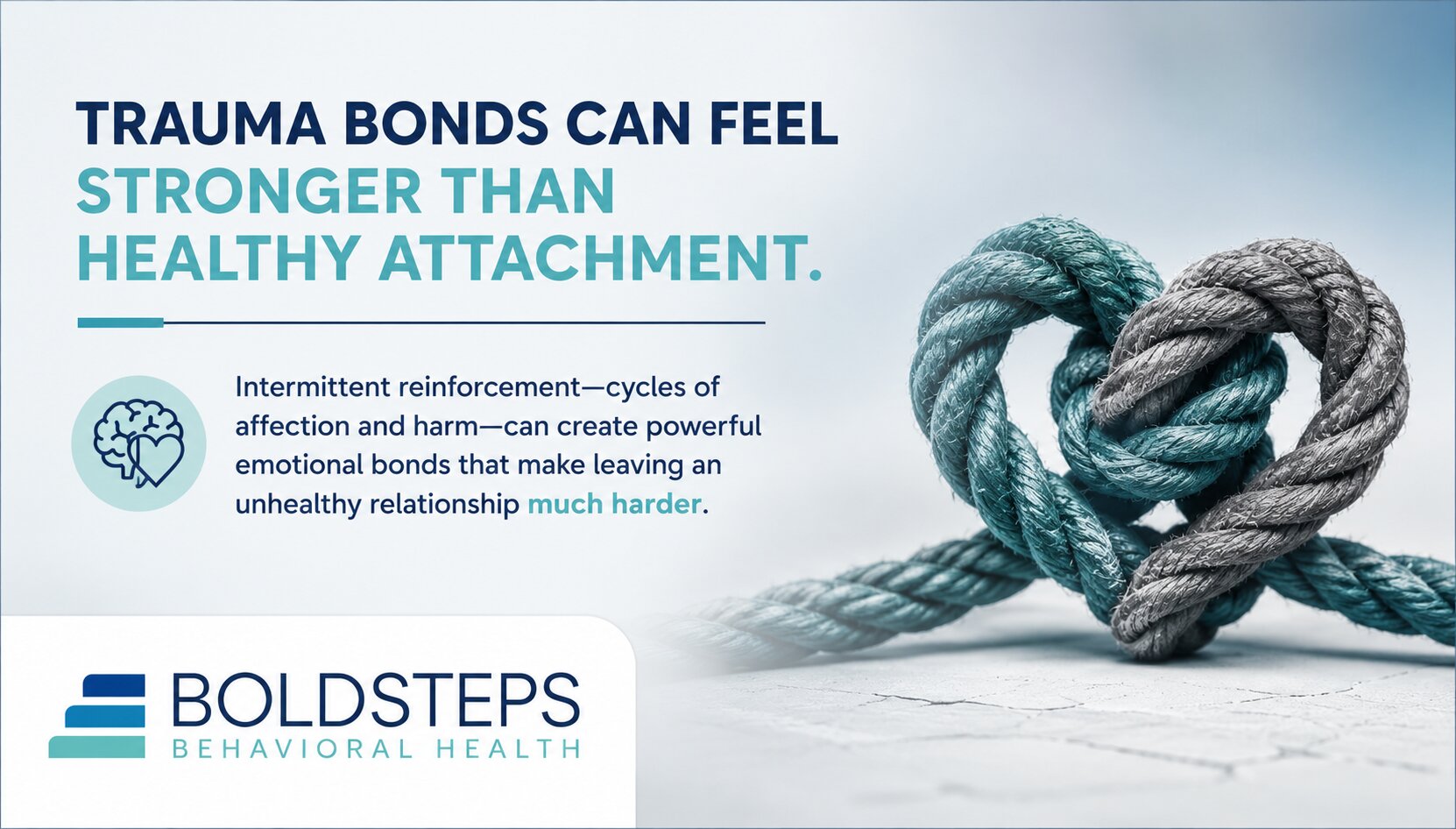
A trauma bond is an attachment formed through a pattern of intermittent reinforcement — repeated cycles of harm and reconciliation — that creates a powerful emotional tie to someone who is causing harm. The person who is being harmed often experiences the relationship as intensely loving, even when the love is being delivered in small, unreliable doses.
The term was originally developed to describe the attachments that form between hostages and captors, but it has come to refer more broadly to any relationship where the cyclical pattern of abuse and reconciliation creates an unusually strong bond.
It is not the same as love. It is not the same as loyalty. It is a survival response to a relationship that has taught the nervous system to associate danger with intimacy.
The Ten Most Common Trauma Bonding Signs
Trauma bonds don’t look the same in every relationship. They can form in romantic partnerships, parent-child relationships, friendships, cults, abusive workplaces, and other dynamics where power is unevenly distributed. The signs below are the most common patterns that show up across these contexts.
1. Cycles of Love Bombing and Cruelty
The person is overwhelmingly affectionate at times — present, attentive, idealized — and punishing or cruel at others. The loving phases feel like proof that the cruel phases aren’t the “real” person. They become the reward that keeps you tolerating the harm.
2. Shame as a Constant Companion
You feel persistently ashamed around them. Not embarrassed — ashamed. Like you are fundamentally less than, or wrong in some essential way. The shame often shows up after the cruel phases and gets reinforced through the next loving phase that follows.
3. Covering for or Making Excuses for Them
You find yourself explaining their behavior to other people. Minimizing what happened. Justifying their actions. You may even defend them to people who are clearly right about what they’re observing. The coverup becomes its own labor.
4.Hypervigilance and Walking on Eggshells
You’re constantly scanning their mood. Adjusting your behavior to avoid setting them off. Your nervous system lives in a state of low-level alert. Even neutral moments feel loaded, because you never know which version of them is going to show up.
5. Isolation From People Who Used to Matter
Over time, the relationships outside the bond shrink. Friendships fade. Family connections weaken. Sometimes the isolation is direct — they restrict who you see — but more often it is gradual and self-driven. The outside relationships feel hard to maintain because they don’t understand what’s happening.
6. Knowing They’re Not Good for You — and Staying Anyway
You can describe, in detail, why the relationship is unhealthy. You see the pattern clearly. You just don’t act on what you see. This is one of the most distressing features of a trauma bond — the gap between insight and behavior feels unbridgeable.
7. Losing Pieces of Yourself in the Relationship
You do things, say things, believe things that don’t match who you were before. Your values shift. Your tolerance shifts. You become a person you don’t recognize in order to maintain the bond.
8. Leaving Feels Impossible Every Time You Try
If you have tried to leave and gone back, you know this one. The attempts feel real at the time. The pull back feels stronger than the reason you left. Leaving is treated as a moral failure by the relationship, by you, or by both.
9. The “Hoover” When You Pull Away
When you try to create distance, they come back intensely. Promises. Apologies. Sudden kindness. Sometimes a complete reinvention of themselves. The hoover is designed to get you back into the loop, and it usually works.
10. Obsessive Thoughts When the Relationship Ends
After the final ending — whether you left or they did — the thoughts about them don’t stop. They may even intensify. The bond’s persistence after the relationship has formally ended is one of the most confusing features of the pattern.
Why Trauma Bonds Form (and Why Willpower Isn’t Enough to Break Them)
Trauma bonds aren’t a character flaw. They are the predictable result of specific psychological mechanisms operating on a nervous system that evolved to seek attachment.
Intermittent Reinforcement
The single most powerful variable in forming a trauma bond is the unpredictability of the reward. Relationships where the harm is consistent are actually easier to leave than relationships where the kindness is unpredictable. The intermittent access to love creates a stronger attachment than consistent love would.
This is the same mechanism that makes gambling addictive. The variable reward, not the harm, is the hook.
Attachment and Survival
For people who grew up in environments where attachment was conditional, intermittent, or unsafe, trauma bonds can feel familiar in a way that healthy relationships don’t. The nervous system reads the cyclical pattern as a familiar attachment structure, even when the conscious mind recognizes it as harmful.
Breaking the bond isn’t just about leaving the person. It’s about updating the attachment system so that familiar no longer means safe.
How Therapy Works on the Bond Itself
Trauma bonds are among the most treatment-responsive patterns in mental health. The bond can be broken, and the underlying systems that made it possible can be rebuilt.
EMDR for the Underlying Trauma
For many adults, the trauma bond sits on top of earlier traumatic experiences — childhood invalidation, previous abusive relationships, unresolved grief. EMDR (eye movement desensitization and reprocessing) is particularly useful here. It helps the brain reprocess the earlier material so it stops driving current relationship patterns.
DBT for the Relational Skill Rebuilding
Dialectical behavior therapy (DBT) addresses the relational skills that trauma bonds erode. The interpersonal effectiveness module — one of DBT’s four core skill areas — is specifically designed to help people ask for what they need, set limits, and stay in relationships without losing themselves. For adults emerging from trauma bonds, this is often the work that makes lasting change possible.
FAQs About Trauma Bonding
Are Trauma Bonds the Same as Love?
No. Love does not require harm to maintain. The intensity of the bond is not evidence of love. It is evidence of a powerful attachment that has formed under conditions that the nervous system reads as survival-critical.
Can a Trauma Bond Happen Outside a Romantic Relationship?
Yes. Trauma bonds can form in parent-child relationships, friendships, religious communities, cults, abusive workplaces, and any other dynamic where one person has power over another and uses it inconsistently. The signs listed above apply across these contexts.
How Long Does It Take to Break a Trauma Bond?
It varies. Breaking the bond can happen relatively quickly with the right support. Healing the underlying patterns that allowed it to form takes longer — typically several months to a year of consistent therapy work. Both are worth doing. The first makes the second possible.
If You See Yourself Here, You Don’t Have to Untangle It Alone
If you’ve read this far and recognized yourself — or someone you love — please hear this. You are not weak. You are not stupid. You are not “too forgiving” or “too easy to manipulate.” You are responding to a relationship that has been engineered to produce these exact responses.
Our trauma-informed care at Bold Steps is designed to address trauma bonds and the underlying patterns that sustain them. Whether the trauma is recent or decades old, whether the relationship is over or still ongoing, there is a path through it. Serving Rockingham, Merrimack, Nashua and Essex County with convenient locations that make quality care accessible close to home.
You don’t have to see it clearly to start. You just have to be willing to look. Call (603) 915-4223 to explore personalized treatment options and begin your recovery journey.