

There is a moment that catches many people off guard.
The day is finally finished.
The responsibilities are done.
The notifications have stopped.
The lights are off.
And instead of feeling tired, your brain suddenly feels more awake than it has all day.
You replay conversations.
You think about tomorrow’s responsibilities.
You worry about something you said three weeks ago.
You imagine problems that haven’t happened.
You try to stop thinking.
That doesn’t work.
You try distracting yourself.
That doesn’t work either.
Before long, it’s midnight.
Then one o’clock.
Then two.
And the only thing you’re accomplishing is becoming more frustrated.
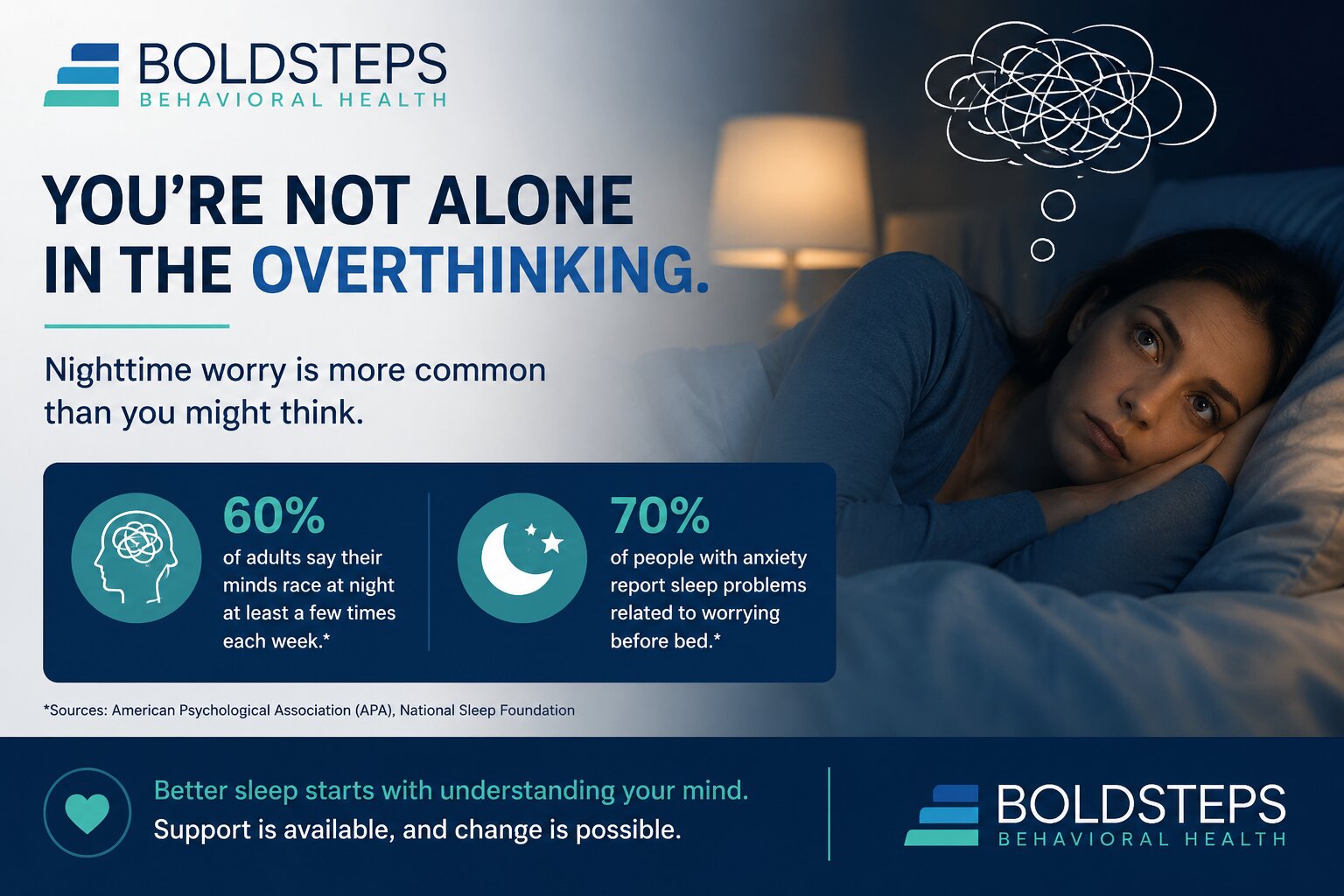
If you’ve ever found yourself wondering, “Why do my thoughts spiral at night?” or “Why can’t I shut my brain off?” you’re far from alone.
At Bold Steps Behavioral Health NH, we speak with many people who feel exhausted not because they’re physically tired, but because their mind never seems to get a chance to rest. Learning more about cognitive behavioral therapy approaches can help explain why this happens and what can be done about it.
The encouraging news is that nighttime overthinking is not a character flaw.
It’s not a sign that you’re broken.
And it’s often more manageable than it feels when you’re lying awake staring at the ceiling.
Your Brain Finally Has Room to Talk
Many people assume their nighttime thoughts appear out of nowhere.
In reality, those thoughts may have been present all day.
The difference is that daytime life keeps them hidden.
During the day, your attention is constantly occupied.
You answer emails.
You attend meetings.
You drive.
You solve problems.
You respond to messages.
You manage responsibilities.
Your brain stays busy.
Then nighttime arrives.
The distractions disappear.
The silence creates space.
And suddenly you can hear everything your mind has been carrying.
Many people describe it as finally hearing a radio that was playing in the background all day.
The radio was always on.
The rest of life was simply louder.
Overthinking Often Disguises Itself as Productivity
One of the reasons nighttime thinking becomes so difficult is because it rarely feels unhelpful in the moment.
It feels important.
Necessary.
Urgent.
You convince yourself that you’re preparing.
Planning.
Problem-solving.
Protecting yourself.
But if you’ve ever spent two hours lying awake analyzing the same issue, you already know something important:
Thinking and solving are not always the same thing.
Overthinking often creates the illusion of progress without actually creating solutions.
The mind keeps revisiting the same questions.
The same worries.
The same possibilities.
It’s like rocking in a rocking chair.
You’re moving constantly, but you’re not actually going anywhere.
Why the Worst-Case Scenarios Show Up at Bedtime
Have you ever noticed that problems seem bigger at night?
A small concern suddenly feels enormous.
An unanswered email becomes a catastrophe.
An upcoming conversation feels impossible.
A minor mistake feels life-changing.
This happens because tired brains are not always objective brains.
When we’re exhausted, our ability to evaluate situations accurately can decrease.
Stress feels heavier.
Uncertainty feels scarier.
Potential risks feel larger.
The emotional part of the brain becomes louder while the logical part becomes harder to access.
As a result, nighttime thinking often becomes disproportionately negative.
Many people spend hours worrying about situations that seem far less threatening the next morning.
Anxiety Loves Unanswered Questions
Anxiety has a complicated relationship with uncertainty.
It hates it.
The anxious mind constantly searches for guarantees.
It wants certainty.
It wants control.
It wants reassurance.
The problem is that life rarely offers those things.
Questions like these often appear at night:
- What if I fail?
- What if something bad happens?
- What if I made the wrong decision?
- What if people are upset with me?
- What if tomorrow goes badly?
Notice something about these questions.
Most of them cannot be answered at 1:00 a.m.
Yet the mind keeps searching.
The result is often a cycle of racing thoughts at night that feels impossible to shut off.
The more answers you seek, the more questions appear.
Sleep and Overthinking Feed Each Other
One of the most frustrating aspects of nighttime overthinking is that it creates the very problem you’re trying to avoid.
You stay awake because you’re worried.
Then you become worried because you’re awake.
The longer you’re awake, the more frustrated you become.
The more frustrated you become, the harder it is to sleep.
The cycle begins feeding itself.
Poor sleep can increase:
- Anxiety
- Irritability
- Stress sensitivity
- Difficulty concentrating
- Emotional reactivity
Then the next evening arrives.
You’re already exhausted.
Your stress tolerance is lower.
Your brain becomes even more vulnerable to spiraling thoughts.
This is why sleep difficulties and anxiety often become deeply connected.
Why Telling Yourself to Relax Usually Fails
If you’ve struggled with overthinking, you’ve probably tried commanding yourself to stop.
“Relax.”
“Go to sleep.”
“Stop worrying.”
Unfortunately, the brain doesn’t respond well to orders like these.
Imagine someone saying:
“Whatever you do, don’t think about a bright yellow balloon.”
What happens immediately?
You think about the balloon.
The same principle applies to worries.
The more aggressively you fight thoughts, the more attention you give them.
Your brain interprets them as important.
The thoughts become stronger.
This is one reason many therapeutic approaches focus less on eliminating thoughts and more on changing your relationship with them.
The Question That Can Interrupt a Mental Spiral
One simple question can sometimes create a surprising amount of relief:
“Is this something I can solve right now?”
If the answer is yes, write down the action you can take tomorrow.
If the answer is no, continuing to think about it tonight is unlikely to create a solution.
This question doesn’t magically remove anxiety.
But it often reduces the urgency surrounding it.
You begin recognizing that not every thought requires immediate attention.
Not every concern is an emergency.
Not every question needs to be answered before sleep.
How CBT Helps You Regain Control
Many people arrive at therapy believing they need to stop having anxious thoughts.
What they often discover is something different.
The goal isn’t necessarily fewer thoughts.
The goal is a different response.
Through cognitive behavioral approaches, people learn to examine thoughts rather than automatically believing them.
For example:
Instead of:
“Tomorrow is going to be terrible.”
They learn to ask:
“What evidence supports that?”
Instead of:
“I always mess things up.”
They ask:
“Is that completely accurate?”
Instead of:
“Something bad is going to happen.”
They ask:
“Am I predicting the future?”
These questions create distance between the thought and the emotional reaction.
That distance matters.
Because once a thought is examined, it often loses some of its power.
Small Habits That Can Make a Difference
Many people assume they need a major life change to improve sleep.
Sometimes smaller adjustments help more than expected.
Examples include:
Creating a Consistent Bedtime
The brain benefits from routine.
Going to bed and waking up at similar times can improve sleep quality over time.
Writing Thoughts Down
Many people try to remember every worry.
Writing concerns on paper tells your brain:
“I don’t need to keep rehearsing this.”
Limiting Stimulation Before Bed
Constant scrolling, work emails, and stimulating content can make it harder for the brain to transition into rest mode.
Creating a Worry Window
Some people benefit from setting aside 15 minutes earlier in the evening specifically for problem-solving.
This reduces the pressure to do all of it at bedtime.
Practicing Balanced Thinking
Learning to question catastrophic assumptions can reduce emotional intensity and make sleep easier.
You’re Not the Only Person Lying Awake
One of the cruelest parts of nighttime overthinking is how isolating it feels.
When you’re awake at 2:00 a.m., it can seem like everyone else is sleeping peacefully.
Meanwhile you’re trapped in your own thoughts.
The reality is that countless people are experiencing something similar.
Parents.
Professionals.
Students.
Business owners.
Healthcare workers.
People who appear calm and successful often struggle privately with the exact same problem.
You are not uniquely broken.
You are not uniquely anxious.
You are not the only person whose mind becomes louder after dark.
Hope Often Starts With Understanding
Many people spend years trying to force themselves to stop overthinking.
What often helps most is understanding why it’s happening.
When you recognize that your brain is attempting to solve problems, seek certainty, or protect you from discomfort, the experience begins making more sense.
And when something makes more sense, it often becomes less frightening.
For individuals seeking support in Areas We Serve or looking for treatment options in Merrimack County NH, learning practical strategies for managing nighttime thought spirals can be an important step toward better sleep and improved emotional well-being.
The goal isn’t a perfectly silent mind.
The goal is a mind that no longer feels like it’s running the show.
Frequently Asked Questions
Why do my thoughts seem worse at night?
Nighttime removes many of the distractions that occupy your attention during the day. As external stimulation decreases, internal thoughts become easier to notice.
Is nighttime overthinking a sign of anxiety?
It can be. Many people with anxiety experience increased worry at night, although overthinking can occur even without a diagnosed anxiety disorder.
Why can’t I stop thinking when I’m tired?
The brain often interprets important or threatening thoughts as problems that need immediate attention. This can make it difficult to disengage, even when you’re exhausted.
Can poor sleep make anxiety worse?
Yes. Sleep deprivation can increase emotional reactivity, stress sensitivity, and worry, creating a cycle where anxiety and poor sleep reinforce each other.
What does CBT do for overthinking?
CBT helps people identify thought patterns, evaluate them more objectively, and develop healthier responses instead of automatically accepting every thought as true.
How long does it take to improve nighttime overthinking?
Every person is different. Some notice changes quickly after learning new strategies, while others experience gradual improvement through consistent practice.
When should I seek professional help?
If overthinking is interfering with sleep, relationships, work, daily functioning, or quality of life, professional support may be helpful.
Call 603-915-4223 or visit our therapy and CBT services to learn more about our therapy, cbt services in New Hampshire.