

Medically reviewed by Kerry Andrek, Clinical Director
If you’re researching EMDR therapy cost, you’re probably asking a practical question: Can I actually afford this? Cost is a real part of deciding whether to start treatment, and it’s understandable to want clear answers before scheduling your first appointment.
If you’re still learning about the treatment itself, our guide to EMDR therapy explains how the approach works and who may benefit from it. Once you understand the basics, the next step is figuring out what you may actually pay, whether insurance covers it, and how to verify your benefits before your first session.
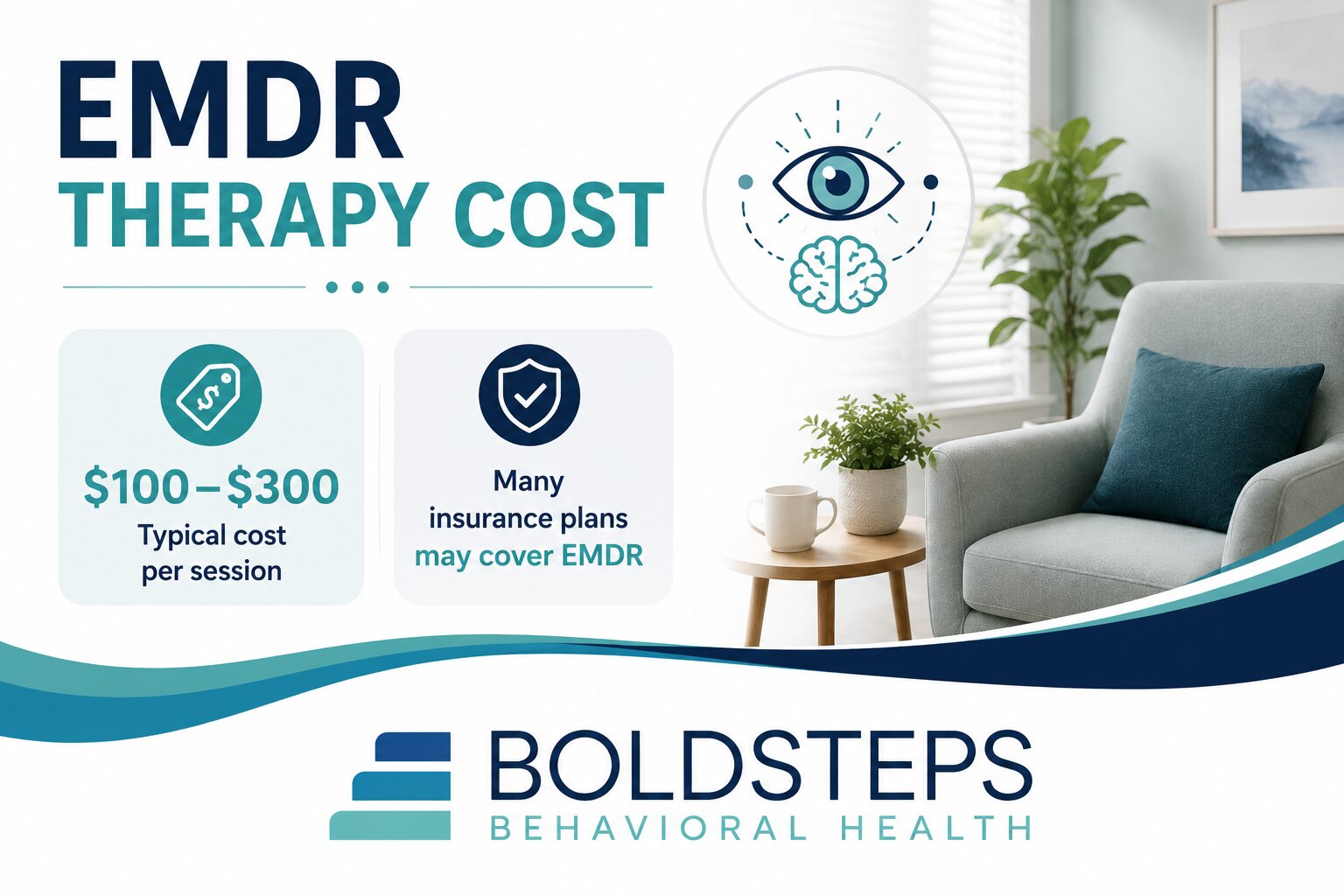
The good news is that many insurance plans cover EMDR when it is provided by a licensed mental health professional. Even if you don’t have insurance, there are ways to estimate costs and explore your options before making a commitment.
How Much Does EMDR Therapy Cost Per Session?
When people ask, “How much does EMDR therapy cost?”, the answer depends on several factors, including where you live, your therapist’s credentials, whether you use insurance, and how long each appointment lasts.
Without insurance, the national average for EMDR cost per session typically ranges from $100 to $300, with some highly specialized practices charging more. Providers in major metropolitan areas often fall toward the higher end of that range, while prices in other communities may be somewhat lower.
Although New Hampshire rates may vary, this national range provides a reasonable benchmark for planning your budget.
It’s also important to remember that EMDR isn’t usually completed in one or two visits.
For many people, treatment includes:
- An initial assessment and treatment planning
- Preparation and coping skills development
- Multiple EMDR processing sessions
- Follow-up sessions focused on progress and future goals
Depending on your needs, 8 to 20 or more sessions may be recommended. Some individuals with a single traumatic event may complete treatment more quickly, while people with complex trauma, anxiety disorders, or multiple life experiences often benefit from additional sessions.
Rather than focusing only on the cost of a single appointment, it helps to consider the overall treatment plan your therapist recommends.
EMDR Cost by Session Length
Not every EMDR appointment lasts the same amount of time.
Many therapists offer traditional therapy sessions lasting approximately 50 minutes, while others also provide extended 90-minute sessions or intensive treatment blocks.
Standard 50-minute sessions
These are the most common appointment length and generally fall within the national range of $100 to $300 per visit without insurance.
Standard appointments work well for many clients because they allow time for preparation, processing, and stabilization while fitting into a normal weekly schedule.
Extended 90-minute sessions
Longer EMDR sessions typically cost more because additional clinician time is involved.
Some therapists recommend extended appointments because they may allow clients to:
- Spend more time processing difficult memories
- Reduce the number of interrupted processing sessions
- Potentially complete treatment over fewer weeks
While the cost per visit is higher, longer sessions may shorten the overall timeline for some individuals. Whether this approach makes sense depends on your clinical needs and your therapist’s recommendation.
EMDR Therapy and Insurance Coverage
For many people, EMDR therapy insurance coverage makes treatment far more affordable than paying entirely out of pocket.
One common misconception is that insurance has a special billing category specifically for EMDR. In reality, insurance companies generally reimburse psychotherapy services—not the particular therapeutic approach being used.
That means your therapist bills for psychotherapy using standard mental health CPT codes while providing EMDR as the treatment modality during the session.
Common EMDR CPT codes
Several CPT codes are commonly associated with psychotherapy sessions that may include EMDR treatment.
90837
- Individual psychotherapy, approximately 60 minutes
90834
- Individual psychotherapy, approximately 45 minutes
90836
- Psychotherapy add-on code used alongside certain evaluation and management services
These are psychotherapy billing codes rather than “EMDR codes.” Whether your session includes cognitive behavioral therapy, EMDR, or another evidence-based approach, insurance generally evaluates the psychotherapy service itself.
Does insurance usually cover EMDR?
In many cases, yes.
Most commercial insurance plans cover medically necessary outpatient mental health treatment when provided by licensed professionals within the plan’s network.
Coverage depends on factors such as:
- Your specific insurance plan
- Medical necessity
- Whether your therapist participates in your network
- Prior authorization requirements, if applicable
- Your deductible and cost-sharing responsibilities
Every insurance policy is different, so verifying benefits before treatment begins is always worthwhile.
In-network providers
When your therapist participates in your insurance network, your costs are often more predictable.
You may pay:
- A fixed copay
- Coinsurance after meeting your deductible
- Nothing after reaching your annual out-of-pocket maximum
Many people find in-network care to be the most affordable option.
Out-of-network providers
If your therapist is not contracted with your insurance company, you may still have benefits.
Depending on your plan:
- You may pay the therapist’s full fee upfront.
- Your insurance may reimburse part of the cost.
- Your deductible for out-of-network care may be higher.
- Your coinsurance percentage may also be higher.
Some practices provide documentation known as a superbill that patients can submit to their insurance company for possible reimbursement.
Medicare and Medicaid
Many Medicare and Medicaid plans cover outpatient mental health therapy when services are provided by participating providers and medical necessity requirements are met.
Coverage rules vary by state, plan type, and provider participation, so confirming benefits before beginning treatment remains important.
What Drives the Cost of EMDR Therapy?
Two therapists may both offer EMDR but charge different fees. Several factors influence pricing.
Therapist training and credentials
Some clinicians have completed standard EMDR training, while others have pursued additional consultation, advanced education, or certification through organizations such as EMDRIA.
Additional training and specialization may influence session fees.
Session length
Longer appointments naturally involve more clinician time and therefore typically cost more than standard sessions.
Geographic location
Office overhead and regional cost of living affect pricing.
Practices in large cities frequently charge more than providers in suburban or rural communities.
Practice model
Some therapists accept insurance contracts.
Others operate as private-pay practices without insurance participation.
Each model has advantages, but costs to patients can differ significantly.
Number of sessions needed
Treatment costs are also influenced by how many sessions are appropriate for your situation.
Someone processing a single traumatic event may require fewer appointments than someone working through multiple traumatic experiences accumulated over many years.
Your therapist should regularly review progress and adjust your treatment plan as appropriate.
What Might You Pay Out of Pocket?
Every insurance policy is different, but these examples illustrate how costs often work.
Scenario A: In-network insurance
You have commercial insurance, your therapist participates in your network, and your deductible has already been met.
You may pay:
- Copay: approximately $20–$50 per session
- Or a modest coinsurance amount
This is often the lowest-cost option for ongoing therapy.
Scenario B: Out-of-network insurance
Your therapist is outside your insurance network.
You may:
- Pay the therapist’s full session fee initially.
- Receive partial reimbursement later.
- Owe a higher deductible before reimbursement begins.
Your final cost depends entirely on your insurance plan.
Scenario C: No insurance
Without insurance, you’ll typically pay the therapist’s standard private-pay rate.
Some practices may offer:
- Sliding-scale fees
- Payment plans
- Reduced rates based on financial need
Not every practice offers these options, but it’s reasonable to ask.
How to Verify Your EMDR Coverage Before Your First Session
Many people delay therapy because they’re worried about surprise bills.
Fortunately, a quick benefits verification can answer most questions before your first appointment.
Step 1: Call your insurance company
Use the customer service number on the back of your insurance card.
Step 2: Ask specific questions
Helpful questions include:
- Is outpatient mental health therapy covered?
- Is this provider in my network?
- Do I have a deductible?
- How much of my deductible has already been met?
- What is my copay or coinsurance?
- Do I need prior authorization?
- Are there limits on the number of therapy visits?
Writing down the answers can help avoid confusion later.
Step 3: Ask the treatment provider for help
Many treatment centers help prospective clients verify insurance benefits before the first appointment.
This can save time and reduce uncertainty, especially if you’re unfamiliar with insurance terminology.
If you’re considering treatment, Bold Steps NH can help verify your insurance benefits and explain your expected costs before you begin.
Cost Shouldn’t Be the Reason You Delay Getting Help
It’s understandable to hesitate when you’re unsure what therapy will cost.
But many people discover that insurance covers more than they expected—or that there are payment options available that make treatment manageable.
The most accurate way to understand your costs is to verify your benefits before your first appointment. That allows you to make an informed decision without guessing what your financial responsibility might be. And for those in Rockingham County, Merrimack County, Hillsborough County, Nashua or Essex County, we have nearby locations to make care accessible.
If you’re interested in learning whether your insurance covers treatment, call (603) 915-4223 to verify your insurance coverage for EMDR therapy at Bold Steps NH.
Frequently Asked Questions
How much does EMDR therapy cost without insurance?
Without insurance, national averages typically range from $100 to $300 per session, although rates vary depending on location, therapist experience, and session length. Some practices may charge more for extended appointments or offer sliding-scale fees for eligible clients.
Does insurance cover EMDR therapy?
Yes. Most insurance plans cover EMDR when it is provided as medically necessary outpatient psychotherapy by a licensed mental health professional. Coverage depends on your individual plan, network status, deductible, copays, and any prior authorization requirements.
What CPT codes are used for EMDR?
EMDR sessions are generally billed using standard psychotherapy CPT codes rather than a unique EMDR billing code. Common codes include 90837 for approximately 60-minute psychotherapy sessions, 90834 for approximately 45-minute sessions, and 90836 as a psychotherapy add-on code used with certain evaluation and management services.