

Clinically reviewed by Kerry Andrek, Clinical Director
The first time I heard the term CBT, I was twenty-three and sitting in therapy. My therapist said we were starting cognitive behavioral therapy. I nodded like I understood.
I didn’t.
Everything changed when I started practicing CBT exercises. I realized my thoughts weren’t facts. That insight changed how I understood anxiety, depression, and myself.
Later, I learned DBT. I needed more than changing thought patterns. I needed skills to manage intense emotions and respond differently in difficult moments. That’s when I realized CBT and DBT aren’t competing therapies. They solve different problems and often work best together.
If you’re exploring treatment, understanding the difference matters. The right approach depends on what’s driving your symptoms. A structured CBT program helps many people identify and change unhelpful thinking patterns, while DBT builds practical skills for emotional regulation and distress tolerance.
Here’s a practical comparison of CBT and DBT, where they overlap, how they differ, and how to decide which approach may fit your needs best.
Both Therapies Share the Same Foundation
CBT and DBT are closely related, but they serve different purposes. Both grew from cognitive behavioral therapy, which teaches that thoughts, emotions, and behaviors constantly influence one another. Change one, and the others often change too.
CBT established that framework. DBT expanded it to help people who experience intense emotions that CBT alone may not fully address.
Think of DBT as an evolution of CBT. It keeps the same foundation while adding practical skills for emotional regulation, distress tolerance, mindfulness, and healthier relationships.
What Cognitive Behavioral Therapy Focuses On
CBT helps people identify and change unhelpful thinking patterns. The goal is straightforward: change the way you think to improve the way you feel and behave.
How Thoughts, Feelings, and Behaviors Work Together
CBT explores the connection between situations, thoughts, emotions, and behaviors. Your therapist helps you recognize automatic thought patterns and challenge beliefs that fuel anxiety, depression, or other symptoms.
As those thought patterns become more balanced, emotional reactions and behaviors often improve as well.
CBT works especially well for conditions driven by distorted or unhelpful thinking, including anxiety, depression, phobias, obsessive thoughts, and perfectionism.
Conditions CBT Treats
Research consistently supports CBT for:
- Anxiety disorders
- Depression
- Obsessive-compulsive disorder (OCD)
- Post-traumatic stress disorder (PTSD)
- Eating disorders
- Insomnia
At Bold Steps, our CBT program adapts these techniques for individual therapy, group therapy, and higher levels of care.
What Dialectical Behavior Therapy Focuses On
DBT builds on CBT by focusing on emotional regulation. It combines structured skills training with individual therapy and ongoing clinical support.
Instead of asking only, “How can I change this thought?” DBT also asks, “How can I manage this emotion without making things worse?”
The Four Core DBT Skills
DBT teaches four essential skill sets:
- Mindfulness: Stay present without judging yourself.
- Distress Tolerance: Handle crisis situations without making impulsive decisions.
- Emotion Regulation: Reduce emotional intensity and respond more effectively.
- Interpersonal Effectiveness: Build healthier relationships while respecting your own needs.
These skills help people whose emotions often feel overwhelming or difficult to control.
Conditions DBT Treats
DBT began as a treatment for borderline personality disorder. Today, clinicians also use it for:
- Borderline personality disorder
- Chronic depression
- PTSD
- Substance use disorders
- Binge eating disorder
- Other conditions involving emotional dysregulation
At Bold Steps, our DBT program delivers the full evidence-based model with the structure it requires.
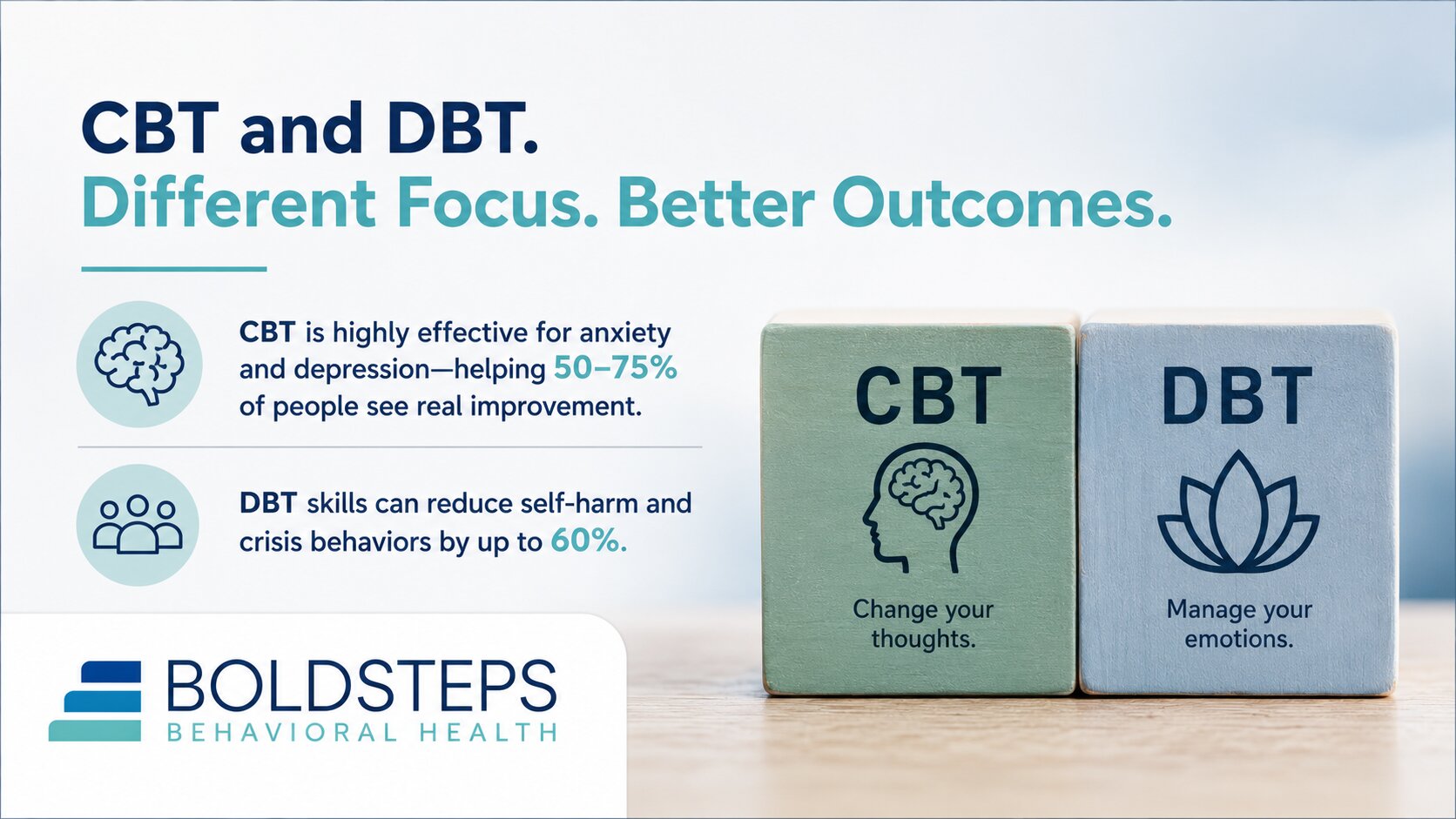
Key Differences Between CBT and DBT
Both therapies rely on research. Both teach practical skills. The biggest difference is what each approach emphasizes.
Change vs. Acceptance
CBT focuses primarily on change. It teaches you to identify distorted thoughts and replace them with healthier ones.
DBT combines change with acceptance. It acknowledges painful emotions while teaching healthier ways to respond.
That balance often resonates with people who felt previous therapy focused too much on “thinking differently” before feeling understood.
Treatment Structure
CBT usually centers on individual therapy with practice between sessions.
Full-model DBT includes four parts:
- Individual therapy
- Skills training groups
- Between-session phone coaching
- Therapist consultation teams
Programs offering only individual DBT often provide an adapted version rather than the complete model.
Length of Treatment
CBT often lasts 12 to 20 sessions, depending on your goals.
DBT usually requires a longer commitment. Traditional programs often run close to a year. Adapted IOP and PHP versions typically last several months.
Many Programs Combine Both
You don’t always need to choose between CBT and DBT.
Many treatment programs blend both approaches because they address different parts of recovery.
CBT targets unhelpful thought patterns. DBT strengthens emotional regulation and coping skills.
People managing anxiety, depression, trauma, and substance use often benefit from both.
Which Therapy Fits Best?
Your symptoms—not the therapy’s popularity—should guide the decision.
CBT may fit best if you:
- Get stuck in negative or distorted thinking
- Struggle with anxiety or depression driven by thought patterns
- Want structured tools for changing behaviors
DBT may fit best if you:
- Experience intense emotions
- Act impulsively during distress
- Struggle with relationships or emotional regulation
Many people benefit from an integrated treatment plan that includes both therapies.
A clinical assessment remains the best way to determine what will help you most.
FAQs About CBT and DBT
Can You Do CBT and DBT at the Same Time?
Yes. Many treatment programs deliver both therapies as part of a comprehensive plan. CBT techniques can be used to address thought patterns while DBT skills address emotional and relational patterns. The two approaches complement each other in most clinical settings.
Is DBT Just CBT for Emotions?
Approximately, but with significant additions. DBT takes the cognitive behavioral foundation and adds mindfulness-based acceptance, explicit emotion regulation work, distress tolerance skills, and a structured delivery model (skills groups, individual therapy, phone coaching, consultation team). It is more accurately described as a specialized adaptation of CBT for problems that involve emotional dysregulation.
Which Therapy Is Better for Addiction?
Both have evidence. CBT for substance use disorders focuses on identifying triggers, restructuring thoughts related to use, and building relapse prevention skills. DBT for addiction adds distress tolerance and emotion regulation skills that are particularly useful when substance use is driven by overwhelming emotions. Many programs integrate both, often delivered through an IOP level of care.
Picking a Therapy Is a Clinical Question, Bring It to the Right People
The choice between CBT and DBT shouldn’t be a self-help guess. It should be part of a clinical evaluation with a treatment team that can actually assess what’s driving your symptoms.
Reach out to our admissions team and we can walk through what you’re experiencing, what you’ve already tried, and what approach is most likely to work for where you are right now. Whether the answer is CBT, DBT, or both, the right framework is one that fits your life. And for those in Rockingham, Merrimack County, Hillsborough County, Nashua or Essex County, we have nearby locations to make care accessible.
You don’t have to pick the therapy before you start. You just have to start the conversation. Call (603) 915-4223 to explore personalized treatment options and begin your recovery journey.