

Clinically reviewed by Kerry Andrek, Clinical Director
I was being treated for depression. Good therapist, good medication, weekly sessions for two years. Nobody asked about the drinking.
Not because they didn’t care. Because nobody connected the two things. I drank a bottle of wine most nights. I drank beer on top of that on weekends. I had, by any reasonable definition, a problem. But my problem, as far as my treatment was concerned, was depression. The drinking was just a fact about me.
It took getting into a dual diagnosis program — where someone specifically asked “how much are you actually drinking?” and then paused long enough for me to answer — for me to understand that these weren’t two separate things I was dealing with. They were one thing. And the one thing had a name.
That was where real recovery started.
What “Dual Diagnosis” Actually Means
Dual diagnosis refers to the co-occurrence of a substance use disorder and a mental health condition. It is not a specific diagnosis — it is a clinical description of two conditions that exist together. The substance use can be the primary problem, the mental health condition can be the primary problem, or they can be so intertwined that distinguishing between them doesn’t make sense.
The clinical term that maps to this pattern is “co-occurring disorders.” You may also see it referred to as “comorbidity” or, in everyday language, having both a mental health condition and an addiction at the same time.
What makes dual diagnosis clinically distinct is not just the presence of two conditions. It is that the conditions interact with each other in ways that change how each one should be treated.
Why Treating One and Not the Other Usually Fails
The traditional approach to co-occurring substance use and mental health conditions was to treat them sequentially. Detox and rehab for the addiction first, then address the depression or anxiety once sobriety was established.
For some people, this works. For many, it doesn’t. The reason is that the conditions are reinforcing each other in real time.
If someone is drinking to manage anxiety, sobriety alone removes the coping mechanism without providing a replacement. If someone is using stimulants to push through depression, getting clean puts them face to face with the underlying mood symptoms. If someone drinks to manage trauma flashbacks, sobriety without trauma treatment leaves them exposed to the symptoms without their usual buffer.
Dual diagnosis treatment exists because sequential treatment has predictable failure modes. Integrated treatment was designed to address them.
Common Mental Health Conditions That Travel With Addiction
Substance use disorders co-occur with most of the major mental health conditions. The rates are striking — for many diagnoses, addiction rates are several times higher than in the general population.
Depression and Anxiety
Mood and anxiety disorders are among the most common co-occurring conditions with substance use. People often begin drinking or using to manage difficult emotional states, and over time the substance becomes both the trigger and the attempted solution.
PTSD and Trauma Disorders
Trauma is one of the strongest predictors of substance use disorders. Adults with PTSD are at significantly higher risk for developing addiction, and many people in treatment discover trauma histories they had not previously named. Trauma-informed treatment is often the missing piece in recovery for people whose addiction has no other obvious origin.
Bipolar Disorder
Substance use is significantly more common among adults with bipolar disorder than in the general population. The mood instability of bipolar episodes creates a strong pull toward self-medication, and the substances chosen often make mood symptoms worse over time.
ADHD
ADHD and substance use disorders frequently travel together. The impulsivity, restlessness, and difficulty with emotional regulation that characterize ADHD can all be temporarily relieved by substances, which often leads to patterns of use that develop into dependence.
What Dual Diagnosis Treatment Looks Like
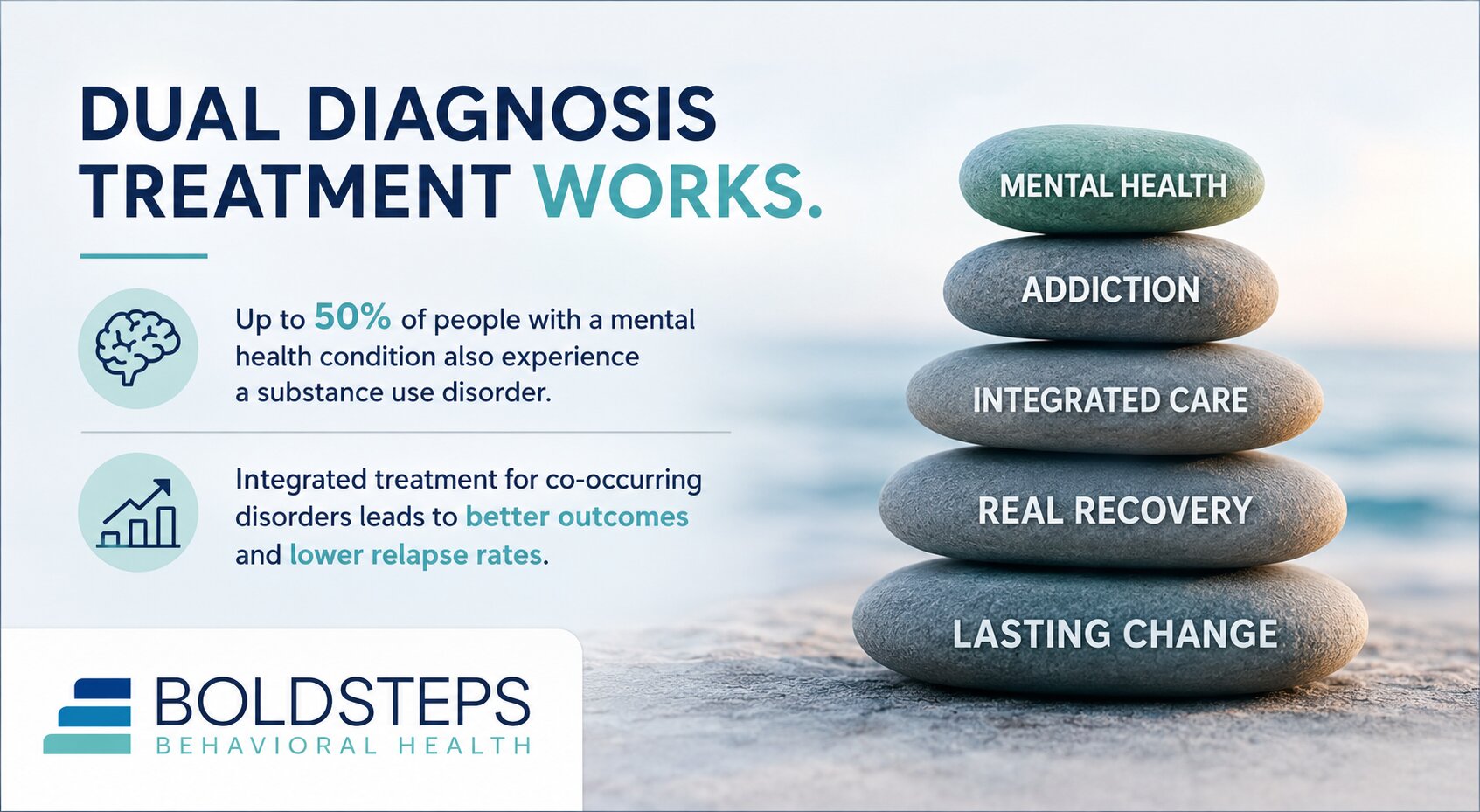
Dual diagnosis treatment is not two parallel treatments running side by side. It is integrated care in which the same clinical team addresses both conditions in the same plan.
Integrated Therapy Rather Than Parallel Care
The defining feature of dual diagnosis treatment is integration. The therapist working on the substance use knows about the depression. The prescriber managing medication for the mood disorder is also aware of the substance use patterns. Group programming addresses both conditions together. The treatment plan is one plan, not two.
This is meaningfully different from going to a substance use program that doesn’t ask about mental health, and a mental health program that doesn’t address substance use. Both programs can be well-intentioned and clinically sound individually. Together, they miss the case that actually needs both.
PHP and IOP Settings for Co-Occurring Disorders
For adults whose symptoms are severe enough to need more than weekly therapy, partial hospitalization programs (PHP) and intensive outpatient programs (IOP) are common settings for dual diagnosis treatment. These programs offer the structure, frequency, and clinical intensity needed to stabilize both conditions at once, with daily or near-daily clinical contact during the most acute phase of treatment.
Medication Support When Appropriate
Medication is often an important part of dual diagnosis treatment. Antidepressants, mood stabilizers, anti-anxiety medications, and medication-assisted treatment for alcohol or opioid use can all play a role. The right medication plan depends on the specific combination of conditions, and is usually built up over time as part of a comprehensive plan rather than started all at once.
How to Tell If a Program Really Does Dual Diagnosis Care
Not every program that claims to handle co-occurring disorders actually does. Ask these questions before you commit:
- Are the substance use and mental health treatment delivered by the same clinical team?
- Do the therapists in the program have specific training in co-occurring disorders?
- Is there psychiatric support available on-site or through the same program?
- Does the programming address both conditions in the same group sessions, or are they separated?
- What happens if a mental health symptom emerges during substance use treatment?
- What happens if a substance use pattern emerges during mental health treatment?
If the answers are vague or evasive, the program is probably running parallel tracks rather than integrated care.
FAQs About Dual Diagnosis Treatment
Is Dual Diagnosis Treatment More Expensive?
It can be, because it is more clinically intensive than treating either condition alone. Most major insurance plans cover dual diagnosis treatment when it is deemed medically necessary, and coverage for co-occurring disorders has improved significantly over the past decade. The admissions team at any program should be able to verify your benefits and explain your out-of-pocket costs.
How Long Does Dual Diagnosis Treatment Last?
It depends on the severity of the conditions and the level of care needed. Acute stabilization often happens within the first 30 to 90 days. Comprehensive treatment — including the work of addressing both conditions in depth — typically runs several months. Ongoing recovery support and aftercare planning are usually recommended for at least a year.
What If I’ve Been Treated for Depression and the Drinking Was Never Discussed?
You are not alone. This is one of the most common patterns in dual diagnosis treatment — adults whose substance use has been visible to themselves and others but never directly addressed in mental health treatment. Bringing it up with the current provider is a reasonable first step. If the response is dismissive, a dual diagnosis program specifically designed for co-occurring care is often the right next move.
If Both Have Been There, Both Deserve Real Care at the Same Time
If you’ve been dealing with both a mental health condition and substance use — whether anyone has named them together or not — they deserve real, integrated care. Treating one and ignoring the other usually doesn’t last. Treating both at the same time, by a single clinical team that understands them as related, is the approach that has the strongest evidence.
You don’t have to figure out which came first. You don’t have to choose which one is “real.” Our admissions team can walk through what’s going on, what you’ve already tried, and what a dual diagnosis treatment plan could look like for you. Serving Rockingham, Merrimack, Hillsborough, Nashua and Essex County with convenient locations that make quality care accessible close to home.
Both have been there. Both deserve care. Both can get better. Call (603) 915-4223 to explore personalized treatment options and begin your recovery journey.