

Medically reviewed by Kerry Andrek, Clinical Director
You’re meeting every deadline.
You answer texts. You show up to work. You remember birthdays. People describe you as dependable, organized, ambitious, maybe even “the one who has it all together.”
Then you get home, collapse onto the couch, and realize you’ve spent the entire day bracing for disasters that never happened.
If you’ve been searching for high functioning anxiety, there’s a good chance you’ve heard some version of this before:
“But you don’t seem anxious.”
That’s the problem.
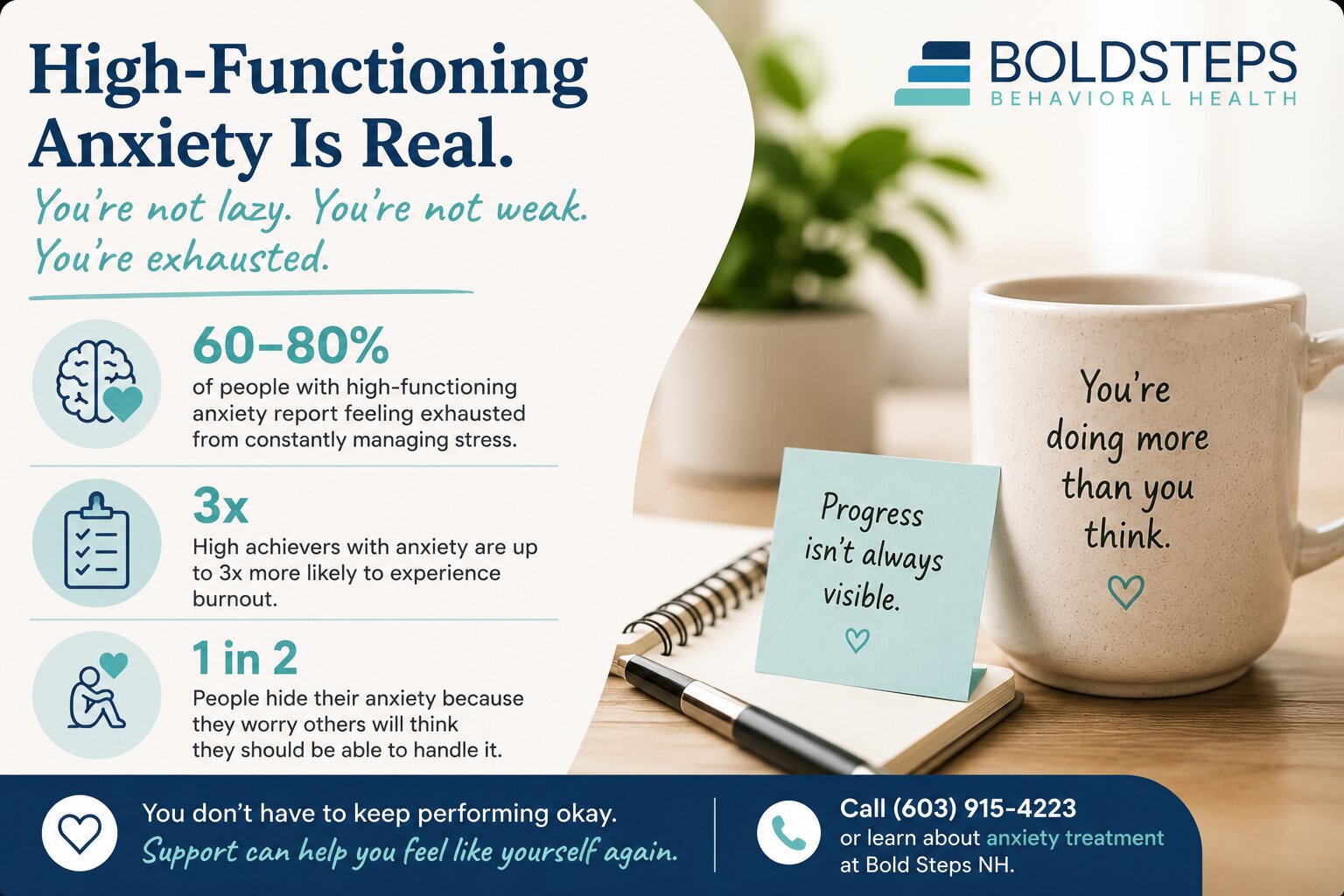
The anxiety is real. It’s just hidden behind productivity, achievement, and a carefully practiced ability to keep moving.
If you’re wondering whether what you’re experiencing deserves attention, learning more about anxiety treatment can help you understand what support looks like. You don’t have to wait until everything falls apart before asking for help.
Here’s the truth that doesn’t get said often enough:
Some people don’t break down in public. They build entire lives around making sure no one notices they’re struggling.
That doesn’t mean they’re okay.
What Is High-Functioning Anxiety?
The first thing to know is important:
High-functioning anxiety is not a diagnosis listed in the DSM-5.
That doesn’t make it imaginary.
Instead, it’s a commonly used term that describes a very real pattern of experiencing anxiety while continuing to appear highly capable from the outside.
Many people with high functioning anxiety symptoms:
- Earn promotions
- Raise families
- Meet deadlines
- Volunteer
- Care for others
- Keep busy almost constantly
Outwardly, life appears successful.
Internally, it can feel like your nervous system never gets permission to rest.
The “high-functioning” part isn’t the absence of anxiety.
It’s the mask.
For many high achievers, anxiety becomes fuel. The fear of disappointing others, making mistakes, or losing control pushes them to prepare more, work harder, and stay constantly productive.
The problem is that anxiety isn’t designed to be an engine.
Eventually, it becomes an exhaust system that never stops running.
7 Signs of High-Functioning Anxiety
Not everyone experiences anxiety the same way, but these are some of the most common signs of high functioning anxiety.
1. Your Mind Never Stops Reviewing Everything
The meeting ended three hours ago.
You’re still replaying one sentence you wish you’d said differently.
Your friend hasn’t replied to your message yet.
You’ve already imagined six reasons they might be upset with you.
Even when things go well, your brain keeps looking for what you missed.
Overthinking isn’t occasional—it’s your default setting.
2. Perfectionism Feels Like Survival
People often compliment your attention to detail.
What they don’t see is that missing a small mistake doesn’t just feel disappointing.
It feels dangerous.
You may spend hours:
- Rewriting emails
- Checking work repeatedly
- Preparing for conversations
- Researching every possible outcome
Perfectionism often isn’t about wanting things to be perfect.
It’s about believing mistakes aren’t safe.
3. You Procrastinate Because You’re Afraid to Fail
This surprises many people.
How can someone who’s productive procrastinate?
Because sometimes the anxiety becomes so intense that starting feels overwhelming.
You don’t delay because you’re lazy.
You delay because beginning means risking imperfection.
Then, when the deadline gets close, adrenaline takes over.
You finish.
People praise your ability to “work well under pressure.”
They don’t realize pressure has become the only way your brain knows how to start.
4. Your Body Carries the Anxiety
Anxiety isn’t just thoughts.
It often shows up physically.
Common high functioning anxiety symptoms include:
- Tight chest
- Muscle tension
- Jaw clenching
- Frequent headaches
- Stomach discomfort
- Digestive problems
- Trouble sleeping
- Racing heart
You may spend years treating the symptoms without realizing anxiety is contributing to them.
5. Relaxing Feels Weird
Vacation arrives.
Instead of feeling relieved, you feel restless.
A free afternoon somehow turns into cleaning the house, organizing your closet, answering emails, or planning next week’s schedule.
Stillness feels uncomfortable because your nervous system has learned to associate constant activity with safety.
Rest begins to feel unfamiliar.
Sometimes even undeserved.
6. You Pull Away From Unpredictable Social Situations
You aren’t necessarily antisocial.
You simply prefer situations you can anticipate.
Large gatherings.
Networking events.
Parties where you don’t know many people.
These situations may leave you mentally rehearsing conversations before you even walk in.
Sometimes it’s easier to stay home than manage the uncertainty.
7. Achievement, Overwork, or Alcohol Become Coping Strategies
This sign often gets overlooked.
Some people manage anxiety by achieving more.
Others stay constantly busy so they don’t have time to think.
Some unwind each night with alcohol because it’s the only thing that seems to quiet their mind.
None of these automatically mean someone has an anxiety disorder or substance use disorder.
But when achievement or alcohol becomes the primary way you regulate overwhelming feelings, it’s worth paying attention.
The goal isn’t perfection.
It’s having more than one way to cope.
High-Functioning Anxiety vs. GAD
One reason high-functioning anxiety is misunderstood is that people often compare it directly to Generalized Anxiety Disorder (GAD).
The two overlap—but they aren’t identical.
GAD is a recognized mental health diagnosis characterized by excessive, difficult-to-control worry that affects multiple areas of life and is often accompanied by physical symptoms such as restlessness, muscle tension, fatigue, irritability, and sleep difficulties.
Someone with high-functioning anxiety may also meet the criteria for GAD—but not always.
The biggest difference is often how the anxiety appears from the outside.
With high-functioning anxiety:
- Responsibilities are usually still being met.
- Work performance may remain strong.
- Other people often describe the person as successful or dependable.
- The distress is largely internal.
With GAD, the anxiety may be more visibly impairing, though many people with GAD also appear outwardly capable.
The distinction matters because someone with high-functioning anxiety may never receive an evaluation simply because they don’t “look” like they’re struggling.
Success can hide suffering.
Being productive doesn’t automatically mean you’re well.
Why High-Functioning Anxiety Is So Often Missed
This is where many people feel seen for the first time.
You Convince Yourself It Can’t Be Anxiety
You tell yourself:
“I’m still functioning.”
“I haven’t missed work.”
“Other people have it worse.”
“If I were really anxious, I’d be falling apart.”
But functioning isn’t the same thing as thriving.
Surviving isn’t the same thing as feeling okay.
Clinicians May Not See the Whole Picture Right Away
Some people arrive at appointments:
- Well dressed
- Organized
- Polite
- Prepared
- Successful
None of those qualities rule out anxiety.
If you’ve spent years hiding your distress, it can take time before you feel safe enough to describe what’s happening beneath the surface.
Employers and Family See the Performance
They see the person who gets things done.
They don’t see:
- The sleepless nights before presentations
- The panic after sending an email
- The constant self-criticism
- The exhaustion from pretending everything is fine
Sometimes the performance of okayness becomes its own full-time job.
And here’s the part many people recognize immediately:
You stop asking whether you’re okay and start asking whether you can keep this pace for another year.
That question matters.
When It’s Time to Get Help
You don’t need to wait until your life falls apart.
You don’t need to lose your job.
You don’t need to have a panic attack in public.
It may be time to reach out when:
- You’re exhausted by constantly managing your anxiety.
- Your self-worth depends entirely on achievement.
- Rest makes you feel guilty instead of refreshed.
- You’re relying on alcohol, overwork, or constant productivity to cope.
- The effort required to appear “fine” is becoming unsustainable.
The goal isn’t to become less driven.
It’s to stop believing your value depends on never slowing down.
Recovery doesn’t mean losing your ambition.
It means learning how to achieve without your nervous system paying the price every single day.
If you’re still functioning but no longer feel like yourself, that’s reason enough to have a conversation.
You deserve support before burnout becomes a crisis.
Frequently Asked Questions
Is high-functioning anxiety a real diagnosis?
No. High-functioning anxiety is not an official DSM-5 diagnosis. It’s a commonly used term that describes people who experience significant anxiety while continuing to appear successful or capable in daily life. The experience is real, even though the label is informal.
What are the signs of high-functioning anxiety?
Common signs include constant overthinking, perfectionism, fear-driven procrastination, physical symptoms like muscle tension or headaches, difficulty relaxing, avoiding unpredictable situations, and relying on achievement, overwork, or alcohol to manage anxiety.
How is high-functioning anxiety treated?
Treatment depends on the individual but often includes evidence-based therapies such as cognitive behavioral therapy (CBT), acceptance and commitment therapy (ACT), mindfulness-based approaches, stress management skills, and lifestyle changes. A mental health professional can help determine the approach that best fits your needs.
Final Thoughts
The hardest part about high-functioning anxiety isn’t always the anxiety itself.
It’s how convincing the performance becomes.
Eventually, everyone believes you’re okay—including you.
Until one day you realize you’re carrying your entire life with clenched fists.
You don’t have to earn help by falling apart first. Serving Rockingham, Merrimack, Hillsborough, and Essex County with convenient locations that make quality care accessible close to home.
If you’re tired of performing okay instead of actually feeling okay, call (603) 915-4223 or learn about anxiety treatment at Bold Steps NH.