

Medically reviewed by Kerry Andrek, Clinical Director
Your heart is racing.
Your thoughts are moving faster than you can keep up. You feel trapped in a loop of “what if?” questions, and no matter how many times someone tells you to “just relax,” it doesn’t seem to help.
If you’re searching for grounding techniques for anxiety, chances are you aren’t looking for another generic list of coping skills. You’re looking for something that might actually help right now.
If anxiety has become a regular part of your life, learning more about anxiety treatment can help you understand both immediate coping tools and longer-term support. In the meantime, grounding techniques can be valuable between therapy sessions—or even before you’ve decided to seek professional help.
The important thing to know is this:
Grounding isn’t about pretending your anxiety isn’t real.
It’s about helping your brain recognize that you are here, in the present moment, and safe enough for your nervous system to begin settling down.
These skills won’t erase anxiety overnight, but they can interrupt the spiral long enough for you to regain control.
What Grounding Is—and Why It Works
When anxiety takes over, your brain isn’t making a logical decision to panic.
It’s responding as though there’s an immediate threat.
Deep inside the brain, the amygdala acts like an alarm system. When it senses danger—whether the threat is real or imagined—it activates the body’s fight, flight, or freeze response. Your heart beats faster, your muscles tense, your breathing changes, and your thoughts become focused on survival.
The problem is that anxiety can trigger this alarm even when you’re sitting safely at your desk or relaxing at home.
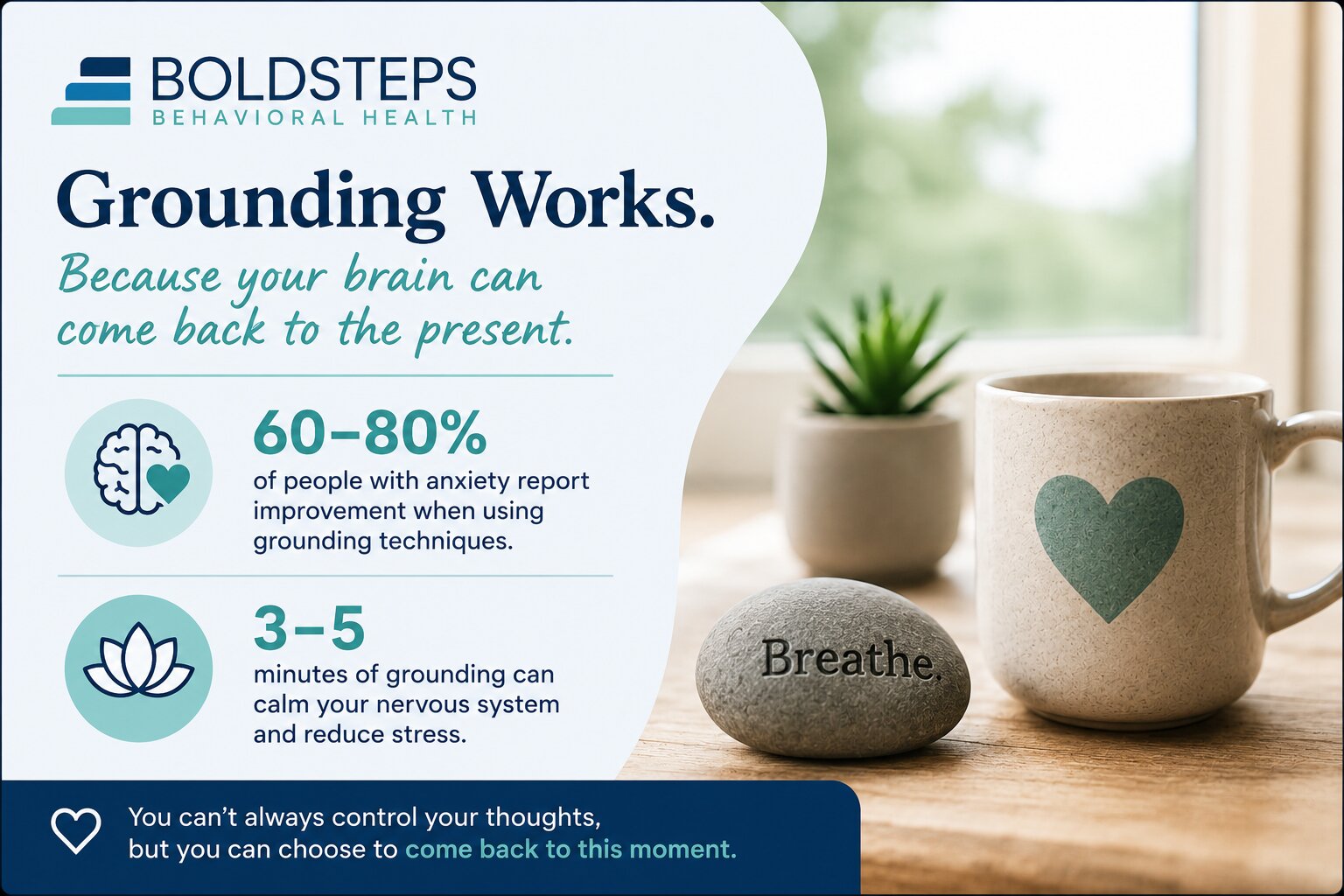
Grounding techniques help interrupt that cycle.
Instead of feeding anxious thoughts, they gently redirect your attention to what’s happening right now. By engaging your senses, focusing your attention, or using intentional breathing, grounding helps re-engage the parts of the brain responsible for reasoning, awareness, and decision-making.
Think of it like this:
Imagine your brain is a smoke alarm that’s become overly sensitive. It starts blaring because someone burned toast—not because the house is on fire.
Grounding doesn’t rip the batteries out of the alarm.
It helps your brain realize that burnt toast isn’t the same thing as an emergency.
Over time, practicing grounding techniques can teach your nervous system that not every anxious feeling requires a full-body alarm response.
The 5-4-3-2-1 Grounding Technique
One of the most effective grounding exercises for anxiety is also one of the simplest.
The 5-4-3-2-1 grounding technique uses all five senses to anchor you in the present moment.
Here’s how it works:
5 Things You Can See
Look around and slowly identify five different objects.
They might be:
- A window
- A coffee mug
- A plant
- A book
- The pattern on the floor
Take your time.
4 Things You Can Feel
Notice physical sensations.
Examples include:
- Your feet on the floor
- Your shirt against your skin
- The chair supporting your back
- The cool air on your face
3 Things You Can Hear
Pause and listen carefully.
Maybe you hear:
- Air conditioning
- Birds outside
- A clock ticking
- Distant traffic
2 Things You Can Smell
Notice any scents around you.
If nothing is obvious, gently smell your clothing, a cup of coffee, or nearby soap.
1 Thing You Can Taste
Pay attention to what’s already in your mouth, or take a sip of water, tea, or a mint.
Why It Works
This technique engages multiple senses at once.
Instead of allowing anxious thoughts to pull you into imagined futures, it repeatedly reminds your brain:
“I’m here. I’m present. I can observe what’s actually happening.”
It may feel a little awkward the first few times.
That’s normal.
Like any skill, grounding becomes more natural with practice.
Physical Grounding Techniques
Sometimes anxiety feels too physical to think your way through.
That’s when body-based techniques can be especially helpful.
Box Breathing
Box breathing is used by therapists, athletes, and even first responders because it’s simple and effective.
Try this pattern:
- Inhale for 4 seconds
- Hold for 4 seconds
- Exhale for 4 seconds
- Hold again for 4 seconds
Repeat several times.
The predictable rhythm encourages slower breathing and signals your nervous system that it can begin calming down.
Cold Water
Cold stimulation activates parts of the body’s calming response.
You can try:
- Splashing cold water on your face
- Holding a cool washcloth to your cheeks
- Running cold water over your wrists
- Holding a cold pack wrapped in a towel
The sudden temperature change shifts your attention away from anxious thoughts and back toward physical sensations.
Press Your Feet Into the Floor
Sit comfortably.
Place both feet flat on the ground.
Slowly notice:
- The pressure beneath your heels
- The firmness of the floor
- The weight of your legs
- The support of your chair
Take several slow breaths while focusing only on these sensations.
Progressive Muscle Relaxation
Anxiety often causes muscles to tighten without us realizing it.
Starting with your feet, gently tense a muscle group for about five seconds.
Then slowly release it.
Move upward through:
- Legs
- Hands
- Arms
- Shoulders
- Jaw
The contrast between tension and relaxation helps your body recognize what letting go actually feels like.
Mental Grounding Techniques
Sometimes your body feels relatively calm—but your thoughts won’t slow down.
Mental grounding exercises give your brain a structured task that competes with anxious thinking.
Name Categories
Pick a category and slowly list items within it.
Examples include:
- Five animals
- Five fruits
- Five cities
- Five movies
- Five musicians
The goal isn’t speed.
The goal is attention.
Count Backward by Sevens
Start at 100.
Subtract seven each time:
100…
93…
86…
79…
This exercise requires enough concentration that anxious thoughts have less room to dominate your attention.
Describe Your Environment
Pretend you’re describing the room to someone who can’t see it.
Notice:
- Colors
- Shapes
- Textures
- Lighting
- Furniture
- Sounds
The more detail you include, the more your brain shifts toward observation instead of worry.
Why Mental Grounding Helps
Anxiety narrows your focus onto perceived threats.
Mental exercises gently widen that focus again.
Rather than arguing with anxious thoughts, you’re giving your brain another meaningful job to do.
Sensory and Self-Soothe Techniques
For some people—especially during intense anxiety or moments of dissociation—strong sensory input can be particularly effective.
Peppermint
Keep peppermint gum or mints nearby.
The strong flavor immediately captures attention.
Ice
Hold an ice cube in your hand or wrap it in a cloth.
The cold sensation provides immediate sensory feedback that helps reconnect you to the present moment.
Citrus Scents
Fresh lemon or orange can create a noticeable sensory experience.
Essential oils or fresh fruit may both work.
Comfort Objects
Some people carry:
- A smooth stone
- A favorite keychain
- A small piece of fabric
- A meaningful piece of jewelry
Touching familiar objects can provide reassurance during anxious moments.
Why Sensory Grounding Helps
When panic or dissociation becomes intense, subtle techniques may not feel strong enough.
More noticeable sensory experiences can interrupt the nervous system’s alarm response and redirect attention to what’s happening in the present.
When Grounding Techniques Aren’t Enough
Grounding is incredibly useful.
It’s also important to understand what it is—and what it isn’t.
Grounding helps you manage anxiety in the moment.
It doesn’t eliminate the underlying causes of chronic anxiety.
If anxiety is:
- Affecting your work
- Straining relationships
- Keeping you from sleeping
- Leading you to avoid places or situations
- Causing frequent panic attacks
- Making daily life feel overwhelming
it may be time to look beyond coping strategies alone.
Professional support can help you understand why anxiety keeps showing up and teach skills that go beyond managing symptoms in the moment.
Grounding is one tool in a much larger toolbox.
Sometimes it’s enough for a stressful afternoon.
Sometimes it’s the bridge that helps you get through the day while you work on deeper healing.
Both are valuable.
Frequently Asked Questions
What is the 5-4-3-2-1 grounding technique?
The 5-4-3-2-1 grounding technique is a sensory exercise that guides you to identify five things you can see, four you can feel, three you can hear, two you can smell, and one you can taste. It helps shift your attention from anxious thoughts to the present moment.
Do grounding techniques really work for anxiety?
For many people, yes. Grounding techniques can reduce the intensity of anxious thoughts and physical symptoms by helping calm the nervous system and redirect attention to the present. While they aren’t a cure for anxiety, they can be highly effective coping tools.
When should I see a therapist for anxiety?
Consider talking with a therapist if anxiety is interfering with work, relationships, sleep, or daily activities, or if coping strategies no longer feel like enough. Therapy can help address the underlying causes of anxiety while teaching additional skills for long-term management.
Final Thoughts
When anxiety takes over, it’s easy to feel like you’ve lost control.
Grounding techniques remind your brain and body that you haven’t.
They won’t make anxiety disappear instantly, but they can help create enough space to take the next breath, the next step, and eventually the next conversation about getting support. Serving Merrimack, Nashua and Essex County with convenient locations that make quality care accessible close to home.
If anxiety has become more than an occasional stressful moment, call (603) 915-4223 or learn about anxiety treatment at Bold Steps NH.