

Medically reviewed by Kerry Andrek, Clinical Director
You’re not trying to feel better right now.
You’re trying not to make it worse.
Maybe you’re sitting in your car after an argument, gripping the steering wheel so tightly your hands hurt. Maybe you’re staring at your phone, fighting the urge to send a text you’ll regret. Or maybe the emotions are coming so fast that you can’t even tell whether you’re angry, scared, ashamed, or all three at once.
If you’ve been searching for distress tolerance skills, chances are you’re looking for something practical—not another reminder to “just calm down.”
If you’re exploring healthier ways to cope with overwhelming emotions, learning more about DBT can help you understand how these skills fit into a larger treatment approach. Until then, knowing what to do during an emotional crisis can help you get through the moment without making it more painful.
That’s what distress tolerance is about.
Not pretending everything is okay.
Not forcing yourself to feel happy.
Simply getting through one difficult moment in a way that protects tomorrow’s version of yourself.
What Is Distress Tolerance?
In Dialectical Behavior Therapy (DBT), distress tolerance refers to the ability to experience painful emotions without reacting in ways that make the situation worse.
That distinction matters.
When emotions become overwhelming, the brain naturally searches for immediate relief. Sometimes that relief comes from healthy coping. Other times, it comes from actions that feel helpful in the moment but create bigger problems later.
Examples include:
- Sending angry messages
- Walking out of important relationships
- Drinking or using drugs
- Self-harming
- Spending impulsively
- Saying things you can’t take back
Distress tolerance asks a different question:
“What will help me survive this moment without creating another crisis?”
Unlike emotion regulation, which focuses on reducing emotional vulnerability over time, distress tolerance is a crisis-first skill set.
Think of it this way.
If your house were on fire, you wouldn’t start remodeling the kitchen.
You’d put out the fire first.
That’s exactly what DBT distress tolerance skills are designed to do.
Crisis Survival Skills: TIPP, ACCEPTS, and Self-Soothe
When emotions become so intense that thinking clearly feels impossible, it’s often helpful to stop trying to reason with yourself.
Start with your body.
Then work outward.
TIPP Skills (DBT)
The TIPP skills DBT teaches are designed for moments when your emotions feel like they’re at a 9 or 10 out of 10.
They’re fast, practical, and focused on calming your body’s stress response.
Temperature
Imagine you’ve just received devastating news.
Your heart is pounding.
Your breathing feels shallow.
Instead of trying to talk yourself out of panic, change your body’s temperature.
Splash cold water on your face.
Hold a cool washcloth against your cheeks.
Place a cold pack over your eyes for several seconds.
Cold stimulation activates the body’s natural calming response and can reduce the intensity of overwhelming emotions surprisingly quickly.
Intense Exercise
You don’t need an hour-long workout.
You need movement.
Walk briskly around the block.
Do jumping jacks.
Run up and down a flight of stairs.
The goal is to give your body’s stress chemicals somewhere to go.
Paced Breathing
When anxiety speeds up your breathing, intentionally slow it down.
Try inhaling for four seconds and exhaling for six.
Longer exhales help activate the parasympathetic nervous system—the part responsible for calming the body after stress.
Progressive Muscle Relaxation
Clench your fists tightly.
Hold for five seconds.
Release.
Continue through your shoulders, legs, and jaw.
Many people don’t realize how much physical tension they’re carrying until they intentionally let it go.
ACCEPTS (DBT)
Sometimes your emotions aren’t at their absolute peak—but they’re still threatening to overwhelm you.
That’s where ACCEPTS DBT skills can help.
Rather than trying to erase painful emotions, ACCEPTS gives your brain something else to focus on until the emotional intensity naturally decreases.
Activities
Wash dishes.
Take a walk.
Organize a drawer.
Do a puzzle.
Movement and meaningful activity interrupt emotional spirals.
Contributing
Send someone an encouraging message.
Help a neighbor.
Donate unused clothing.
Helping someone else often shifts attention away from immediate distress.
Comparisons
Think about another difficult situation you’ve survived.
Not to minimize your pain—but to remind yourself:
“I’ve gotten through hard things before.”
Emotions
Watch a funny video.
Listen to uplifting music.
Read an inspiring story.
Temporary emotional shifts can reduce the intensity of overwhelming feelings.
Pushing Away
If you can’t solve the problem right now, mentally place it inside an imaginary box.
Tell yourself:
“I’ll come back to this after I’ve calmed down.”
You’re postponing—not avoiding.
Thoughts
Count backward from 100 by sevens.
Spell words backward.
Name every state you can remember.
These tasks occupy the thinking part of your brain.
Sensations
Hold ice.
Chew peppermint gum.
Take a cool shower.
Wrap yourself in a soft blanket.
Strong physical sensations can interrupt emotional overwhelm.
Self-Soothe Using Your Five Senses
Sometimes what you need isn’t distraction.
It’s comfort.
Self-soothing uses your senses to remind your nervous system that you’re safe in this moment.
Try asking yourself:
What can I see?
A candle.
Nature.
Photos of people you love.
What can I hear?
Gentle music.
Rain sounds.
Ocean waves.
What can I smell?
Lavender.
Fresh coffee.
Vanilla.
Citrus.
What can I taste?
Warm tea.
Peppermint.
Dark chocolate.
What can I touch?
A soft blanket.
A smooth stone.
Your favorite sweatshirt.
When you’re overwhelmed and can’t think straight, self-soothing isn’t about fixing your emotions.
It’s about giving your nervous system permission to settle.
Radical Acceptance
Of all the distress tolerance skills, this is often the hardest.
It’s also the most misunderstood.
Radical acceptance DBT does not mean:
- Agreeing with what happened
- Saying something was fair
- Approving of someone else’s behavior
- Giving up
Instead, it means acknowledging reality as it exists in this moment.
Imagine repeating:
“I wish this hadn’t happened.”
That makes sense.
Now compare it with:
“This shouldn’t have happened. I refuse to accept that it did.”
The first statement acknowledges pain.
The second adds another layer of suffering by fighting something that cannot be changed right now.
Radical acceptance asks:
Can I stop arguing with reality long enough to decide what I want to do next?
Acceptance isn’t surrender.
It’s the point where healing can finally begin.
When to Use Which Skill
Not every situation calls for the same approach.
Here’s a simple guide.
If your distress feels… |
Try… |
|---|---|
| Panic, overwhelming emotion, racing heart | TIPP skills |
| Strong urges to react impulsively | ACCEPTS skills |
| Emotionally exhausted or overwhelmed | Self-soothe |
| Facing painful realities you cannot immediately change | Radical acceptance |
| Distress has begun to settle but difficult emotions remain | Continue practicing skills while reaching out for support if needed |
One important reminder:
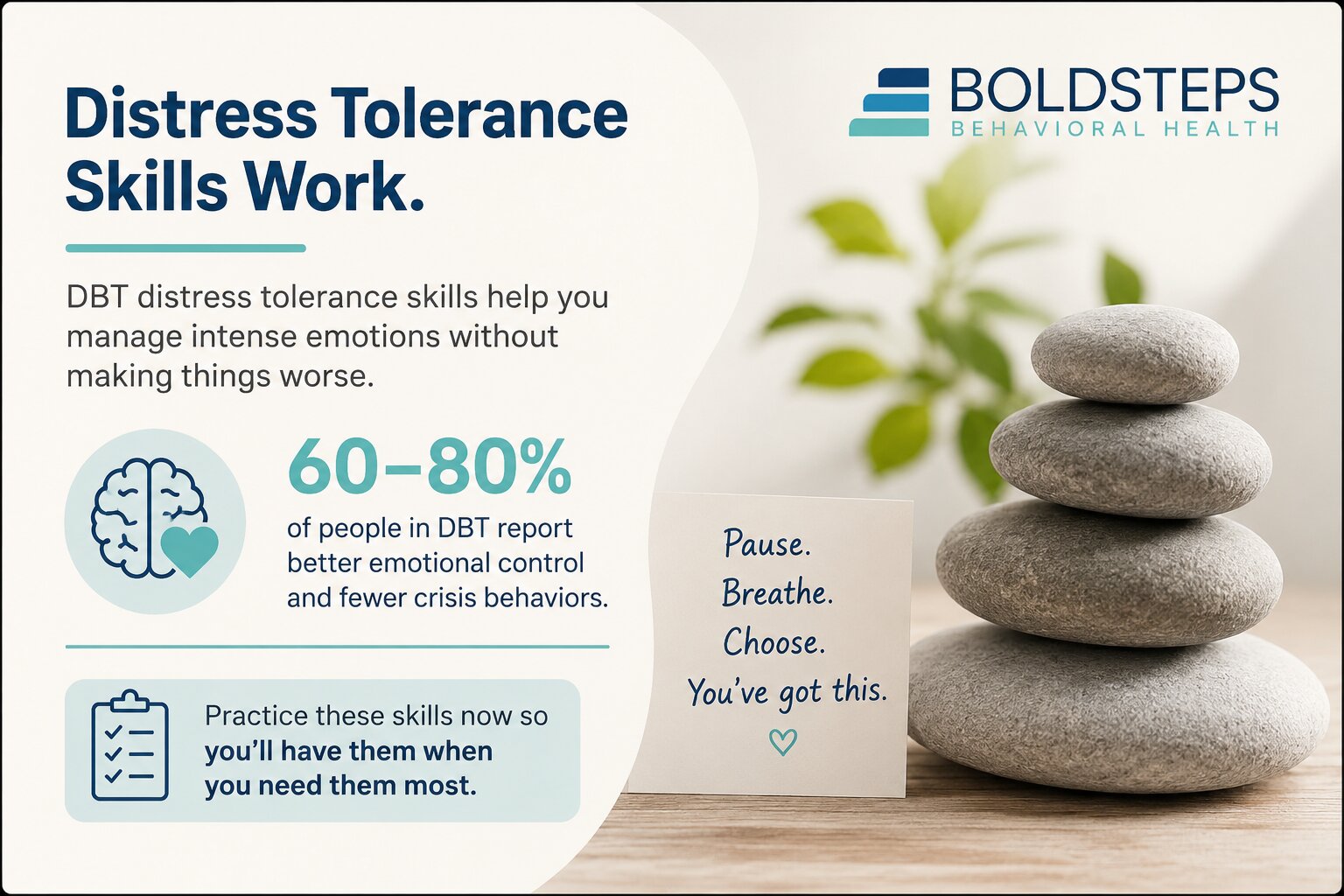
You don’t have to wait until you’re completely overwhelmed to practice these skills.
In fact, they work best when you’ve practiced them during calmer moments first.
Think of them like a fire extinguisher.
You don’t want the first time you use one to be during the biggest emergency of your life.
When Distress Tolerance Skills Aren’t Enough
These are powerful tools.
They are not meant to replace therapy.
If you find yourself reaching for crisis survival skills every day, every week, or every time life becomes stressful, that’s important information.
It doesn’t mean you’re failing.
It may simply mean your nervous system needs more support than coping strategies alone can provide.
DBT isn’t just a collection of worksheets or acronyms.
It’s a structured therapy that helps people:
- Build distress tolerance
- Regulate emotions
- Improve relationships
- Reduce impulsive behaviors
- Develop a life that feels worth living
Working with a therapist—and often practicing skills in a DBT group—provides guidance, accountability, and real-world coaching that can be difficult to build on your own.
The goal isn’t to rely on crisis skills forever.
The goal is to need them less often because your overall ability to cope has grown.
Frequently Asked Questions
What are the distress tolerance skills in DBT?
Distress tolerance skills are tools from Dialectical Behavior Therapy that help people get through emotional crises without making the situation worse. Common examples include TIPP, ACCEPTS, self-soothe techniques, and radical acceptance.
What is the TIPP skill?
TIPP is a DBT crisis survival skill that stands for Temperature, Intense Exercise, Paced Breathing, and Progressive Muscle Relaxation. These strategies help calm the body’s stress response during moments of intense emotional distress.
What is radical acceptance?
Radical acceptance is a DBT skill that involves fully acknowledging reality as it is, even when it’s painful. It doesn’t mean approving of what happened—it means stopping the struggle against facts that cannot be changed in the present moment so you can move forward more effectively.
Final Thoughts
When emotions reach their breaking point, it’s easy to believe you have only two choices:
React immediately.
Or somehow force yourself not to feel anything at all.
Distress tolerance offers another path.
It helps you stay with difficult emotions long enough for them to pass without letting them decide what happens next.
That doesn’t make the pain disappear.
But it can keep one painful moment from becoming a much bigger crisis. Serving Rockingham, Merrimack, and Nashua with convenient locations that make quality care accessible close to home.
If overwhelming emotions are becoming a regular part of your life, call (603) 915-4223 or learn about DBT at Bold Steps NH.