

For a lot of people, the sentence “therapy didn’t work for me” comes with a story behind it.
Maybe you tried it once. Maybe you tried it twice. Maybe you sat in a quiet office week after week explaining your feelings while nothing in your actual life seemed to improve.
If that’s your experience, skepticism makes sense.
Many people who later benefit from skill-based approaches actually arrive with that same doubt. Some even come to explore DBT-informed care expecting it to be the same old routine—until they realize it operates differently from what they tried before.
For individuals seeking mental health support in Hillsborough County, New Hampshire, that moment of realizing therapy can be practical—not just reflective—often becomes the turning point in how they view treatment.
When Therapy Feels Like Talking in Circles
A common frustration people describe is the feeling that therapy became repetitive.
You talk about what happened that week.
You revisit emotions from the past.
You explain the same patterns again and again.
And while those conversations might bring some insight, they don’t always change what happens when stress hits in real life.
You still snap during arguments.
You still feel overwhelmed by anxiety.
You still react the same way in situations that trigger you.
At some point, it’s natural to start wondering:
If I understand my problems, why do they keep happening?
That question isn’t resistance.
It’s awareness.
The Difference Between Understanding and Changing
Understanding your emotions is valuable.
But understanding alone doesn’t always lead to change.
Think about learning to drive a car.
You could read books about driving for months. You could understand every rule of the road. But until you actually sit in the driver’s seat and practice steering, braking, and reacting to traffic, the knowledge stays theoretical.
Emotions work the same way.
Insight explains why you feel something.
Skills help you handle what happens next.
Why Emotional Reactions Feel Automatic
One of the most frustrating parts of intense emotions is how quickly they take over.
Something small happens—an unexpected comment, a stressful conversation, a moment of rejection—and suddenly your body reacts before you even have time to think.
Your heart speeds up.
Your thoughts race.
Your patience disappears.
It feels like your nervous system hit the gas pedal without asking you first.
When that pattern repeats often enough, people start to believe they simply “are that way.”
But emotional reactions are often learned responses. And learned responses can be retrained.
Learning How to Interrupt the Spiral
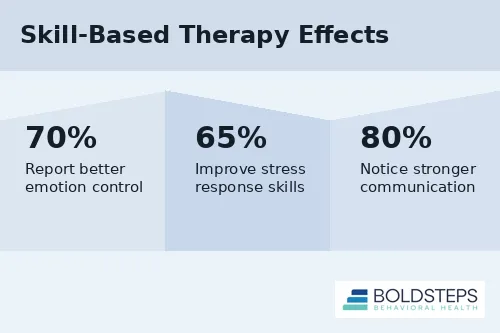
Skill-based therapy focuses on something many people were never taught growing up: how to regulate emotional reactions while they’re happening.
That might involve learning how to slow down your body’s stress response before anger escalates.
It might mean recognizing the early signals that anxiety is building so you can intervene before panic takes over.
Or it might involve learning how to communicate needs clearly during conflict rather than shutting down or exploding.
These tools don’t erase emotions.
They give you room to choose your response instead of being dragged by the emotion itself.
At first, those pauses might last only a few seconds.
But those seconds matter.
Because they create the space where change becomes possible.
Therapy That Feels More Like Training
For people who previously felt therapy was just conversation, one surprising shift is how practical sessions can become.
Instead of simply discussing emotions in the abstract, sessions often focus on real-life situations that happened recently.
You might examine a stressful moment step by step:
What triggered the emotion?
What physical sensations came first?
What thoughts followed?
What reaction happened next?
Then you practice what could happen differently next time.
This process can feel less like venting and more like training your brain to respond differently.
It’s not about judging past reactions. It’s about building new options for future ones.
Skepticism Isn’t a Barrier — It’s a Starting Point
People sometimes worry that skepticism means therapy won’t work for them.
In reality, skepticism can be helpful.
Someone who questions things tends to pay close attention to whether something actually helps. They notice when strategies work and when they don’t.
That awareness can lead to honest feedback, stronger engagement, and more meaningful progress.
In fact, many people who eventually experience significant improvement started therapy saying something like:
“I’m not convinced this will help.”
And that honesty often becomes the foundation for real change.
The Quiet Signs That Something Is Working
Movies often portray therapy breakthroughs as dramatic moments—tears, realizations, sudden transformation.
But real progress usually shows up in subtle ways.
You might notice that a stressful moment still bothers you, but it no longer consumes your entire day.
You might pause before responding during an argument instead of reacting instantly.
You might catch your thoughts spiraling and redirect them before they take over.
These shifts can feel small.
But over time, they build momentum.
And eventually people realize something surprising:
Life feels a little easier to navigate.
When Emotional Skills Change Everyday Life
Many people who once doubted therapy describe a similar moment months later.
They’re in a situation that normally would have overwhelmed them—an argument, a stressful deadline, a difficult conversation.
But instead of reacting automatically, something different happens.
They pause.
They breathe.
They respond more calmly than they expected.
That moment often feels strange at first.
Because it means the emotional reaction that once felt inevitable is no longer in control.
Rediscovering Therapy After Giving Up on It
It’s not uncommon for people to return to therapy years after deciding it “wasn’t for them.”
Sometimes life circumstances change. Stress increases. Relationships become more complicated.
But often the biggest difference is discovering that therapy can involve learning practical tools instead of just analyzing emotions.
For many individuals seeking mental health support in Essex County, Massachusetts, that discovery reshapes their entire understanding of what therapy can offer.
Instead of feeling like they’re endlessly discussing their problems, they begin practicing ways to handle them.
And that shift makes therapy feel useful again.
The Reality Most People Discover
There’s an important truth many people realize after trying skill-based approaches:
Therapy isn’t supposed to magically remove emotions.
Life will still bring stress, disappointment, conflict, and uncertainty.
The difference is that emotional reactions no longer feel uncontrollable.
Instead of feeling like emotions run the entire show, people start to experience something new—stability.
Not perfection.
Not constant calm.
But the ability to navigate difficult moments without losing themselves in the process.
FAQs
Why do some people believe therapy didn’t work for them?
Many people feel therapy didn’t work because their previous experience focused mainly on discussion rather than skill-building. While talking about emotions can provide insight, many individuals also need practical tools to manage reactions in everyday situations.
Can therapy still help if someone had a bad experience before?
Yes. Different therapeutic approaches focus on different methods. Someone who felt frustrated with purely conversation-based therapy may respond better to approaches that emphasize emotional skills and practical coping strategies.
Is skepticism about therapy normal?
Absolutely. Many people begin therapy with doubts, especially if previous experiences were disappointing. Healthy skepticism often leads people to ask meaningful questions and engage more thoughtfully in the process.
How long does it take to notice progress in therapy?
Progress varies for each person. Some individuals begin noticing small changes within a few weeks, especially when they actively practice new emotional skills outside of sessions. Others experience gradual progress over several months.
What kind of changes usually happen first?
Early changes often include increased awareness of emotional triggers, improved ability to pause before reacting, and slightly reduced emotional intensity during stressful moments. These small shifts often grow into larger changes over time.
Can therapy help with intense emotional reactions?
Yes. Many skill-based approaches focus specifically on helping individuals manage intense emotional reactions, build tolerance for distress, and respond more effectively to challenging situations.
What if someone feels like their emotions control their life?
Feeling controlled by emotions is more common than people realize. Therapy that focuses on emotional regulation helps individuals learn ways to slow down reactions, understand triggers, and develop more balanced responses to stress.
Is it too late to try therapy again if it didn’t help before?
No. Many people find that therapy becomes more helpful when they encounter an approach that matches their needs and goals. Trying a different style of therapy can lead to a completely different experience.
If your past experience with therapy left you feeling like it didn’t help, that doesn’t mean change is impossible.
Sometimes it simply means you never learned the tools that make emotional stability possible.
Call (603)915-4223 to learn more about our Dialectical Behavior Therapy in Concord, New Hampshire.