

Sometimes, the unraveling happens quietly. You watch your son or daughter withdraw, shut their door, cancel plans, and lose the spark you thought was coming back. You’ve seen them make progress—whether it was therapy, sobriety, or simply getting out of bed again. But now, they’re slipping. And no one told you it might look like this.
It’s common for parents of young adults to feel confused and heartbroken when recovery takes a turn. And while relapse is often blamed, depression is frequently the hidden driver. At Bold Steps Behavioral Health NH, we help families understand how depression treatment fits into the recovery puzzle—especially when things start to fall apart.
Recovery Isn’t Linear—And Depression Doesn’t Wait Its Turn
Recovery doesn’t follow a neat curve. It has momentum, setbacks, plateaus. For many young adults, the hardest part isn’t just stopping the behavior—it’s facing everything underneath it.
You may have heard that relapse is part of recovery, but what often goes unsaid is that untreated depression can make relapse feel inevitable. When your child is overwhelmed by hopelessness, shame, or numbness, the emotional load of recovery can become too much to carry alone.
And here’s the tricky part: depression doesn’t always look like sadness. For some young adults, it looks like:
- Snapping at people they love
- Sleeping through important commitments
- Saying “I don’t care” when you know they used to
- Missing therapy sessions they once valued
These aren’t failures—they’re signals. And the signal might be: I’m not okay, and I don’t know how to say it out loud.
Depression Often Shows Up After the Crisis Is Over
Many parents assume that once the crisis has passed—once their child is sober, or stable, or out of danger—the worst is behind them. But for many, that’s when the depression starts speaking louder.
Here’s why: early recovery is emotionally raw. Without substances or other coping behaviors, a young adult can feel exposed, dysregulated, and unsure of who they are. And if they’ve been numbing emotions for years, they may not yet have the skills to handle the feelings that come rushing back.
That emotional overwhelm—combined with the pressure to “do well”—can leave someone vulnerable to clinical depression or worsening mood symptoms.
Treatment helps stabilize that emotional rollercoaster. It creates a structure for sorting out what’s mood-related versus what’s life-related, and it builds internal resources to stay grounded when the next wave comes.
Signs Your Child Might Need Depression Treatment in Recovery
You don’t need to be a therapist to notice when something’s not right. And while you can’t diagnose depression, you can tune into patterns that suggest more support is needed.
Here are some red flags that depression might be impacting your child’s recovery:
- Persistent exhaustion, even after rest
- Loss of interest in things that once mattered
- Frequent irritability or anger, especially at small things
- Guilt or self-blame that feels heavy or out of proportion
- Avoidance behaviors, like ghosting friends, canceling appointments, or staying in bed all day
- Hopelessness—statements like “What’s the point?” or “Nothing ever changes”
If you’re seeing these, especially if they’ve intensified over weeks, it may be time to explore dedicated depression care.
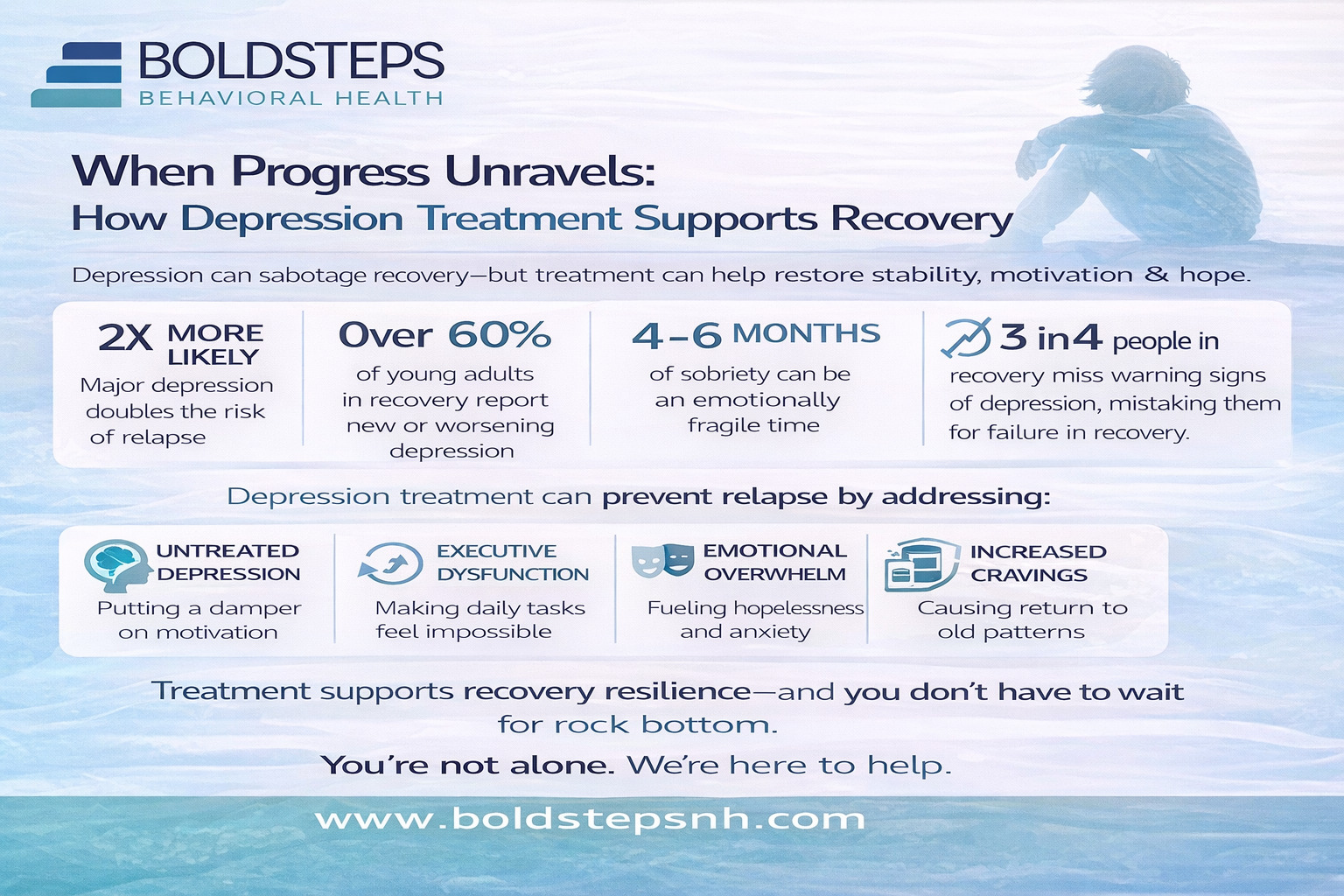
What Depression Treatment Actually Looks Like
Not all depression treatment requires hospitalization or daily programming. In fact, many young adults benefit from outpatient treatment, where they can receive meaningful support without disrupting their lives.
At Bold Steps, we offer individualized depression treatment that may include:
- Evidence-based therapy, such as CBT or DBT, to help change negative thinking and build coping skills
- Medication management, when appropriate, with careful psychiatric oversight
- Supportive psychiatric care, focused on treating the whole person, not just symptoms
- Family involvement, where helpful, to support boundaries and communication without blame
Treatment plans are built collaboratively. We help clients name what they’re feeling, identify what’s working (and what’s not), and regain a sense of agency—because depression often tells people they have none.
“We Thought We Were Past This”—A Painful Truth, and a Place to Begin Again
Few things are more disorienting than watching your child unravel after a stretch of progress. You may think:
- We already did this.
- They said they were okay.
- I don’t know if I can go through this again.
And if you’re like many parents, there’s a deep undercurrent of guilt. You wonder if you missed something—if you should have pushed harder, asked more questions, or backed off sooner.
But here’s the truth: you didn’t cause this, and your love is not the problem. Depression has a way of distorting everything—including hope. But treatment helps bring it back into view.
Depression Treatment Isn’t a Step Back—It’s a Strengthening
When things begin unraveling, it’s tempting to view treatment as a reset button or a step backward. But integrating depression care into recovery is often the next step forward.
It means giving your child the support they need to stabilize their emotions, improve executive function, and reconnect with what matters to them. It also reduces the risk of self-harm, relapse, and long-term disconnection.
In our experience, the most meaningful recovery stories are rarely linear. They’re full of pivots—and depression treatment is often a powerful one.
You’re Not Alone. And This Doesn’t Mean It’s Over.
Watching your child struggle again can feel like failure. But relapse—or unraveling—is often part of a deeper healing process.
You are still in this. And they are not broken beyond repair.
If you’re unsure where to begin, a simple, judgment-free consultation can help you understand what’s going on beneath the surface—and what kind of support might help your family move forward. Serving Rockingham, Merrimack, Hillsborough, and Essex County with convenient locations that make quality care accessible close to home.
FAQs About Depression Treatment in Young Adults
How do I know if it’s depression or just laziness?
This is a common—and painful—question. What often looks like laziness is actually executive dysfunction, a symptom of depression that makes planning, initiating, and following through on tasks feel overwhelming. If your child is missing appointments, avoiding basic hygiene, or sleeping all day, it’s likely more than just “not trying.”
Can someone be in recovery and still need mental health treatment?
Absolutely. In fact, co-occurring depression is one of the most common challenges in early recovery. Supporting both issues gives your child the best chance at long-term stability.
What if my child doesn’t want help?
Many young adults resist help—not because they don’t need it, but because they feel ashamed, hopeless, or unsure if it will even work. The key is keeping the door open with compassion, not pressure. You can also contact us for support in how to have these conversations.
Is medication always required for depression treatment?
No. While medication can be helpful for many, especially those with moderate to severe depression, it’s not the only option. Therapy, lifestyle support, and skill-building interventions are all part of the picture. We work collaboratively to determine what makes the most sense for your child’s needs and comfort level.
📍 Depression treatment can be the missing link in your child’s recovery journey. If you’re looking for trusted care that sees the full picture, we’re here.
📞 Call (603) 915-4223 or visit to learn more about our depression treatment services in Concord, NH.