

I swore I’d never do it again.
Not because I hated it. Not even because it didn’t help. I just thought I was done. Finished. Graduated from pain. I had “completed” my depression treatment, and I didn’t want to need help ever again.
But here’s the thing about depression: it doesn’t care how far you’ve come. It doesn’t care if you’ve had 90 days of light, connection, progress. It can still crawl back into your bones like it never left.
And when it did, I felt ashamed. Embarrassed. Furious with myself. I told no one. I isolated. I hid behind “busy” and hoped it would pass.
It didn’t.
So I went back to treatment—even after promising myself I never would. Here’s what that looked like. And why it changed everything.
The Slow Slip Backward Caught Me Off Guard
It didn’t hit me like a wave. It came as a quiet unraveling.
I stopped making my bed. I stopped answering texts. I skipped breakfast. Then lunch. I started sleeping through alarms and brushing my teeth at 2 p.m.—if at all.
The coping tools I’d picked up in my first round of treatment? They sat unused in a notebook. I told myself I was “just tired.” But the truth was: I was getting swallowed.
And the more I sank, the more stubborn I got.
“I already beat this.”
“I know what to do.”
“I shouldn’t need help again.”
But depression doesn’t listen to logic. It doesn’t care that you’ve already been through the storm. Sometimes, it comes back quieter. Trickier. More convincing.
Pride Told Me I Had Something to Prove
What kept me from reaching out wasn’t a lack of insight—it was pride.
I felt like needing depression treatment again meant I hadn’t “earned” my way out of the darkness the first time. Like I hadn’t tried hard enough. Like I was faking my progress.
And worse, I worried that going back would make people lose trust in me. That I’d look flaky. Weak. Embarrassing.
It took weeks before I admitted to myself: I didn’t need to prove I was healed. I needed to be honest that I was hurting again.
That shift saved me.
I Thought I’d Be Judged. I Was Welcomed Instead.
Returning to Bold Steps felt like walking into a room where I’d left unfinished business. I expected a clipboard. Questions. Subtle judgment.
But what I got was:
“Thanks for coming back.”
No lectures. No side-eyes. Just kindness.
They didn’t ask why I left. They didn’t make me justify anything. They asked how I was doing now, and what I needed next.
That was the moment I realized: I hadn’t failed. I had returned.
And that made all the difference.
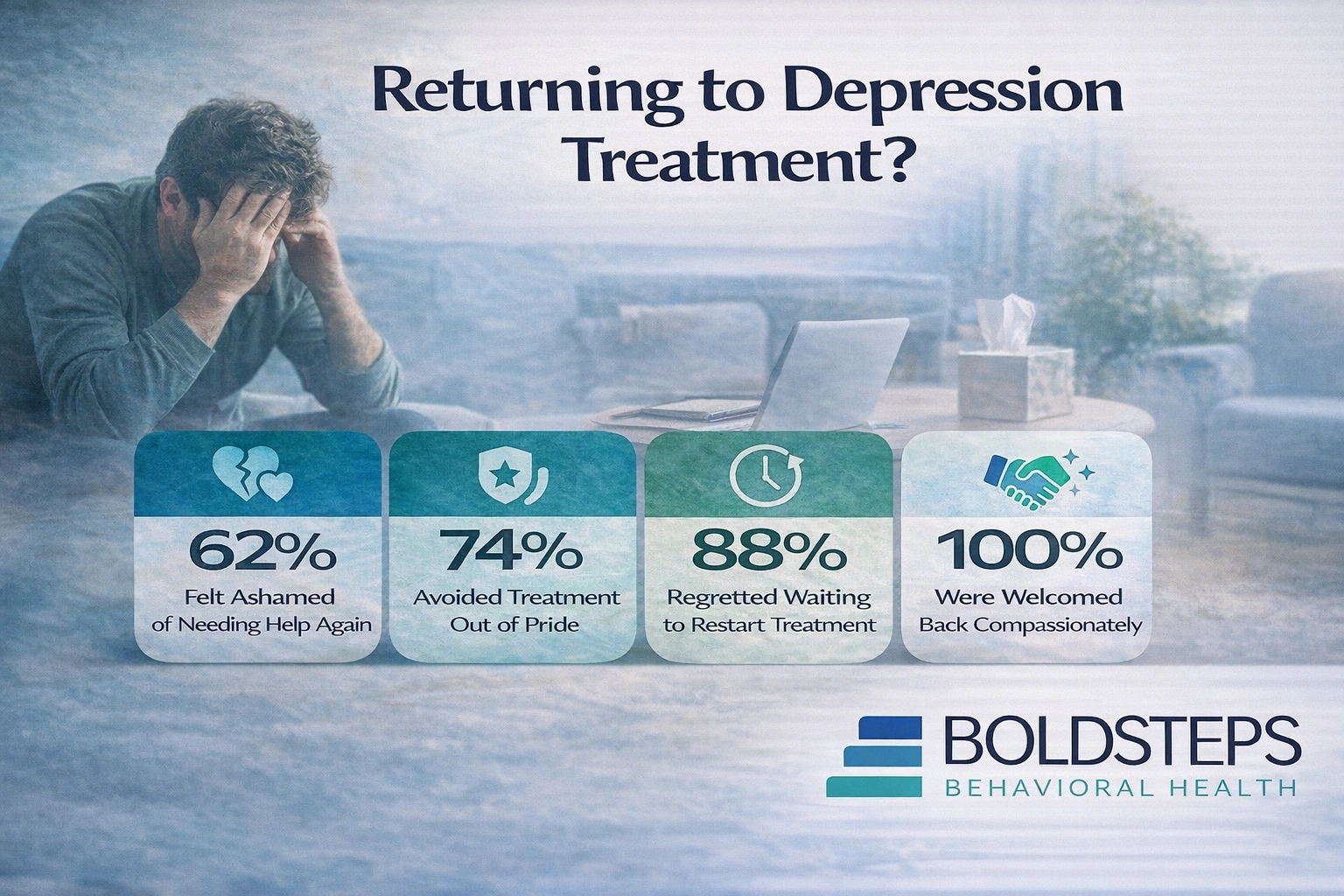
The Second Round of Depression Treatment Was Different
I didn’t need the same things I did the first time. I wasn’t trying to pull myself out of an emergency—I was trying to keep myself from slipping deeper. That meant the work was different.
In the first round of treatment, I was focused on crisis. On surviving. This time, I was focused on sustaining. On recognizing the early signs. On being honest before I broke again.
This round, I brought my whole truth to the table. I didn’t sugarcoat. I didn’t pretend to be fine. I said things like:
- “I’m afraid this means I’ll always be like this.”
- “I hate that I’m back here.”
- “I don’t know if anything will help, but I’m here.”
And weirdly… that made it work better. Because I wasn’t performing. I was actually showing up.
It Wasn’t a Setback—It Was a Continuation
There’s this lie a lot of us believe: that going back to treatment means starting over.
It doesn’t.
My return wasn’t a reset. It was a continuation. Like picking up a book you’d put down, and reading the next chapter with new eyes.
The lessons I learned in my first treatment weren’t gone. They were waiting. Waiting for me to remember them. Waiting for me to use them again, this time with more experience, more self-awareness, and more courage.
And this time, I wasn’t afraid of the work. I was afraid of what would happen if I didn’t do it.
I Let Go of the Shame. It Didn’t Belong to Me.
Shame is what almost kept me from coming back.
But shame doesn’t belong to people who try again.
Shame belongs to systems that tell us we’re only successful if we never struggle again.
Here’s what I know now:
- Healing isn’t a straight line.
- Depression doesn’t care about your timeline.
- Needing help more than once doesn’t make you weak—it makes you real.
The moment I let go of the shame, I found my strength again.
If you live in Hillsborough County, New Hampshire, or Essex County, Massachusetts, and you’re afraid to go back to treatment—you’re not the only one. The depression treatment program at Bold Steps doesn’t see you as a failure. They see you as someone who still wants better. And that’s enough.
Relapse Didn’t Erase My Progress
I was scared I’d lose everything I’d gained.
My 90 days. My good days. My clarity.
But here’s what I found: relapse doesn’t erase your growth. It reminds you why it mattered.
I didn’t lose my insight. I didn’t lose my value. I didn’t go back to square one.
I went forward—with more honesty, more humility, and more humanity than before.
You Can Come Back. You’re Still Worth It.
If you’ve read this far, maybe something in you is whispering:
“Maybe I should go back, too.”
Listen to it.
You’re not broken for needing another round. You’re not weak for still struggling. You’re not too far gone.
You’re still worth showing up for.
You’re still allowed to try again.
You’re still deserving of care.
Frequently Asked Questions (FAQs)
Is it common to return to depression treatment after a break?
Yes. Many people return to treatment after a period of stability. It’s not a failure—it’s a continuation. Returning is a sign of self-awareness, not defeat.
Will I be starting from scratch?
No. Even if it’s been a while, your past experience still matters. It informs your treatment this time around. Think of it as picking up where you left off, but with more perspective.
What if I’m embarrassed to come back?
That’s valid—and normal. But you won’t be judged for coming back. At Bold Steps, returning is welcomed and respected. Many people have walked the same path.
What if treatment didn’t “stick” the first time?
That doesn’t mean it won’t help now. Sometimes, the second time through treatment feels deeper, more personal, and more sustainable. You’ve changed. The support can, too.
Will people see me as a failure?
Absolutely not. In fact, returning to treatment takes more courage than starting it the first time. People will see your return as a commitment to yourself—not a collapse.
You Can Still Choose Yourself
You’re allowed to try again. You’re allowed to feel unsure and still walk through the door.
You’re allowed to say, “I thought I was done… but I still need help.”
And you’re allowed to be helped.
Call (603) 915-4223 to learn more about our depression treatment in Concord, New Hampshire.