

I remember the day my life should have felt perfect.
I’d just been promoted — the corner office, the bigger team, the praise from leadership. My LinkedIn blew up with congratulations. Everyone thought I had arrived.
But that night, after toasting with my partner, I poured a second drink. Then a third. And by the time I walked into work the next morning, my head was heavy in a way ambition and early‑morning caffeine couldn’t fix.
I was supposed to be happy. Instead, I was thirsty — not for success, but for relief.
And that’s when I knew something was wrong.
I didn’t hit rock bottom. I didn’t lose my job. I wasn’t arrested or hospitalized. I was a functioning human being — but inside, I was unraveling.
That’s part of the trick of being high‑functioning: you can wear success like armor while parts of you quietly break underneath.
It took time, honesty, and a willingness to face discomfort to realize that my drinking wasn’t sustainable — no matter how polished my résumé looked.
This is the story of why I chose an intensive outpatient program. Not because everything fell apart, but because I wanted to find a way to stand up without needing a drink in my hand.
When Success and Stress Become Indistinguishable
We’re taught to see success and stress as separate:
Success = good
Stress = bad
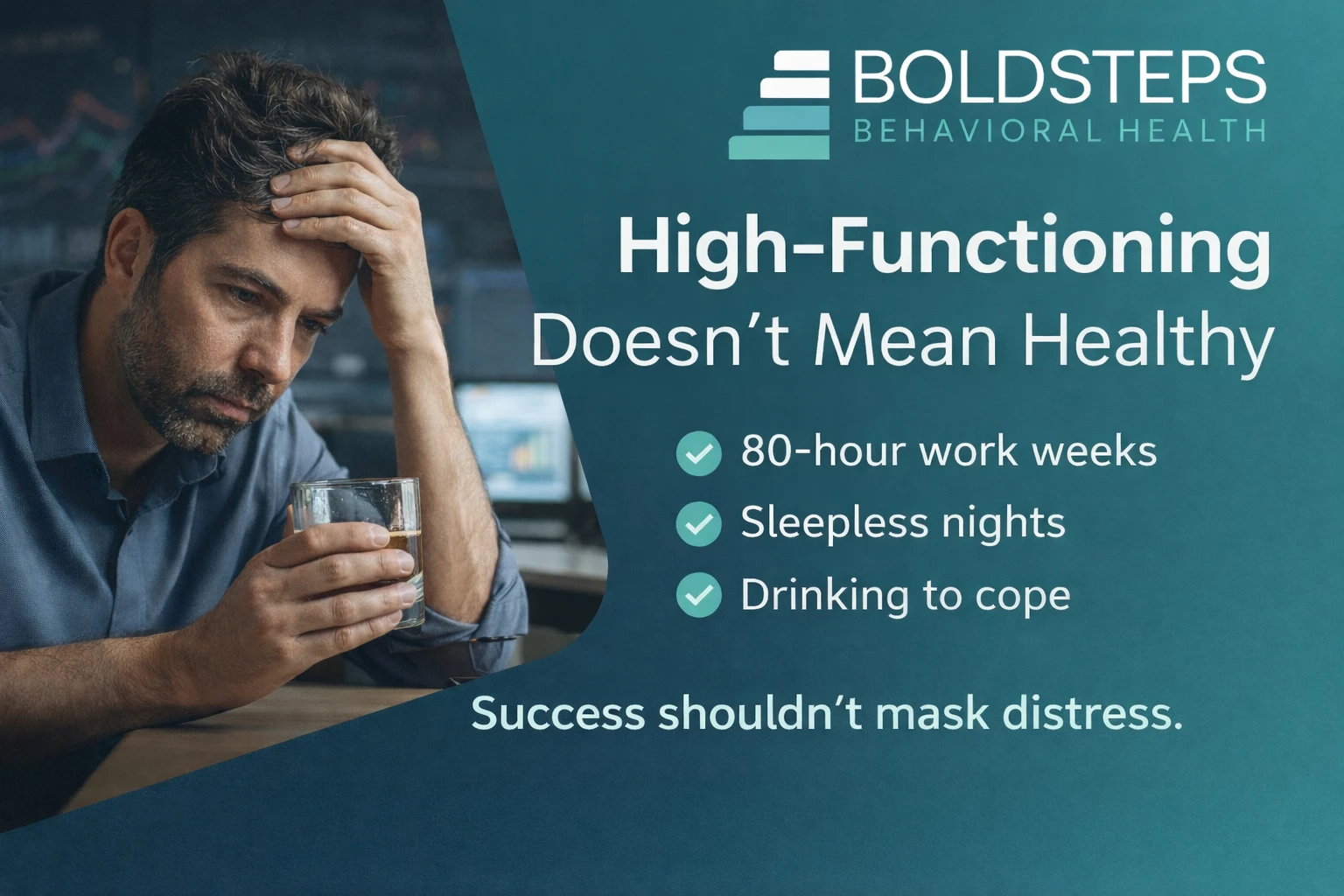
But what happens when success comes with 80‑hour weeks, endless pressure, restless anxiety, and a creeping need to unwind in ways that don’t actually help?
That was me.
Every win seemed to come with a side of:
- Sleepless nights
- Rising tension
- A persistent internal buzz that said “more” even when I was already full
My drinking didn’t start as a problem. It started as:
- A way to relax
- A way to “deserve” comfort
- A reward for hard work
And slowly, without me noticing, it became:
- A way to feel anything other than exhaustion
I was numb inside, high‑functioning on the outside.
And that’s when you learn that success doesn’t protect you from pain — it just hides it better.
When Drinking Becomes the Quiet Partner in Your Life
Some people spiral quickly. For others it’s slow — like water wearing down a rock.
For me, the signs weren’t dramatic:
- I needed a drink to calm my mind after dinner
- Weekends started with brunch and ended with cocktails
- My tolerance increased, but my satisfaction didn’t
- I started hiding how much I drank even from myself
That’s the weird danger of being high‑functioning: you can slip further than you expect before you hit a wall.
I wasn’t a cautionary‑tale headline. I was the guy they’d invite to every holiday dinner — who always had a story and a smile.
But inside, there was that whisper:
This isn’t working.
I didn’t want to give up success. I just wanted to stop burning myself out while pretending nothing was wrong.
And that’s when I started to think about real help.
The First Step Was Admitting Something Was Off
One morning, after an anxious night and a heavy head, I caught my reflection in the elevator mirror.
My eyes looked tired in a way no amount of promotion could fix.
It hit me:
I don’t want to keep doing this.
That’s when I looked up options.
I didn’t want inpatient treatment. I wasn’t sick enough for that — or so I thought.
But I did want support that fit my life, not something that required me to abandon it.
That’s when I found the idea of an intensive outpatient program (IOP).
It promised structure. Support. Community. Tools. Clarity.
But it didn’t demand that I hit a dramatic low.
It said:
“You don’t have to be broken to get help. You just have to care.”
And that was enough to make the phone call.
Choosing an Intensive Outpatient Program Wasn’t Weak — It Was Strategic
One of the lies I told myself for years was this:
If I go get help, it means I’m not strong enough.
But that’s a trap. Strength isn’t about enduring alone. Strength is about knowing when you need support — and getting it.
An IOP allowed me to:
- Keep my job
- Stay connected with responsibilities
- Get emotional support
- Learn real coping skills
- Join a community of people fighting similar battles
It wasn’t a retreat. It was a retooling.
I wasn’t disappearing from my life. I was coming back into it — whole.
What Actually Happened in Treatment
IOP gave me something I hadn’t had before: reflection with support.
Here’s what I found inside treatment:
1. I wasn’t alone.
People who look successful, accomplished, “fine” on the outside? They were there too. That was the first surprise — and relief.
2. I learned how to talk about emotions instead of anesthetizing them.
Before, my default was: Distract, numb, move on. That doesn’t heal — it delays.
3. I learned how stress and alcohol interact in my brain.
Not just physically. Emotionally.
4. I built real coping strategies.
Not generic advice — tools that worked for me.
5. I connected with people who understood how achievement can mask distress.
That community was one of the biggest catalysts for change.
IOP wasn’t therapy that judged me. It was therapy that helped me understand myself.
The Turning Point Didn’t Look Like a Crash — It Looked Like Truth
Most narratives about treatment focus on crisis moments — the dramatic sunrises and fold‑your‑hands confessions.
Mine wasn’t like that.
My turning point was recognition:
I saw that success without peace wasn’t success.
I heard myself express something real for the first time in years.
I realized I didn’t want to numb my way through life anymore.
That’s when I decided to choose care — not because I had to, but because I wanted to live fully again.
And that desire mattered more than any external breaking point.
Looking for intensive outpatient program in Hillsborough County?
If you’re in Hillsborough County, NH or Essex County, MA and ever wondered whether “functional” means healthy — here’s the truth:
You don’t have to fall apart to deserve support.
You deserve clarity, tools, and peace more than you deserve polish.
An intensive outpatient program can meet you where you are — without demanding crisis, without requiring rock bottom, and without asking you to choose between life responsibilities and healing.
Sometimes, treatment is not a retreat from life —
It’s a realignment of it.
What Success Looked Like After IOP
My drinking didn’t magically stop the first day of treatment.
But things changed.
Here’s how:
- Mornings felt clearer
- I stopped waking up with that dull dread
- I learned to notice triggers before they took hold
- I rediscovered joy that didn’t require numbing
- I got honest about things I used to bury under drinks
Success wasn’t a final destination — it was shifted perspective.
That’s the gift of care.
IOP didn’t take away my ambition.
It gave me my life back inside that ambition.
The Myth of the “High‑Functioning” Addict
High‑functioning doesn’t mean unbroken.
It means you’re good at hiding your pain.
And hiding pain doesn’t heal it — it buries it.
I thought if I could just keep performing, everything would sort itself out.
It didn’t.
But that recognition — the moment I saw the gap between performance and peace — became the turning point.
And it started with a courageous choice:
I want help. Not because I failed — but because I want to thrive.
FAQ: High‑Functioning Drinking and IOP
Do I need to be at “rock bottom” for IOP to work?
No. You can be high‑functioning and still benefit deeply from treatment. The point of IOP is support — not punishment.
Will people judge me for how successful I am?
No. Clinicians and peers understand that outward success doesn’t mean inner clarity.
Can I keep working while in IOP?
Yes. IOP is designed to fit into real life — you don’t have to drop everything.
Is this just for “addiction”?
Not necessarily. IOP helps with patterns of use, coping strategies, emotional regulation, and lifestyle balance.
How long does treatment typically last?
It varies, but the goal is sustainable change — not just temporary relief.
What if I’m afraid of opening up?
That’s normal. You don’t have to dive deep instantly. Treatment meets you where you are — even if the first step is just showing up.
Why Choosing Treatment Wasn’t the End — It Was the Start
I didn’t choose an intensive outpatient program because I had failed.
I chose it because I wanted my life back — in a way that felt vibrant, not numbed.
I didn’t abandon ambition.
I clarified it.
If you’re reading this and parts of your life feel like they’re happening around you instead of inside you — maybe it’s time to ask:
What if healing is the next step of success?
It’s a spicy question.
But sometimes the question is the beginning of the answer.
Ready to reconnect with yourself — not just perform?
Call (603) 915‑4223 to learn more about our intensive outpatient program services in Concord, NH.
You don’t have to collapse to change — you just have to stop pretending everything’s fine and start being honest about what you really want.