

You thought the hardest part would be convincing them to get help.
What nobody tells you is what happens after you realize something is really wrong — and you can’t fix it with reassurance, logic, or love alone.
As a clinician, I’ve sat across from parents in this exact place. Parents of 19-, 20-, 24-year-olds who were once full of momentum and now seem withdrawn, irritable, using again, or barely functioning.
If that’s you, let me start here:
You didn’t cause this.
And you’re not crazy for feeling like your entire house has shifted.
If you’re trying to understand whether something like depression treatment might help your child, that instinct isn’t dramatic. It’s protective.
And it makes sense.
The Whole Family Starts Living Around the Mood
Depression in a young adult rarely stays contained to their bedroom.
It seeps.
Dinner conversations get shorter.
Plans get tentative.
Everyone becomes hyperaware of tone.
You may find yourself scanning constantly:
- Are they sleeping too much?
- Are they eating?
- Are they using again?
- Are they safe tonight?
Other siblings often feel the shift but don’t know how to name it. Some get quieter. Some act out. Some become “the easy one” because they don’t want to add to the stress.
Partners can drift into different coping roles. One becomes the problem-solver. The other becomes the peacekeeper. You may even start arguing about strategy — not because you disagree about love, but because you’re scared.
No one tells parents that depression reorganizes family dynamics in subtle, relentless ways.
It’s like the house starts orbiting one person’s nervous system.
You’ll Question Your Entire Parenting History
This is one of the most painful parts.
Parents don’t just worry about their child’s present. They replay the past.
- “Should we have pushed therapy earlier?”
- “Was I too hard on them in high school?”
- “Did the divorce mess them up?”
- “Did we miss signs?”
Here’s what’s true from a clinical standpoint: depression is influenced by biology, temperament, environment, stress, and life transitions. It is not the result of one parenting mistake.
But guilt gives the illusion of control.
If it’s your fault, then maybe you can fix it.
The harder reality — and the one that hurts — is that sometimes you did everything you could, and your child is still struggling.
That doesn’t make you ineffective. It makes you human.
When Mental Health and Substance Use Start Overlapping
You mentioned they’re using again.
This is where things get complicated.
Depression can make substances feel like relief — a temporary lift, a numbing agent, a way to quiet intrusive thoughts or hopelessness. But substances often deepen low mood over time. Sleep worsens. Motivation drops. Shame increases.
Parents end up asking:
“Is it the depression causing the using?”
“Or the using causing the depression?”
Often, it’s both.
And from the outside, it can look like defiance or laziness when in reality your child may be stuck in a loop that feels impossible to break.
This is why comprehensive assessment matters. Not a quick conversation. Not a surface-level check-in. Real clinical evaluation that looks at mood, coping patterns, risk, and readiness.
And yes, sometimes structured care becomes necessary — not as punishment, but as stabilization.
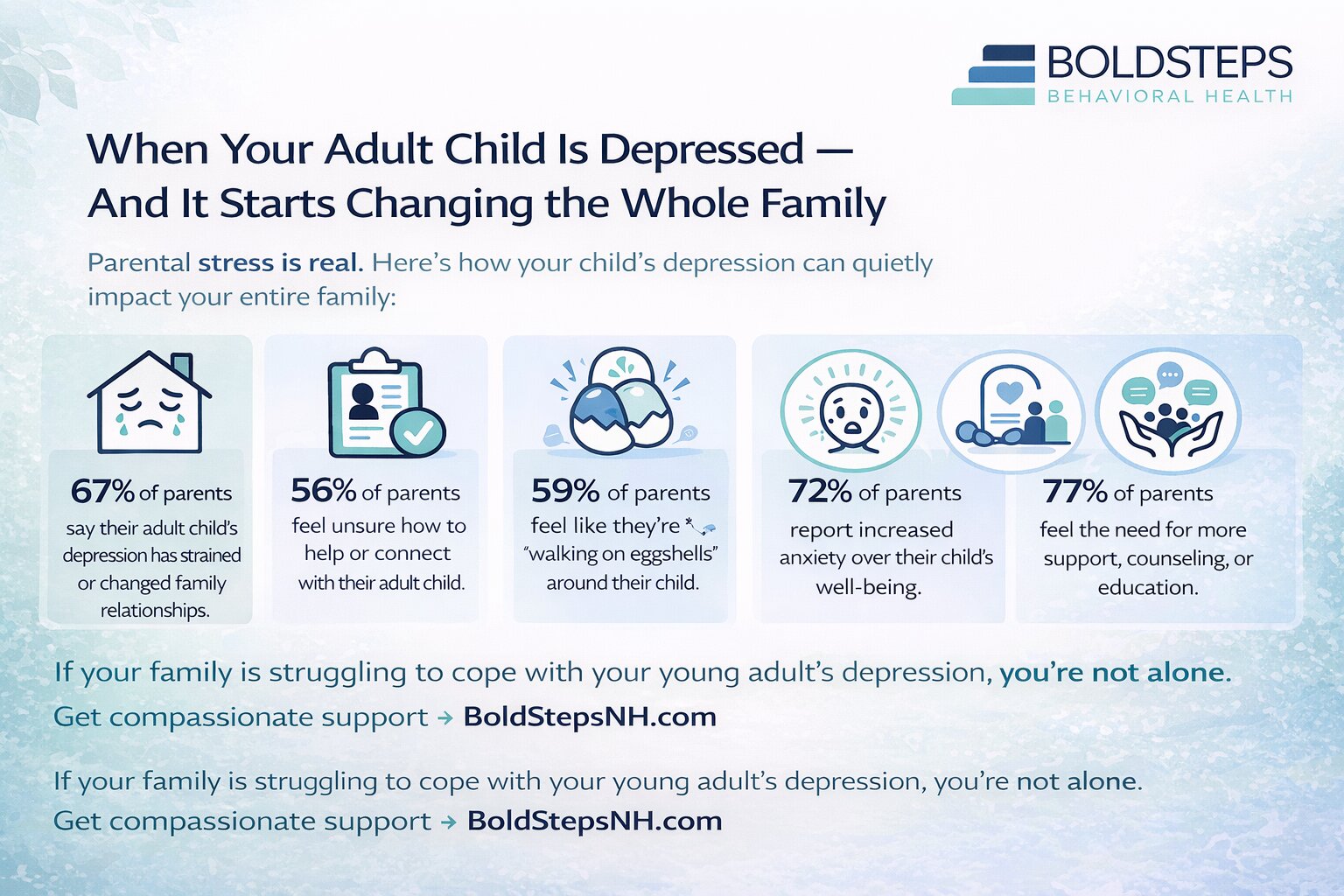
You May Feel Like You’re Walking on Eggshells
I hear this phrase constantly.
“I don’t know what to say anymore.”
Parents become hypervigilant about tone. You soften feedback. You avoid topics. Or you swing the other direction and become stricter because you’re terrified.
Both reactions come from love.
But living in constant calibration is exhausting.
It’s important to remember: boundaries are not betrayals.
You can say:
- “I love you.”
- “I’m worried.”
- “I won’t fund behavior that harms you.”
- “I will support you getting help.”
All at the same time.
That balance doesn’t come naturally when fear is high. It often requires guidance — sometimes for parents as much as for the young adult.
The Grief No One Talks About
There is a quiet grief in watching your child struggle with depression.
You may grieve:
- The version of them who used to laugh easily.
- The independence you thought they’d have by now.
- The milestones that feel delayed.
- The family dynamic you imagined.
This grief is real.
And it can coexist with hope.
Many parents feel ashamed for even having those thoughts. They think, “I shouldn’t make this about me.”
But acknowledging your grief doesn’t take anything away from your child’s pain. It simply recognizes that you’re affected too.
Getting Professional Support Is Not an Overreaction
Some parents hesitate to escalate care because they worry about labeling their child.
Others are afraid of pushing too hard and damaging the relationship.
Here’s a gentle reframe:
Seeking evaluation or higher levels of care isn’t about control. It’s about clarity.
Depression that interferes with functioning — school, work, sleep, motivation, relationships — often needs more than occasional therapy sessions. Sometimes structured daytime care or multi-day weekly treatment provides enough consistency to interrupt the spiral.
And sometimes, yes, families begin exploring formal depression treatment options when symptoms persist or worsen.
That step doesn’t mean you failed. It means you’re responding to the severity of the situation.
Early intervention can prevent years of cycling.
Your Nervous System Is in Crisis Too
Parents rarely notice how dysregulated they’ve become.
You may be:
- Checking your phone constantly.
- Losing sleep.
- Snapping at others.
- Unable to concentrate at work.
- Bracing for worst-case scenarios.
Chronic stress changes the brain. It narrows perspective. It increases irritability. It amplifies fear.
If your 20-year-old is using again while depressed, your body may be living in a low-grade emergency state.
That deserves attention.
Parent counseling, support groups, and psychoeducation aren’t indulgent. They’re stabilizing. When you’re steadier, your communication improves. Your boundaries become clearer. Your reactivity decreases.
And that changes the emotional climate of the home.
Hope Often Starts Small
Parents sometimes expect change to arrive dramatically.
A breakthrough speech.
A moment of clarity.
A sudden commitment to recovery.
More often, it starts quietly.
They admit they’re tired.
They agree to an evaluation.
They show up — reluctantly — to an appointment.
Those small steps matter.
Depression recovery is rarely linear. There are setbacks. There are resistant phases. There are moments where progress feels invisible.
But I’ve watched young adults re-engage with life after periods that looked bleak.
It doesn’t always happen fast.
It doesn’t always happen cleanly.
But it happens.
FAQ: What Parents Often Ask
How do I know if this is “just a phase” or something more serious?
If symptoms persist for weeks, interfere with school or work, involve substance use, or include hopeless statements, it’s more than a phase. Functional impairment is a key indicator that evaluation is warranted.
Should I force my adult child to get help?
You can’t force insight. But you can set boundaries around what you will and won’t support. Sometimes structured consequences — tied to safety and stability — open the door to willingness.
If safety is a concern, immediate evaluation is critical.
What if they refuse treatment entirely?
Start with a professional consultation for yourself. Clinicians can help you craft conversations, set boundaries, and understand leverage points. Even if they refuse initially, your approach can influence eventual openness.
Can depression improve without formal care?
Mild episodes sometimes lift with lifestyle changes and therapy. Moderate to severe depression, especially when paired with substance use, often requires more structured intervention to interrupt the cycle effectively.
How do I protect my other children?
Keep communication open. Validate their experience. Avoid making them emotional caretakers. And consider family sessions when appropriate to rebalance dynamics.
Is it wrong to feel angry?
No. Anger is often fear in disguise. It’s a signal that something feels out of control. Processing that anger in a healthy space is far better than suppressing it or directing it at your child.
If you’re in New Hampshire and trying to understand what next steps could look like, learning more about structured, compassionate options for depression can bring clarity — even before your child is fully on board.
You don’t need to solve the next five years. Just the next right step. And for those in Rockingham County, Merrimack County, Hillsborough County, or Essex County, we have nearby locations to make care accessible.
Call (603)915-4223 or visit our depression treatment services to learn more about our depression treatment services in Concord, NH.