

I remember the first time I slipped after three months of feeling steady.
Not perfect. Not euphoric. Just… stable.
I had routines. I had therapy appointments on the calendar. I had stretches of days where the heaviness lifted enough that I could breathe.
Then one week, it didn’t.
The sleep got weird. The motivation disappeared. The old thoughts started circling. And when I realized I was sliding back into something familiar, my first thought wasn’t, “I need support.”
It was: “I ruined everything.”
If you’re here after 90 days—or 6 months, or a year—and depression has crept back in, I want you to hear this from someone who’s been there:
You didn’t ruin your progress.
And getting help again still matters.
Within weeks of my own relapse, I found myself back on the page for depression treatment at Bold Steps Behavioral Health. Not because I hadn’t already done the work. But because I needed to remember that relapse doesn’t cancel healing—it signals that something needs attention.
Let’s talk about that.
The Myth That You Should Be “Past This”
There’s an unspoken expectation that once you’ve had 90 days of stability, you’ve crossed some invisible line.
You should be better.
Stronger.
Done with this chapter.
But depression doesn’t work on a linear timeline.
It ebbs and flows. It shifts shapes. It adapts to stress, life transitions, seasonal changes, relationship strain, and sometimes nothing obvious at all.
The “I should be over this” narrative is one of the most painful parts of relapse. It turns a manageable flare-up into a shame spiral.
And shame makes everything worse.
You’re not supposed to outgrow depression through willpower. You’re supposed to learn how to navigate it.
That’s very different.
What Relapse Actually Tells You
When symptoms return after a stretch of stability, it’s not a verdict on your character.
It’s data.
Maybe:
- You’ve been carrying more stress than you realized.
- You stopped prioritizing therapy because things felt better.
- Medication adjustments need to happen.
- Isolation slowly crept back in.
- A loss, conflict, or life shift reopened something deeper.
Relapse gives you information about what needs reinforcement.
The first time I sought help, everything felt chaotic and urgent. The second time, it felt clearer. I could say, “Here’s what changed. Here’s what I ignored. Here’s where I need support.”
That’s not starting over.
That’s refining.
You’re Not Back at Zero
This is the part that doesn’t get talked about enough.
When depression resurfaces after 90 days, you’re not the same person you were before treatment.
You have:
- Language for what you’re feeling
- Awareness of your triggers
- Experience with coping tools
- Memory of what stability feels like
That last one is powerful.
When you’ve felt better before, even temporarily, you know it’s possible again.
You may feel discouraged right now. But you are not at zero. You’re at a new starting point—with experience.
Think of it less like falling down a mountain and more like realizing you need better boots for the next stretch.
The Shame Is Often Louder Than the Symptoms
If I’m honest, my relapse hurt less than my reaction to it.
The voice in my head was brutal:
“You should’ve caught this sooner.”
“They’re going to think you didn’t try hard enough.”
“What’s the point of going back?”
Shame convinces you to isolate.
It tells you to “handle it yourself.”
It suggests that asking for help again is embarrassing.
But depression thrives in silence.
Re-engaging with support—whether that’s therapy, medication management, structured daytime care, or multi-day weekly treatment—is not dramatic.
It’s maintenance.
We don’t shame people for adjusting insulin or blood pressure medication. Mental health is no different.
Why Getting Help Again Is a Sign of Strength
There’s something quietly brave about saying, “I need help again.”
It requires humility. Awareness. Honesty.
The second time I reached out, I wasn’t trying to prove I was okay. I didn’t pretend it was “just a rough week.” I walked in and said, “I see the pattern returning. I don’t want to let it spiral.”
That changed everything.
Care after relapse is often more targeted. More personalized. You and your providers can adjust what didn’t quite stick the first time.
Sometimes that means:
- Tweaking medication
- Increasing therapy frequency temporarily
- Trying a different therapeutic approach
- Rebuilding daily structure
- Addressing deeper, unresolved layers
That’s growth, not failure.
Depression Is a Condition, Not a Character Flaw
One of the most dangerous beliefs we carry is that relapse says something about who we are.
It doesn’t.
Depression is influenced by biology, stress, trauma history, sleep patterns, environment, relationships, and countless other variables. It is not a referendum on your discipline.
You didn’t “fail” at being mentally healthy.
Your brain is responding to something.
And brains can be supported.
That’s why depression treatment continues to matter—even after a setback. Not because you’re broken, but because conditions require ongoing care.
The Fear of Walking Back Through the Door
Let’s talk about the awkward part.
Going back.
You might be thinking:
“They’ll be disappointed.”
“They’ll see me as a repeat case.”
“They probably don’t even want me back.”
That fear is common. And it’s rarely true.
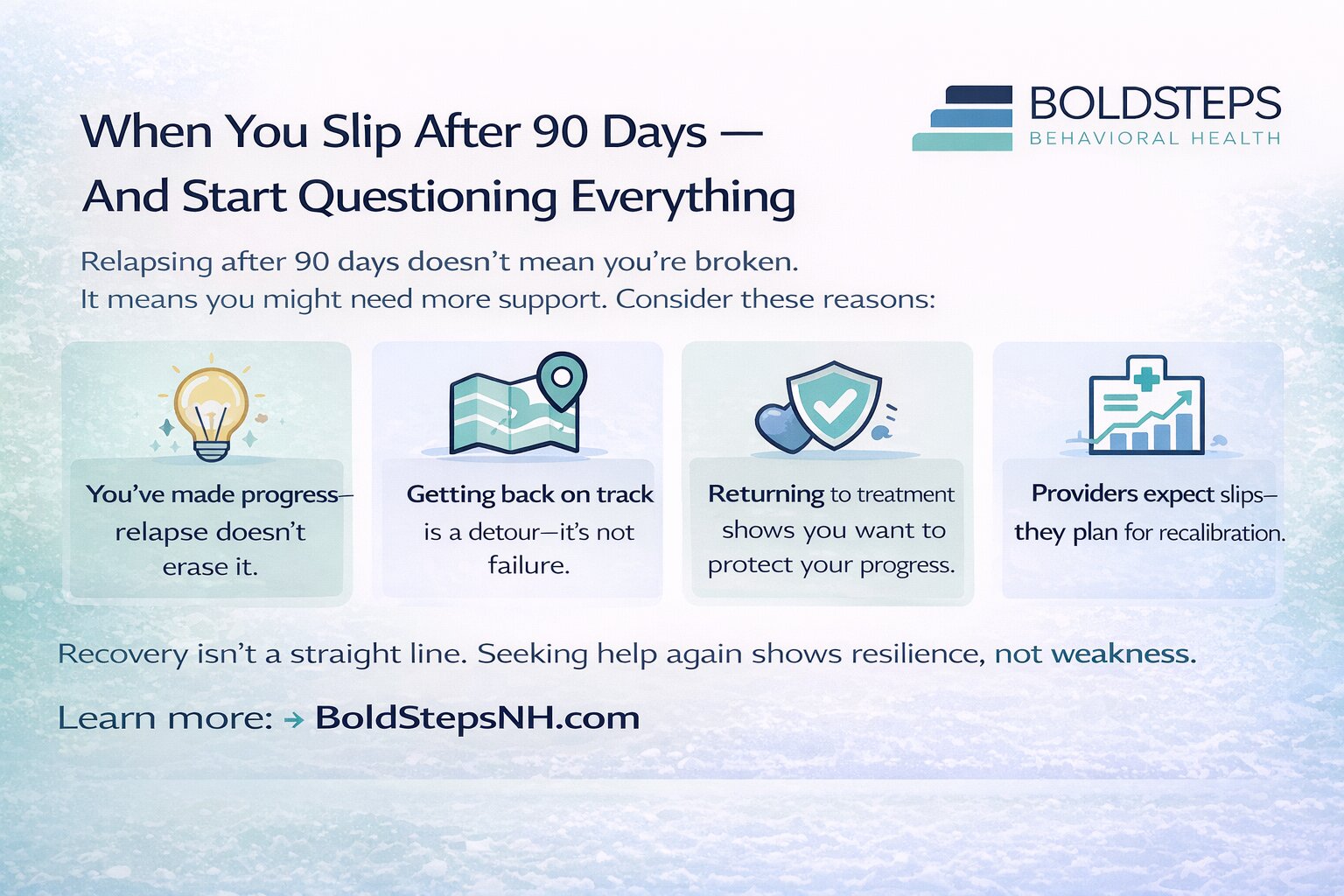
Good providers understand that healing isn’t linear. They expect fluctuations. They plan for them.
Walking back in isn’t an admission of defeat.
It’s a decision to intervene early instead of waiting for things to collapse.
There’s strength in that kind of timing.
This Chapter Is Not the End of Your Story
Relapse can feel dramatic in your mind. It can feel like you fell off a cliff.
But often, it’s more like missing a turn and realizing you need to reroute.
The road is still there.
The tools are still there.
The part of you that wanted to feel better 90 days ago? That part is still there too.
You don’t lose your progress because symptoms returned. You carry that progress forward into the next phase.
If you’re in New Hampshire and noticing the weight return—the fatigue, the numbness, the irritability, the intrusive thoughts—you don’t have to wait until it becomes unbearable.
Call 603-915-4223 or visit our depression treatment services to learn more about our depression treatment services in Rockingham.
You’re not starting over.
You’re continuing.
Frequently Asked Questions
Is it normal to relapse after 90 days of feeling better?
Yes. Very normal. Depression often follows a cyclical pattern. Many people experience periods of improvement followed by flare-ups. A 90-day stretch of stability is meaningful—but it doesn’t guarantee symptoms won’t return.
Relapse doesn’t erase progress. It signals that adjustments may be needed.
Does relapse mean my previous treatment didn’t work?
Not at all. Treatment can absolutely work—and still require ongoing refinement. Think of it like physical therapy. You may regain strength, then hit a setback if you overexert or stop the exercises. That doesn’t mean therapy failed. It means the plan needs updating. The same applies to mental health care.
Should I go back to the same provider?
If you felt heard, respected, and supported, returning to the same provider can be incredibly helpful. They already know your history. If something didn’t feel right the first time, it’s okay to explore different options. What matters most is that you don’t isolate yourself from support.
What if my symptoms feel different this time?
That’s common.
Depression can shift forms. It may look more like irritability than sadness. More numbness than tears. More exhaustion than hopelessness.
Different presentation doesn’t mean it’s worse—or that you imagined the first recovery. It simply means your care plan may need to adapt.
How do I know when it’s time to reach back out?
If you’re:
- Sleeping significantly more or less
- Losing interest in things you recently enjoyed
- Withdrawing from people
- Feeling persistent guilt or worthlessness
- Struggling to function at work or home
It’s time to talk to someone.
You don’t need to wait until you’re in crisis.
Early intervention often makes recovery smoother.
I feel embarrassed. How do I get past that?
You don’t have to eliminate the embarrassment before asking for help.
You can feel embarrassed and still make the call.
Courage isn’t the absence of shame. It’s moving anyway.
And once you’re back in a supportive space, that shame usually softens faster than you expect.
If you’re reading this and quietly thinking, “I don’t know if I can do this again,” I want you to hear something steady:
You already did.
You already proved you can show up.
This isn’t a reset. It’s a recalibration.
Call 603-915-4223 or visit our depression treatment services to learn more about our depression treatment services in Concord, NH.