

Your first few weeks sober can feel like walking into a party where everyone else already knows the dance. If you’ve just enrolled in a Partial Hospitalization Program (PHP), you might be wondering what’s “normal,” what’s awkward, and whether you’re the only one feeling totally out of place.
Spoiler: you’re not.
At Bold Steps Behavioral Health in Concord, NH, we specialize in helping young adults get their footing when sobriety is brand new. PHP is often one of the first structured programs people enter after deciding to get help, and that means most people in the room are just as unsure, self-conscious, and curious as you are.
Here’s a real-world look at what you can expect when you start PHP—especially if you’re the youngest one in your friend group trying to get sober and it feels like everyone else is still out partying.
1. You won’t know what to say at first
Let’s be real. Most people show up to their first PHP group feeling awkward, guarded, or unsure what to say. You might try to sound like you have it together. Or you might stay completely silent, hoping no one notices you. Both are normal. You’re not expected to share anything you’re not ready to. You don’t need to be wise, inspiring, or polished. You’re just asked to be real—or at least as real as you’re willing to be today. The pressure wears off the more you realize others are fumbling through it too.
2. The schedule might feel intense
PHP usually runs five days a week, for about six hours a day. It’s not an overnight program, but it’s still a big time commitment. You might feel overwhelmed at first—especially if you’re used to drifting through your days with no real structure. The idea isn’t to lock you into a rigid routine; it’s to provide enough of a framework so that you can start rebuilding your life with some consistency. Think of PHP like scaffolding. It holds you up while you figure out how to build the inside.
There are breaks. There’s breathing room. You won’t be sitting in therapy the whole time. But the routine matters, especially when you’re trying to rewire habits, patterns, and thought loops that used to revolve around substances.
3. You’ll meet people who get it
Even if they don’t look like you. Even if they don’t talk like you. Somewhere in the first week or two, someone in group will share something that hits way too close to home. That’s part of what makes PHP powerful. You realize that you’re not the only one whose anxiety spirals at night. Or who feels like a fraud in their own life. Or who used substances to take the edge off…and then couldn’t stop.
You’re not there to impress anyone. You’re there to heal. And sometimes healing looks like sitting next to someone who used to feel just like you—and realizing they’re still here.
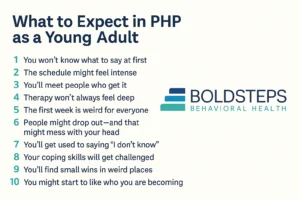
4. Therapy won’t always feel deep
There’s a misconception that every day in treatment will be this big emotional release or epiphany. That’s just not how it works. In PHP, some sessions will dig deep. Others will feel more practical, like learning how to set boundaries or deal with panic attacks. You might have worksheets. You might do role-playing. You might listen to someone else talk the whole time and just try to stay present.
Progress in PHP doesn’t have to be dramatic to be meaningful. Sometimes it’s showing up three days in a row. Sometimes it’s catching yourself mid-self-sabotage thought and choosing to breathe instead. The point is: consistency builds capacity. You don’t need to “feel something big” every session for it to count.
5. The first week is weird for everyone
Seriously. Everyone is in their head during the first few days. You’ll wonder if people are judging you. You’ll overanalyze everything you say. You’ll feel like you’re either too broken or not broken enough to be there. That’s normal.
Then one day, you’ll realize you’ve stopped thinking so hard. You’ll be laughing with someone on break. You’ll speak up in group without over-rehearsing it in your mind. It doesn’t mean the awkwardness is gone forever—it just means you’re settling in. PHP gives you space to be uncomfortable without being alone in it.
6. People might drop out—and that might mess with your head
Someone you talk to one day might not be there the next. That’s part of treatment. People come in and out. Not everyone finishes. It’s easy to take it personally, or to start questioning your own progress when others leave. But it’s important to remember: you can’t do someone else’s recovery for them. And someone else’s choices don’t invalidate your growth.
It’s okay to care. It’s okay to feel sad or confused when someone you connected with disappears. But try to let their absence remind you of why you’re still here—still showing up, still trying.
7. You’ll get used to saying “I don’t know”
One of the most freeing things in PHP is realizing you don’t need to have answers. You can just show up confused, uncertain, or even a little numb. Saying “I don’t know” in group doesn’t make you clueless—it makes you honest. And in early recovery, honesty is the foundation of everything.
You’re allowed to be a mystery to yourself right now. You don’t have to define your identity, your path, or your five-year plan. All you need is the willingness to stay open.
8. Your coping skills will get challenged
You’ll learn skills for managing emotions, cravings, and stress—but knowing them isn’t the same as using them. You’ll forget to use them. You’ll remember halfway through a panic spiral and then judge yourself for not catching it sooner.
That’s okay. PHP gives you a low-risk environment to practice. You’ll be encouraged to try new approaches, reflect on what worked or didn’t, and tweak things as you go. No one expects you to be a mindfulness expert. You’re allowed to mess up. You’re learning. That’s the point.
9. You’ll find small wins in weird places
Like making it through a whole session without checking your phone. Or laughing in group and realizing it didn’t feel fake. Or noticing that you’re hungry—and letting yourself eat. These might sound small, but in early recovery, they’re massive.
PHP teaches you to notice these shifts. To celebrate them. To stop dismissing your own growth just because it doesn’t look like a movie montage. Small wins build big momentum. And the more you notice them, the more they’ll start to stack.
10. You might start to like who you are becoming
It won’t be instant. It might not even happen until your last week in PHP. But somewhere along the way, you’ll start to feel proud of something. Maybe the way you opened up in group. Or the fact that you’ve been sober 28 days when you didn’t think you’d make it past three.
That quiet sense of “I’m doing something real here” is worth everything. It doesn’t mean you’ve figured it all out. It just means you’ve started to believe that healing might actually be possible—for you.
Frequently Asked Questions About PHP
What is a PHP program, exactly?
PHP stands for Partial Hospitalization Program. It’s a structured outpatient treatment model designed for people who need more support than regular therapy but don’t need 24/7 inpatient care. At Bold Steps New Hampshire, our PHP in Concord, NH includes group therapy, individual sessions, skills-building classes, and psychiatric care when needed.
Is PHP just for addiction?
Not at all. Many people attend PHP for mental health concerns like anxiety, depression, trauma, or mood disorders. Others are working through both mental health and substance use challenges. Our Concord-based PHP supports people across that spectrum.
How long does PHP usually last?
It varies. Some people stay for a few weeks, others for a few months. The length of stay depends on your goals, progress, and the clinical team’s recommendations. At Bold Steps, we work with you to make sure your treatment is both effective and realistic for your life.
Can I work or go to school while in PHP?
It depends on your schedule. PHP typically runs during the day, five days a week, which can make working or attending school difficult. However, many clients transition to less intensive care (like IOP or outpatient therapy) after PHP, which allows more flexibility.
What happens after PHP?
Recovery doesn’t end when PHP does. Many clients step down to an intensive outpatient program (IOP) or continue with individual therapy. The idea is to build a support system that evolves with your needs. Our team will help you map out next steps and connect you with the right resources.
Do I have to share in group therapy?
You’ll be encouraged to participate, but you’re never forced to share anything you’re not comfortable with. Respect and safety are huge priorities. You’re allowed to move at your own pace, and the more you trust the process, the easier sharing becomes.
Learn More About Our PHP in Concord, NH
If you’re ready for real support that doesn’t expect you to have it all figured out, we’re here. At Bold Steps New Hampshire, our Partial Hospitalization Program in Concord, NH meets you where you are—with structure, support, and a team that gets it. Serving Rockingham, Merrimack, Hillsborough, and Essex County with convenient locations that make quality care accessible close to home.
Call (603) 915-4223 to learn more about our PHP services in Concord, NH.