

I didn’t want help. I wanted out.
Not out of life, exactly—but out of the fog I couldn’t seem to clear. Out of the numbness that had spread from my chest to my mind. Out of the shame loop that played in the background of every conversation, every sleepless night, every half-finished goal.
What I found instead was dual diagnosis treatment. And honestly? I didn’t expect much. I’d done therapy before. I’d cut back on drinking more times than I could count. I knew how to smile through a panic attack and show up to work on three hours of sleep. I wasn’t new to struggling. I was just… tired.
If that’s where you are—tired, not sure what you need, not sure if you care anymore—I hope this finds you. Because what happened next didn’t fix me, but it helped me come back to myself. And that changed everything.
I Thought I Just Needed to Try Harder
Before I landed in treatment, I had a theory: I was lazy. Unmotivated. Maybe even just a little broken. I saw other people handle their lives—some with kids, jobs, grief, stress—and somehow they were still doing it.
I couldn’t tell you how many times I told myself:
“You have nothing to be upset about.”
“You should be better by now.”
“Everyone else is managing. Why can’t you?”
The truth is, I didn’t know what I was dealing with. I didn’t know that what I was living with had a name. That depression and anxiety can fuel addiction. That addiction can make untreated mental illness worse. That the symptoms I thought were personal failures were actually a loop I couldn’t break on willpower alone.
And when someone finally said the words “dual diagnosis,” it was like someone handed me a map in a language I could read.
What Dual Diagnosis Treatment Meant For Me
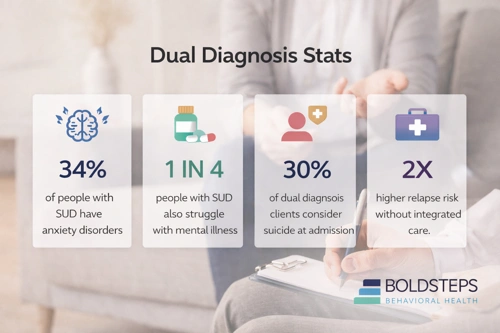
If you’re not familiar, dual diagnosis treatment is care that treats both mental health disorders and substance use disorders at the same time. For me, that looked like:
- Seeing a psychiatrist who didn’t just ask about my symptoms, but about my drinking, my sleep, and my emotional regulation.
- Working with a therapist who knew how trauma, depression, and alcohol tangled together in my life.
- Group therapy where other people weren’t shocked that I was both “high-functioning” and falling apart inside.
- Medication support that addressed both mental health symptoms and cravings—without shaming me for needing it.
No one made me choose between working on my anxiety or addressing my alcohol use. They saw how the two fed each other—and helped me interrupt the cycle.
And for the first time, I wasn’t just surviving the week. I was learning to live with myself instead of against myself.
Burnout Isn’t Failure. It’s a Signal.
Here’s the thing no one told me before I entered treatment: you can be burned out without ever having achieved anything “big.” You can be emotionally fried from carrying around trauma, unspoken fears, and the weight of pretending to be okay.
For me, the crash looked like this:
- Cancelling plans without explanation because I couldn’t fake it anymore.
- Drinking alone “just to sleep,” then waking up more anxious than ever.
- Constant exhaustion, even when I technically had nothing on my schedule.
- Feeling numb during things that used to bring joy—music, friendships, even food.
And the scariest part? None of it felt dramatic enough to call “rock bottom.” I thought I had to be worse off to deserve help.
But dual diagnosis care didn’t wait for me to collapse completely. It met me where I was. And slowly, piece by piece, it helped me remember that I was still in there. Underneath the exhaustion. Underneath the coping.
The First Changes Were Small—but They Mattered
I want to be clear: dual diagnosis treatment isn’t about fixing you. It’s about helping you understand yourself with enough clarity and compassion that healing becomes possible.
Here are some shifts I noticed during the first few weeks:
- I slept—not a full 8 hours, but a kind of sleep that didn’t leave me dreading the morning.
- I cried—in therapy, in the car, watching TV. But it felt real. And afterward, I could breathe.
- I laughed—at stupid things, at nothing. That surprised me the most.
- I stopped lying—about how I was doing, about how much I was drinking. That was harder, but it felt like freedom.
It wasn’t perfect. I had days I wanted to quit. Days I didn’t believe anything would help. But for the first time, I had support that didn’t make me choose between mental health and sobriety.
You Don’t Need to “Get Worse” Before You Get Help
One of the biggest myths that kept me stuck was thinking I hadn’t earned treatment yet. That I was too “functional,” too “not-addicted-enough,” too something.
Here’s what I wish someone had said to me sooner:
You don’t need to hit a dramatic bottom to deserve help.
If your life feels unsustainable, that’s enough.
You’re allowed to ask for support when you’re tired. When you’re numb. When you don’t know what else to do.
Dual diagnosis treatment was never about fixing my personality or making me someone else. It was about helping me reclaim the parts of me that had gone quiet from years of survival mode.
What Recovery Feels Like When You’re Emotionally Exhausted
Not every day is shiny. I’m not suddenly bursting with motivation or sunshine. But I have tools now. And more importantly, I have people.
I know how to name what’s going on in my head without spiraling. I know what makes me want to check out. And I know that when those days hit, I’m not alone.
That matters more than any milestone or sobriety chip. Because recovery—especially with dual diagnosis—isn’t just about not using. It’s about learning to live with the full complexity of who you are, gently, day by day.
If You’re in New Hampshire, Help Is Closer Than You Think
I know it can be hard to picture walking into a treatment center, especially if you’re not sure what’s wrong yet. But the team at Bold Steps Behavioral Health made that first step feel… human.
They don’t expect you to have it all figured out. They’re used to people arriving tired, unsure, or emotionally raw. And they offer dual diagnosis treatment that respects your whole story—not just your diagnosis.
Frequently Asked Questions About Dual Diagnosis Treatment
What is dual diagnosis treatment?
Dual diagnosis treatment is care designed for people who are experiencing both a substance use disorder and a mental health condition, like depression, anxiety, or PTSD. It treats both at the same time because they often interact in complex ways.
How is it different from regular addiction treatment?
Standard addiction treatment may focus mostly on substance use. Dual diagnosis care also addresses underlying or co-occurring mental health issues—like mood swings, trauma, or panic attacks—so you’re not just treating the symptom, but the full picture.
Do I need a diagnosis before I start?
No. You don’t have to come in with a label or perfect explanation. An experienced care team can help assess what’s going on and guide you toward the right support.
Can dual diagnosis treatment really help if I’ve tried therapy before?
Yes. Many people find that standard therapy isn’t enough when substance use is also in play. Dual diagnosis programs use therapists and clinicians trained specifically in integrated care—so they know how to support both sides of the struggle.
Ready to Start Somewhere?
You don’t have to be sure. You don’t have to be ready. You just have to be tired enough of being tired.
If you’re in New Hampshire and wondering if dual diagnosis treatment could help, reach out. The team at Bold Steps Behavioral Health is here to support you—with clarity, kindness, and care that sees your whole story.
Call (603)915-4223 to learn more about our dual diagnosis treatment services in New Hampshire.