

You followed the rules.
You made it to every session. You talked when you didn’t want to. You sat through the hard parts. You even started to believe that maybe—just maybe—this time would be different.
So why does it still feel like you’re falling apart?
This is one of the most common, most painful questions we hear from people after completing a partial hospitalization program, or PHP. That quiet, haunting question: Why am I still struggling?
Let’s talk about it—honestly, clearly, and without judgment.
PHP Is a Start—Not a Finish Line
A partial hospitalization program is a vital part of recovery.
It’s a place where things stabilize. Where your nervous system starts to feel safer. Where you gain tools and support and insight. But PHP is not a magic cure. It’s not meant to “fix” your entire mental health history in 6–8 weeks. That’s just not how healing works.
What PHP can do is stop the spiral. It gives structure, rhythm, support, and accountability when everything else feels unstable. It’s the scaffolding—not the whole house.
If you’ve walked out of PHP expecting a brand-new life, you’re not wrong to hope. But part of recovery is learning that hope has to stretch beyond the discharge date.
The Struggle After PHP Is More Common Than You Think
Let’s say it clearly: you are not the only one feeling this way.
Here’s what many former clients have said, weeks after completing PHP:
“I thought I was supposed to feel stronger.”
“I still wake up with dread. What did I do wrong?”
“Group helped. But now I’m back in the real world, and nothing’s changed.”
That last one is key. You can do amazing, real work inside treatment—but still feel overwhelmed when you step back into an environment that hasn’t shifted.
Especially if your job, home life, or relationships are still high-stress, high-conflict, or trauma-charged… of course you’re struggling.
That doesn’t make you weak. It makes you someone who’s still in it.
You’re Not Back at Zero—You’re Just in the Middle
Struggle after PHP doesn’t mean you’re starting over.
You’ve built things already:
- Tools to name what you’re feeling
- Skills to navigate conflict without exploding or folding
- Awareness of your triggers and patterns
- A list of things that helped (even if only slightly)
You’re not back at square one. You’re just in that frustrating middle place where you know what’s wrong but don’t feel better yet. That’s not a failure—it’s a transition.
Let’s Be Honest: Sometimes the Pain Gets Louder After Treatment
Why would that happen?
Because when you’re in crisis, your body protects you. It numbs. It disconnects. PHP helps you reconnect. That’s a gift—but it also means you start feeling more.
You might notice:
- Old memories surfacing
- Emotions that feel too big for your body
- Frustration that your coping skills don’t “work” right away
This isn’t backsliding. This is deeper work. It’s uncomfortable, but it’s real.
Treatment Doesn’t Always “Work” the Way We Think It Will
We want treatment to be clean, clear, and definitive. But real healing is messy.
You might not leave PHP feeling “better” in the way you hoped. You might leave feeling raw, unsteady, or disappointed. That doesn’t mean it failed.
Instead, ask:
- Am I more aware of my needs now?
- Do I feel a little less alone in what I’m going through?
- Did I show up and tell the truth, even once?
These are not small things. They’re signs that treatment worked in the ways it could, even if your pain didn’t disappear.
Success Stories Don’t All Sound the Same
Maybe you’re looking at people who left PHP and seem fine now. Good for them. But here’s the truth no one posts on social media:
“It took me three rounds of PHP before I stopped feeling like I was wasting everyone’s time. But round three? That one stuck. And I’m still here.”
– Former Client, 2023
Or:
“I didn’t realize PHP helped me until months later, when I made a choice I wouldn’t have made before. I stopped texting someone who always pulled me into a spiral. That was new.”
– Alumni, 2022
Healing often looks like nothing, until it doesn’t. Then one day, you realize you didn’t spiral. You didn’t isolate. You didn’t hurt yourself. You paused. You made a different choice. That’s the win.
Feeling This Way Doesn’t Mean You Wasted Your Time
It means you’re paying attention.
Struggling after treatment is painful. But it’s also a sign that you’re showing up to your life with your eyes open. That’s exhausting—but powerful.
Many of our clients across Merrimack County, Rockingham County, Hillsborough County, NH and Essex County, MA have said the same thing: “I thought I’d feel more fixed.”
What they often discover is this: you don’t need to be fixed. You need to be supported, seen, and given more time to grow.
So… What Should You Do Now?
Here’s what we recommend:
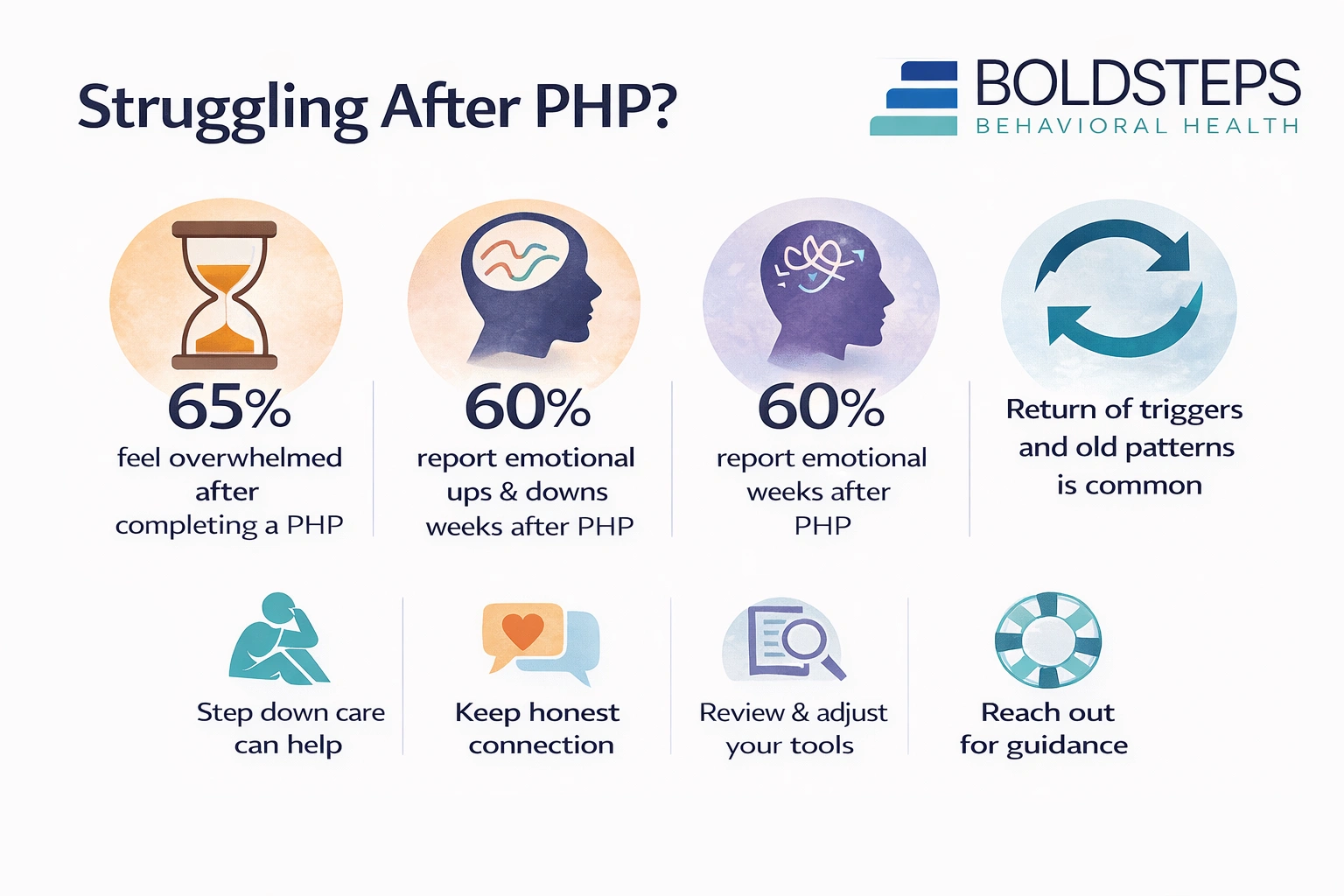
- Keep going. If PHP felt incomplete, consider a step-down to IOP (intensive outpatient). Less hours, but continued support.
- Stay connected. Isolation is tempting but dangerous. Whether it’s group, therapy, or even a friend who gets it—don’t vanish.
- Get curious. What parts of PHP helped? What felt unfinished? This is data—not shame.
- Reach out. You don’t have to figure out next steps alone. We’re here.
PHP isn’t the end of the story. It’s one chapter. You get to keep writing.
FAQ: Still Struggling After PHP? You’re Not Alone
Is it normal to feel worse after PHP?
Yes. You’re leaving a highly structured environment and re-entering daily life. That’s jarring. It takes time to adjust—and support helps.
How do I know if I need more treatment?
If symptoms are returning, if you’re isolating, or if old patterns are resurfacing, that’s a good reason to seek continued care—like IOP or weekly therapy.
Will people think I failed if I ask for more help?
Not at Bold Steps. We see continued treatment as a strength—not a weakness. The people who come back often go further.
What if I did everything right and still feel empty?
That’s grief talking—and it’s valid. You might be mourning the version of healing you hoped for. Talk about that with someone. It matters.
Is this just how I’m always going to feel?
No. It’s how you feel right now. And that deserves attention—but not prediction. Many clients feel stuck… until they don’t.
Still Carrying Heavy Feelings After PHP? You’re Not Alone.
You’re allowed to keep healing. You’re allowed to ask for more care. Call (603) 915-4223 or visit partial hospitalization program in Concord, NH to explore what ongoing support can look like at Bold Steps in Concord, NH.