

You walked out the doors of treatment with your head high. Or maybe just a little less low. Either way, you finished.
You sat through group when you didn’t want to. You opened up when it felt risky. You started taking your meds on time. You made progress. You found language for your pain.
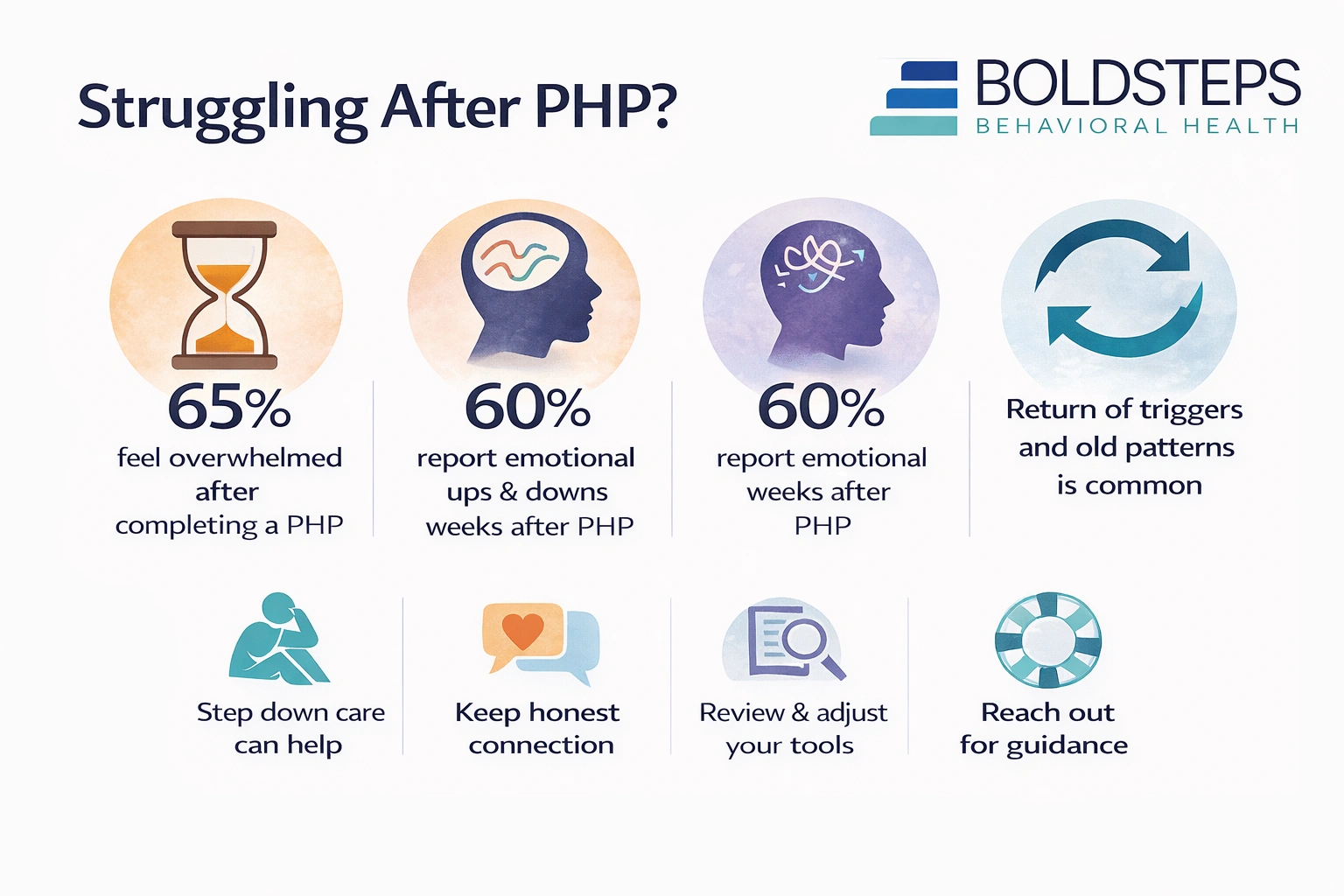
But now, some time has passed. Life has settled, routines are back—and yet, something feels… off. You’re not crashing. You’re not in crisis. But you’re also not thriving. You’re not where you expected to be.
If you’re feeling emotionally flat after completing depression treatment, you’re not alone. And you’re not failing.
This stage—quiet, low, directionless—is more common than you think. At Bold Steps Behavioral Health in Concord, NH, we work with long-term alumni who hit this wall. And we want to say, clearly: there’s nothing wrong with you.
This Is the Part No One Talks About
The in-between is real.
Most people think of mental health recovery as a mountain. You climb it, and eventually, you reach the top. Cue music. Roll credits.
But here’s what we see more often:
Recovery is a landscape with seasons. And one of those seasons—often after “graduation”—is a plateau. The crisis has passed. The coping skills are there. But the spark is missing.
You might feel:
- Unmotivated but not depressed “enough” to ask for help
- Emotionally distant from your people (and yourself)
- Like you should feel better than you actually do
- Unsure of what comes next, but too tired to figure it out
This isn’t regression. It’s recognition. You’re starting to notice that something deeper still needs care.
Depression Doesn’t Disappear—Even After Treatment
Completing depression treatment is a massive accomplishment. But it doesn’t erase your biology, your history, or your emotional patterns.
It gives you tools. It gives you structure. It helps stabilize you.
But depression isn’t just sadness. It’s often:
- Flattened affect (feeling disconnected from emotion)
- Low motivation (even for things you love)
- Difficulty feeling joy or purpose even when things “look good”
This is why follow-up care, re-entry support, and alumni engagement are so important. Because even when the symptoms return in smaller waves, you don’t have to handle them alone.
What If I Thought I’d Feel Better Than This?
Let’s be honest:
So many people finish treatment expecting clarity. A “new chapter.” The spark. The forward motion.
Instead, you get:
- An inbox full of emails you’re too tired to answer
- A messy apartment that feels like a metaphor
- Friends who mean well but don’t understand this kind of silence
That gap between what you thought you’d feel and what you actually feel? That’s grief. It’s real. It’s valid. And it’s worth exploring—not ignoring.
We talk a lot about hope during treatment. But after treatment, we need to talk about maintenance, doubt, disconnection, and what to do when motivation fades.
You’re Not Failing—You’re Facing the Next Layer
Here’s the thing:
The fact that you’re noticing this dip at all is a sign that the foundation you built is working. It means you’re not numb anymore. It means your awareness has grown.
At Bold Steps, we see this stage as an invitation—not a setback. It might mean:
- It’s time to revisit therapy with a new lens
- You need medication support or a dosage adjustment
- You’re ready to go deeper into emotional work, identity exploration, or trauma healing
This isn’t going backward. This is going further.
The Work You Did Still Matters—Even If You Don’t Feel It
Depression is sneaky. It whispers: “Nothing’s changed.” “You’re still the same.” “What was the point?”
That’s a lie.
What’s true is:
- You have coping skills now. You just might need to dust them off.
- You’ve navigated tough moments without spiraling all the way down.
- You’ve asked for help before. You can ask again.
Healing is not about intensity—it’s about continuity. If the flame feels dim right now, that doesn’t mean it’s out. It just means you need wind, not fire.
We Still Know You. And You’re Still Welcome Here.
One thing alumni often say is:
“I thought I couldn’t come back. I already got my help.”
or
“I didn’t want to take up space that someone else needs more.”
Let us be clear: you still matter here.
You’re not a burden. You’re not broken. You’re not taking up space that belongs to someone else.
Your story isn’t over—and neither is your relationship with care.
Whether it’s a check-in session, a short-term return to therapy, a support group, or even just a conversation with someone who remembers you, Bold Steps offers options for alumni across Rockingham County, Merrimack County, Essex County, MA and beyond.
Depression Treatment Isn’t a One-and-Done Experience
Most people need more than one round of care. That’s not a failure. That’s how healing works.
You might not need a full program again. But you might need:
- A therapy reboot—a few weeks to reconnect and reorient
- A psychiatric tune-up—medication changes, new symptoms, or better sleep support
- A spiritual or creative focus—help reconnecting with things that give life meaning
- A structured alumni group where you can talk with others in the same “flat” phase
Our job is to meet you where you are—not where you were, and not where you think you should be.
FAQ: Long-Term Recovery Questions We Hear Often
What if I’m not in crisis? Can I still come back?
Yes. You don’t need to be falling apart to deserve support. If you’re feeling disconnected, dull, or unsure, we welcome you back.
Is it normal to feel stuck after treatment?
Completely. This “stuck” feeling is often the beginning of deeper work. Many clients re-engage for exactly this reason.
Do I have to restart treatment from scratch?
Not at all. We offer alumni re-entry options, short-term refreshers, and ongoing outpatient care that picks up where you left off.
I’m embarrassed. What if people think I didn’t try hard enough?
You did. And this isn’t about effort—it’s about care. You’re human. Needing support again means you’re paying attention, not failing.
What if I don’t even know what I need right now?
That’s okay. Start with a call. We’ll help you figure it out together.
Still Feeling Stuck After Depression Treatment? Let’s Talk.
Motivation can fade. But the work you did still matters. Call (603) 915-4223 or visit Depression Treatment in Concord, New Hampshire to reconnect with Bold Steps Behavioral Health in Concord, NH—quietly, honestly, and on your own terms.