

There’s a space so many people live in—but rarely talk about. It’s not crisis. Not emergency. Not even a clear cry for help. It’s quieter than that.
It’s the space between despair and hope. Between “I want out” and “I’m still here.”
If you’re living in that space right now—if you’re feeling like life is too heavy but you don’t actually want to die—you’re not alone. And there’s nothing wrong with you.
Depression treatment in New Hampshire is designed for this very moment. Not just when things fall apart, but when you’re still holding on by a thread and wondering how much longer you can keep going.
When Suicidal Thoughts Don’t Mean You Want to Die
A lot of people think suicidal ideation means a plan, a note, an immediate emergency. But in reality, it can show up as something quieter:
- A wish to disappear.
- A fantasy about not waking up.
- A sense of emotional flatness that makes living feel more like enduring.
You might still be functioning—at work, with family, even laughing with friends. But inside, there’s a growing numbness. A steady hum of “I can’t keep doing this.”
This kind of suicidal ideation is often missed because it’s silent. But it matters. And it deserves care.
Depression Is a Slow Disconnection
Depression doesn’t always crash down like a storm. Sometimes, it’s more like a long fog rolling in.
You start feeling less connected to the things you used to care about. Your energy fades. Basic tasks feel monumental. You stop reaching out—not because you don’t want people, but because you don’t want to burden them.
Eventually, you might start thinking that maybe it wouldn’t matter if you weren’t here.
That’s not drama. That’s pain. And pain, untreated, gets heavier over time.
Depression Treatment Offers Room to Breathe
One of the hardest parts of depression is how isolating it becomes. You feel like you should be able to push through. That asking for help makes you weak. That others have it worse, so you should be fine.
But here’s the truth: You don’t have to earn support by falling apart.
Depression treatment gives you space to be honest—without performance, without pressure.
At Bold Steps New Hampshire, our depression treatment programs are designed for those who are still showing up but barely holding on. We provide:
- Individual therapy that helps you put words to what you’re feeling
- Safe spaces to explore suicidal thoughts without judgment or fear
- Medication support if you’re open to it—but never forced
- Clinicians who don’t panic when you say you’re not okay—they listen
Whether you’re in Merrimack County or Rockingham County, our team is here to walk with you—at your pace, not ours.
You Don’t Have to “Get Worse” to Get Help
So many people wait until they hit rock bottom before reaching out. But you don’t have to.
If you’re wondering whether you’re “sick enough” to deserve care, that’s your sign that you already do. Depression treatment isn’t just for people in crisis—it’s for anyone who’s hurting more than they can handle alone.
Getting help now—before things escalate—can be the thing that keeps you safe.
One Step Is Enough
You don’t have to feel hopeful to begin treatment. You don’t even have to believe it will work.
You just need to be willing to take one small step. That might mean calling a number. Sending a text. Clicking a link.
That first step doesn’t need to fix anything. It just needs to interrupt the weight of going it alone.
“I didn’t think I could be helped. I didn’t even know how to ask. But just saying ‘I’m not okay’ opened a door I didn’t know was there.”
— Outpatient Client, 2023
If You’re Suicidal But Don’t Want to Die
This is a hard place to be. You might feel ashamed, confused, or like no one would understand.
But we do.
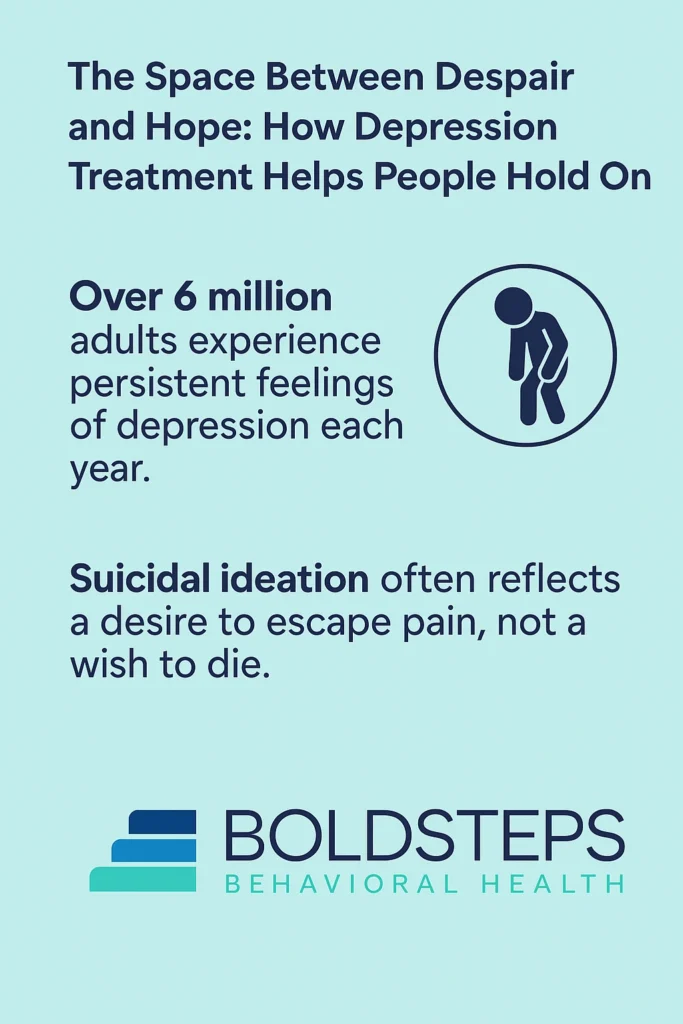
Being suicidal doesn’t always mean you want to end your life. Sometimes it means you’re longing for relief from the pain. You want the suffering to stop—but not your heartbeat.
Treatment can help make that distinction. It can help you start separating the depression from who you are.
Because who you are—right now—is still someone worth helping.
Looking for Depression Treatment in Hillsborough or Merrimack County?
If you’re in or around Concord, Merrimack County or Hillsborough County, Bold Steps offers depression treatment programs that are gentle, human, and stigma-free.
You don’t have to explain everything. You don’t have to be sure. You just have to show up.
Frequently Asked Questions
What if I’m not sure I really need help?
That’s okay. Most people feel uncertain at first. If daily life feels harder than it should—emotionally or physically—that’s enough of a reason to talk to someone.
I’m thinking about suicide, but I don’t want to die. Will you hospitalize me?
Not automatically. Suicidal thoughts are more common than most people realize, and we treat them with compassion—not alarm. Hospitalization is only used when there’s an immediate safety concern, and even then, it’s discussed openly with you.
What if I’ve tried therapy before and it didn’t work?
That’s valid. One approach doesn’t work for everyone. Our team focuses on building the kind of connection and trust that makes treatment feel safe and effective. We also offer different therapy styles depending on your needs.
Will I have to take medication?
Not unless you want to. Medication can be helpful for some, but it’s never forced. We’ll talk with you about your comfort level, and if you’re curious, we’ll explain your options without pressure.
How soon can I start?
You can start with a simple call or message today. We’ll walk you through the next steps and help you find care that fits your needs and schedule.
📞 You Don’t Have to Do This Alone
If you’re living in that in-between space—where it hurts to stay but you’re not ready to leave—help is here.
Call (603) 915-4223 or visit our depression treatment page to learn more about depression treatment in Concord, NH.
We’ll meet you where you are.