

There’s usually a moment right after.
The words are already out. The tone sharper than you meant. The look on someone’s face changes—just slightly, but enough that you feel it.
And then comes the weight of it.
Why did I say that?
Why does this keep happening?
If you’ve ever felt like your emotions take over in ways you don’t recognize—or don’t want—you’re not alone. And more importantly, this isn’t the real version of you. It’s what happens when your internal system gets overwhelmed.
For many people navigating this in Rockingham County, New Hampshire, these moments aren’t about a lack of care—they’re about intensity that doesn’t yet have a place to land safely.
It’s Not a Personality Flaw—It’s an Overloaded System
People often assume emotional outbursts mean something is wrong with their character. That they’re “too reactive,” “too sensitive,” or “too much.”
But that’s not what’s actually happening.
What’s happening is speed.
Your emotional brain moves faster than your thinking brain can keep up. By the time logic tries to step in, the reaction has already happened. Words come out. Tone escalates. And suddenly, you’re in a place you didn’t intend to go.
This isn’t a failure of who you are.
It’s a signal that your system needs support—not suppression.
Why the Regret Hits So Hard
The moment itself might pass quickly. But what comes after tends to linger.
You might replay conversations in your head, trying to figure out where things shifted. You might feel embarrassed, or even ashamed—not just of what you said, but of how easily it came out.
Sometimes it leads to pulling away from people you care about. Not because you don’t want connection—but because you’re afraid of hurting them again.
This is the quiet cost.
Not just conflict—but disconnection from others and from yourself.
The Hidden Fear: “If I Change This, Do I Lose Me?”
For a lot of people, especially those who feel things deeply, there’s a fear that doesn’t get said out loud.
If I learn to control this… do I become less myself?
Maybe your emotions are tied to your creativity.
Your humor.
Your honesty.
Your presence in a room.
There’s a worry that if you “tone it down,” you’ll lose something essential. That you’ll become flat, distant, or disconnected.
That fear makes sense.
Because no one wants to trade intensity for emptiness.
What Therapy Actually Helps You Do
The goal isn’t to take anything away from you.
It’s to give you space inside your experience.
Therapeutic approaches like dialectical behavior therapy focus on helping you notice what’s happening in real time—without judgment—and respond in a way that aligns with who you actually want to be.
Not a different person.
A more grounded version of you.
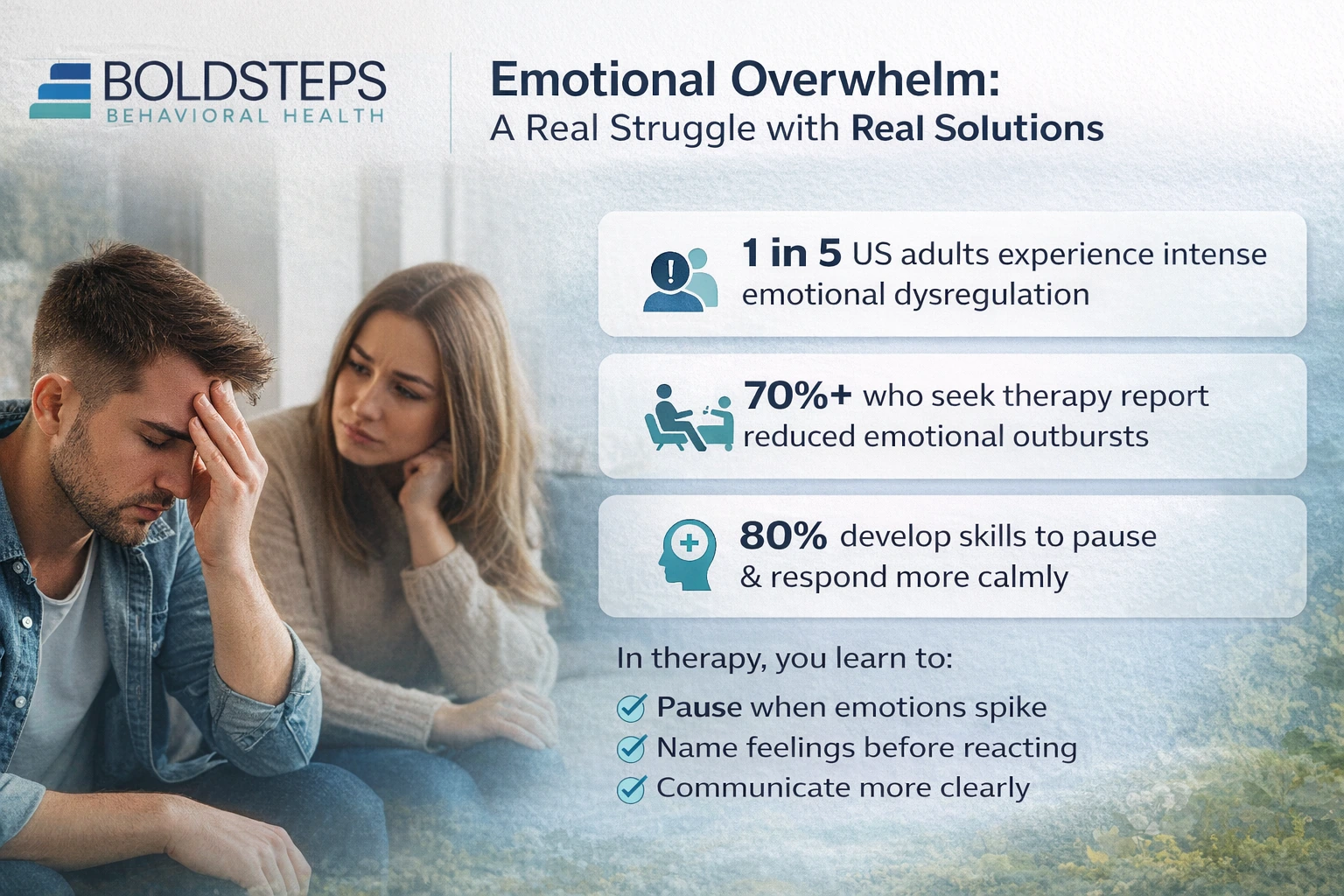
This is especially helpful for people who are trying to manage emotional outbursts adults often struggle to explain, because it focuses on skills—not labels.
Skills like:
- Pausing when emotions spike
- Naming what you’re feeling without acting on it immediately
- Communicating clearly instead of reactively
- Recovering more quickly when things do go off track
These are learnable. And they don’t erase your emotional depth—they support it.
The Power of the Pause
One of the most meaningful changes people describe isn’t dramatic.
It’s subtle.
It’s the moment where something could escalate—but doesn’t.
A breath.
A pause.
A split second where you recognize what’s happening internally before reacting externally.
That pause doesn’t make you less expressive.
It gives you choice.
Instead of:
- Saying the most hurtful version of what you feel
You might: - Say the truest version instead
Instead of:
- Escalating a situation
You might: - Step back long enough to respond differently
Over time, these small shifts build trust. Not just in your relationships—but in yourself.
You Don’t Have to Shut Down to Stay in Control
A common misconception is that emotional control means being calm all the time.
But real emotional regulation isn’t about shutting down.
It’s about staying present without losing yourself.
You can still:
- Feel deeply
- Care intensely
- Express honestly
But without the aftermath that leaves you questioning who you are.
For many people in Merrimack County, New Hampshire, this realization becomes a turning point. Not because everything suddenly becomes easy—but because it becomes possible.
Rebuilding Trust With Yourself
After repeated emotional outbursts, it’s common to lose confidence in yourself.
You might think:
- I can’t trust my reactions
- I always take things too far
- I’m going to mess this up again
Therapy works to rebuild that trust slowly.
Not by promising perfection.
But by helping you see progress.
Maybe you still feel the same intensity—but you express it differently.
Maybe you still get overwhelmed—but you recover faster.
That matters.
Because the goal isn’t to never struggle again.
It’s to know you can move through it without losing yourself in the process.
The Version of You That’s Already There
There’s a version of you that exists beneath the overwhelm.
The one who:
- Thinks before speaking
- Communicates clearly
- Feels deeply without causing harm
- Stays connected, even in difficult moments
That version isn’t something you have to become.
It’s something you come back to.
Therapy doesn’t replace who you are.
It removes the barriers that make it hard to access that version of yourself consistently.
You’re Allowed to Want Change Without Losing Identity
Wanting to handle your emotions differently doesn’t mean rejecting who you are.
It means you care enough about yourself—and your relationships—to grow.
That’s not weakness.
That’s awareness.
And awareness is where real change begins.
FAQs
Why do I say things I don’t mean during emotional moments?
When emotions spike, the brain shifts into a more reactive state. This makes it harder to access thoughtful, measured responses. You’re not choosing to hurt someone—your system is overwhelmed and trying to release pressure quickly.
Can people really change how they react emotionally?
Yes. Emotional responses can be reshaped over time with the right tools and support. It doesn’t happen overnight, but consistent practice builds awareness, which leads to different choices in the moment.
Does learning emotional regulation make you less expressive?
No. It actually helps you express yourself more clearly and effectively. Instead of reacting impulsively, you’re able to communicate what you truly feel in a way that others can understand.
What if I’ve been like this for years?
Patterns can feel permanent, but they’re not fixed. Even long-standing habits can shift with the right approach. The brain is capable of learning new responses at any stage of life.
How is this different from just “calming down”?
“Calming down” often implies suppressing emotions. Emotional regulation is different—it’s about understanding what you’re feeling, allowing it to exist, and choosing how to respond in a way that aligns with your values.
What kind of therapy helps with this?
Therapies that focus on emotional awareness and skill-building are especially effective. They help you recognize patterns, build coping strategies, and respond more intentionally in high-intensity moments.
If you’ve been carrying the weight of these moments—the things said too quickly, the reactions that don’t match who you want to be—you don’t have to figure it out alone.
Call (603)915-4223 or visit our therapy, dbt services to learn more about our Dialectical Behavior Therapy in Concord, New Hampshire.