

Most high-functioning clients don’t enter treatment dramatically.
There’s usually no cinematic collapse. No public meltdown. No obvious rock bottom.
More often, they walk into an assessment carrying a laptop bag, answering work emails in the parking lot, and quietly insisting:
“I don’t think I need that much help.”
And honestly, from the outside, they may look mostly okay.
They’re still employed.
Still parenting.
Still productive.
Still showing up.
That’s exactly why they’re so hard to identify sometimes.
A lot of high-functioning people become experts at surviving in visible ways while unraveling privately.
By the time they start exploring structured outpatient support, they’ve often spent months — sometimes years — trying to convince themselves their exhaustion isn’t serious enough to count.
High-Functioning People Usually Don’t Feel “Sick Enough”
This is one of the biggest emotional barriers clinicians see.
Many clients searching for help quietly compare themselves to extreme versions of addiction or mental health crises and conclude:
- “I’m not that bad.”
- “Other people need treatment more than I do.”
- “I still have my job.”
- “I’m still functioning.”
- “I can still hold things together.”
What they often miss is how expensive that “holding it together” has become internally.
Because functioning can hide a lot:
- Drinking every night after work
- Constant panic hidden behind productivity
- Depression disguised as burnout
- Emotional numbness masked by achievement
- Quiet dependence on substances to sleep, socialize, or calm down
- Secret exhaustion nobody else fully sees
Some people are surviving by sheer force of discipline.
And eventually, discipline stops being enough.
The Most Common Sentence We Hear Is: “I Can Manage This Myself”
High-functioning clients are often deeply capable people.
That capability becomes part of the problem.
They’ve solved things alone their whole lives:
- Careers
- Finances
- Family stress
- Emotional pain
- Relationship conflict
So when symptoms worsen, their instinct is usually:
“Work harder.”
“Push through.”
“Get more organized.”
“Hide it better.”
Not:
“Maybe I need more support.”
That mindset can delay treatment far longer than people realize.
Because many high-functioning individuals don’t wait until they’re struggling.
They wait until their coping system starts actively breaking down.
Sleep deteriorates.
Irritability increases.
Alcohol use escalates.
Relationships become strained.
Anxiety becomes physical.
The nervous system stays activated constantly.
And still, many continue saying:
“I’m fine.”
Not because they’re lying.
Because they genuinely don’t know where the line is anymore between coping and suffering.
The Decision Is Rarely About Pride Alone
People often assume resistance to treatment comes from denial.
Sometimes it does.
But high-functioning people are often very aware something is wrong. The deeper fear is usually about identity.
If you’ve spent your life being:
- Reliable
- Productive
- Independent
- The strong one
- The successful one
…then needing structured support can feel emotionally threatening.
Some clients hear “daytime care” and immediately imagine:
- Losing their professional identity
- Being judged
- Becoming “the sick person”
- Losing control over their life
- Confirming their worst fears about themselves
That fear runs deep.
Especially for people whose self-worth has become tightly tied to competence.
Choosing the Right Level of Support Is More Emotional Than People Expect
When clients compare IOP vs PHP, they often enter the conversation asking:
“Which one is lighter?”
But emotionally, what they’re really asking is:
“How much help am I allowed to need without feeling ashamed?”
That’s the real question underneath a lot of these decisions.
Because many high-functioning clients are not afraid of hard work.
They’re afraid of surrendering the image that they can still manage everything alone.
And honestly, some people choose less support than they truly need because it feels psychologically safer.
Not clinically safer.
Emotionally safer.
There’s a difference.
Some Clients Need More Structure Than Their Lifestyle Wants to Admit
This becomes especially clear with clients who are deeply depleted.
From the outside, they’re still functioning.
Internally, they’re hanging on by threads nobody else can see.
They may be:
- Drinking to shut their brain off nightly
- Having panic attacks privately
- Fantasizing about disappearing
- Feeling emotionally detached from their family
- Struggling to get through basic routines
- Unable to stop racing thoughts
- Losing motivation completely
- White-knuckling through every day
But because they still appear “successful,” they convince themselves they should be able to handle it independently.
That belief keeps many people under-supported for far too long.
Sometimes more structured daytime care provides enough stabilization for someone’s nervous system to finally stop operating in survival mode temporarily.
Other times, clients benefit from maintaining work and home responsibilities while attending several therapeutic sessions weekly.
The right fit depends on the severity of symptoms, emotional stability, coping ability, and safety — not appearances.
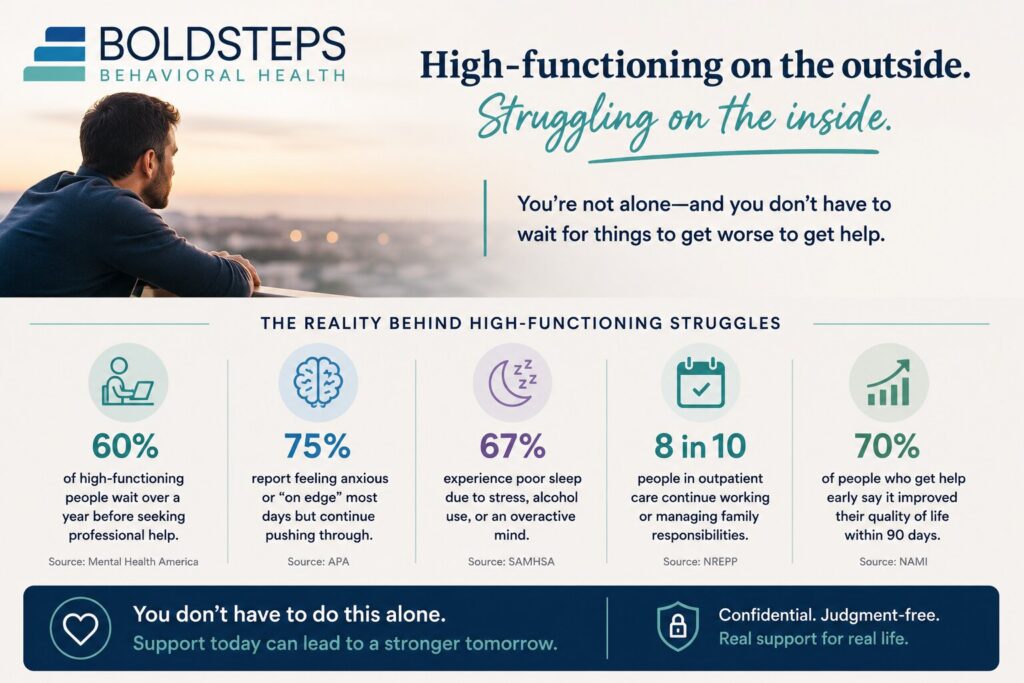
The “Least Disruptive” Option Isn’t Always the Best Option
This is hard for high-functioning people to hear sometimes.
Many clients initially search for the treatment option that interferes least with life.
That instinct makes sense.
They’re trying to preserve:
- Careers
- Income
- Parenting responsibilities
- Professional identity
- Routine
- Privacy
But choosing care based entirely on convenience can backfire if someone’s symptoms are already overwhelming their ability to cope safely.
Good clinical assessments look deeper than productivity.
Because some people are still functioning while their nervous system is essentially on fire internally.
The goal isn’t choosing the smallest amount of help possible.
The goal is choosing enough support to actually heal.
A Lot of High-Functioning Clients Are Addicted to “Holding It Together”
This is something clinicians notice often but clients rarely say aloud.
For some people, high-functioning behavior becomes its own survival mechanism.
Productivity creates temporary emotional safety.
Achievement creates temporary control.
Being needed creates temporary worth.
So slowing down feels terrifying.
Treatment asks people to stop performing stability long enough to honestly examine what’s happening underneath it all.
That can feel deeply uncomfortable.
Especially for people who built their entire identity around being “the responsible one.”
I’ve had clients say things like:
- “If I stop moving, I’ll fall apart.”
- “I don’t know who I am without work.”
- “I’m scared of how exhausted I actually am.”
- “I don’t know how much longer I can keep this pace up.”
Those statements matter.
A lot.
Because exhaustion hidden beneath high performance still deserves care.
Sometimes the Strongest Decision Is Letting Someone Else Help Carry the Weight
One of the biggest shifts high-functioning clients experience in treatment is realizing they no longer have to manage every emotion alone.
That realization sounds simple.
It isn’t.
For many people, receiving help feels far more vulnerable than enduring pain silently.
But eventually, there comes a moment where maintaining appearances becomes harder than telling the truth.
That truth may sound like:
- “I’m functioning, but barely.”
- “I’m tired all the time.”
- “I don’t feel like myself anymore.”
- “I can’t keep doing this forever.”
- “I need more support than I’ve been allowing myself to admit.”
Those moments are often turning points.
Not because someone suddenly became weak.
Because they finally stopped treating suffering like a personal performance test.
The Goal Isn’t Collapse Prevention Alone
A lot of high-functioning clients initially seek treatment simply to avoid completely falling apart.
That’s understandable.
But eventually, treatment becomes about more than crisis prevention.
It becomes about:
- Sleeping normally again
- Feeling emotionally present
- Reconnecting with relationships
- Reducing shame
- Learning healthier coping skills
- Feeling like life is sustainable again
- Existing without constant internal pressure
Many people don’t realize how much energy they’ve been spending simply trying to appear okay.
Until they finally stop.
And sometimes the first real sign of healing is not dramatic emotional breakthrough.
It’s relief.
FAQ: Choosing Between Different Levels of Outpatient Care
What’s the difference between more structured daytime care and weekly outpatient support?
Structured daytime care typically involves more hours of therapeutic support each week and is often recommended for people needing additional stabilization, accountability, or symptom management. Multi-day weekly treatment usually offers greater flexibility while still providing intensive therapeutic support.
How do I know if I need more support than standard therapy?
If symptoms are interfering with daily functioning, relationships, emotional stability, work performance, or safety, a higher level of support may help. Many high-functioning people wait longer than necessary because they’re still technically functioning.
Can you still work while attending treatment?
In many cases, yes. Some clients continue working while attending intensive outpatient care. Others temporarily reduce responsibilities to focus more fully on stabilization and healing.
Does needing structured care mean I’m “severe”?
Not necessarily. Level of care recommendations are based on support needs, symptom severity, coping stability, and safety — not personal worth or failure.
Why do high-functioning people delay treatment?
Many fear judgment, loss of identity, disruption to work, or admitting they need help. High-functioning individuals are often skilled at compensating for symptoms long after things become emotionally unsustainable.
Is it possible to be high-functioning and still struggling badly?
Absolutely. Many people maintain careers, relationships, and responsibilities while privately experiencing severe anxiety, depression, burnout, substance misuse, or emotional exhaustion.
How do clinicians determine the appropriate level of care?
Assessments usually consider factors like emotional stability, coping ability, substance use severity, safety concerns, mental health symptoms, daily functioning, support systems, and risk of worsening symptoms without intervention.
What if I’m afraid treatment will disrupt my life?
That fear is extremely common. The goal of treatment is not to destroy your life structure — it’s to help create one that becomes emotionally sustainable long-term.
Call (603)915-4223 or visit our intensive outpatient program services to learn more about our intensive outpatient program services in Hillsborough County, NH.