

So you stopped drinking. Or using. Or both. Maybe for a week. Maybe for a month. Maybe longer. Either way—you’re not the same, and neither is your world.
Suddenly everything feels… sharper. But also weirder. Your old routines don’t work anymore. Your friends don’t feel as close. You’re clear-headed, but also uncertain, a little bored, and maybe even a little lost.
Welcome to early recovery.
This is where a partial hospitalization program (PHP) makes a real difference. It’s not just about “getting help.” It’s about building skills—actual, useful, confidence-boosting tools you can take into real life.
At Bold Steps Behavioral Health in Concord, NH, our PHP meets you where you are: newly sober, maybe shaky, and ready to figure out how to live again—on your terms.
1. Identifying Triggers Without Freaking Out
Let’s be honest: it’s not always the big things that trip you up.
Sometimes it’s a song. Or scrolling Instagram. Or that one bar that’s on your walk home.
In PHP, we help you learn what your triggers are before they show up—and how to face them without shutting down. That might look like:
- Learning the difference between a trigger and a craving
- Understanding your patterns (emotional, physical, social)
- Practicing how to respond rather than react
Why does this matter? Because life doesn’t come with a “trigger warning.” But you can learn to handle it without collapsing.
2. Actually Saying What You Need (Without Apologizing)
Most people in early recovery are pretty bad at this. (That’s not shade—it’s just honest.)
PHP gives you the language and support to start identifying and expressing your needs in real time:
- “I don’t feel safe there.”
- “I need to leave early.”
- “I’m not ready for that conversation.”
These are things you might’ve never said out loud before. But once you do? Game changer. You start realizing your voice matters—and you don’t have to perform for anyone anymore.
3. Dealing with Emotions That Used to Mean “Go Drink”
Let’s talk about rage. Or shame. Or that weird combination of boredom + self-hate that creeps in at 3 p.m.
PHP doesn’t just teach you how to talk about emotions—it gives you tools to move through them.
We teach:
- How to feel the thing without becoming the thing
- How to stay present when everything in your body wants to run
- How to channel emotion into something other than self-destruction
Real talk: most people never learn this stuff. But you can. And it makes all the difference.
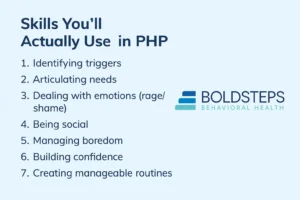
4. Learning How to Be Social Without Substances
This one is huge.
Being young and sober can feel like being dropped on a different planet. Parties? Dating? Hanging out? It all feels different.
In our Concord-based PHP, we talk honestly about:
- How to tell your friends you don’t drink
- How to survive your first sober party
- What to say when someone offers you a shot “just for fun”
No fake scripts. No “just say no” speeches. Just real tools, practice, and space to find what feels authentic to you.
5. Making Peace with Boredom (and Turning It Into Something Better)
One of the biggest triggers in early recovery? Boredom.
You might not even notice it at first. You just know you’re antsy. Agitated. Like your skin doesn’t quite fit. That’s often boredom + withdrawal + identity shift all at once.
In PHP, we don’t just hand you a list of hobbies. We help you:
- Notice your early boredom cues
- Experiment with different ways of engaging (movement, creativity, connection)
- Build sustainable routines that don’t rely on chaos to feel alive
Fun fact: boredom can actually be a sign your brain is healing. We’ll help you sit with it—without losing your mind.
6. Rebuilding Confidence After a Crash
Addiction shakes your self-trust. Even if you seemed high-functioning on the outside, there’s a part of you that wonders: Can I actually do this? Can I handle life without numbing out?
PHP is where that self-trust starts to rebuild. Slowly. Quietly. Day by day.
At Bold Steps, we celebrate wins like:
- Showing up on a day you wanted to hide
- Making it through a hard group without zoning out
- Telling the truth—even if your voice shakes
This isn’t about “fixing” you. It’s about reminding you that who you are now is already enough.
7. Building a Routine That Doesn’t Feel Like Prison
Structure matters—but so does flexibility. At Bold Steps, our PHP helps you design a recovery routine that actually works for you.
We explore:
- When to build in movement, rest, therapy, and work
- How to create rhythms that support your energy (not fight it)
- Ways to balance productivity with recovery
If sobriety feels like a punishment, we’re doing it wrong. PHP helps it feel like freedom—with training wheels.
What Makes PHP Different (And Why It Might Be Right for You)
A partial hospitalization program isn’t inpatient, but it’s more intensive than outpatient therapy. At Bold Steps, it usually means:
- 5 days a week, 6 hours a day
- A mix of individual therapy, group work, and skills training
- Help managing anxiety, depression, trauma, or co-occurring mental health issues
- Real-life recovery tools, not just “coping strategies”
And if you’re in Merrimack County, Rockingham County, Hillsborough County, or Essex County, MA we’re local, accessible, and familiar with the stressors you’re navigating.
FAQs About Partial Hospitalization Programs
What if I’m sober, but still feel like I’m falling apart?
That’s actually really common. Early sobriety often brings up stuff that was numbed out before. PHP helps you deal with that safely, without feeling overwhelmed or isolated.
Do I have to “hit bottom” to qualify for PHP?
Not at all. PHP is ideal for people who are sober (or trying to be), and need structure and support to stay that way. You can be high-functioning and still benefit deeply.
Will I lose my job or school schedule?
We’ll help you figure that out. Many of our clients work part-time, take classes in the evening, or shift schedules temporarily. It’s all about creating space to focus on recovery now—so the rest of your life feels possible later.
Is this like being in a hospital?
Nope. Despite the name, our PHP isn’t a hospital. It’s a calm, welcoming outpatient setting where you come for therapy and skills training, and go home at night. No gowns. No fluorescent lights.
What happens when PHP ends?
We help you step down to a less intensive level of care—like intensive outpatient (IOP) or weekly therapy. Recovery isn’t a cliff; it’s a staircase. And we walk it with you.
You’re Not Weird—You’re Brave
Being young and sober can feel isolating. But you’re not the only one. And you don’t have to figure it out alone.
Ready to build real-life recovery skills?
Call (603) 915-4223 to learn more about our partial hospitalization program services in Concord, NH. You’ve already done the hardest part—starting over. Now let’s make it stick.