

You didn’t think it would get this bad.
Maybe it was the call from school. Or the night you found them in their room, staring into nothing. Or the day they said the words no parent ever wants to hear: “I don’t want to be here anymore.”
Now you’re googling in the quiet of the house. You’re exhausted. Afraid. Wondering if you’re overreacting—or not reacting fast enough.
If someone has mentioned inpatient care or a partial hospitalization program (PHP) for your child or young adult, you might be asking yourself: What’s the difference? Which one do we need? And what if I make the wrong call?
Take a breath. You’re not alone. This blog will gently walk you through the differences—so you can make the next right step, not the perfect one.
Inpatient Care Is for Immediate Safety and Stabilization
Let’s start here—because this is where most crisis paths begin.
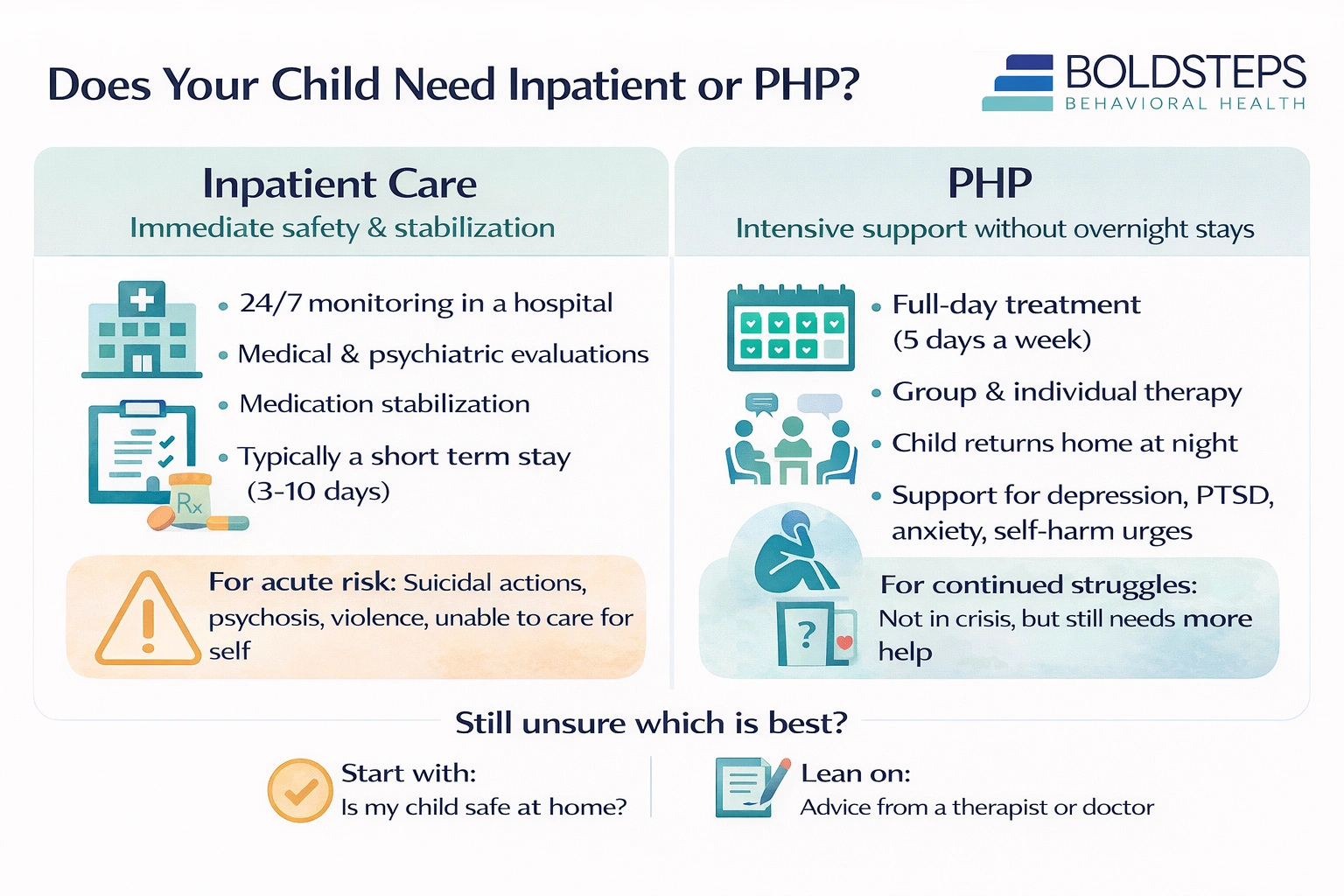
Inpatient care (also called psychiatric hospitalization or residential treatment) is designed for acute, life-threatening mental health emergencies.
It provides:
- 24/7 monitoring in a hospital or secure facility
- Medical and psychiatric evaluations
- Medication stabilization
- Crisis containment
- A short-term stay (typically 3–10 days)
This level of care is critical when a child or young adult is:
- Actively suicidal or engaging in self-harm
- Experiencing delusions or psychosis
- Violent or unable to safely care for themselves
- In immediate danger due to substance use or mental illness
It’s not about punishment. It’s about safety. It’s often the first stop when things reach a tipping point.
A Partial Hospitalization Program Offers Intensive Support—Without Overnight Stays
A partial hospitalization program, or PHP, is the next level down. It offers full-day treatment (usually 5 days per week), but your child returns home at night. PHP is a step up from weekly therapy and a step down from inpatient care.
At Bold Steps Behavioral Health in Concord, NH, our PHP includes:
- Individual and group therapy
- Psychiatric support and medication management
- Structured daily schedules
- Trauma-informed and skill-based care
- Support for depression, anxiety, PTSD, self-harm urges, and more
PHP is often the next step after inpatient, or an alternative to inpatient if your child isn’t actively at risk but still needs more help than outpatient therapy can provide.
How to Know Which Level of Care Your Child Needs
Here’s a simple—but powerful—question to ask yourself:
Is my child currently safe at home?
If the answer is no, and you’re seeing suicidal behavior, psychosis, extreme mood swings, or substance-induced risk—start with inpatient care. That’s not giving up. That’s giving your child the safest container for acute crisis.
If the answer is yes, but they’re still struggling daily to function, talk about their feelings, attend school, or maintain basic routines—PHP may be the right fit. Especially if traditional outpatient therapy isn’t making a dent.
You don’t have to make this decision alone. A therapist, pediatrician, or emergency evaluator can help assess what level of care is appropriate.
PHP Can Be Easier to Accept—Especially for Teens and Young Adults
Let’s be honest: most young people are scared of inpatient care. It feels like being locked away, especially if they’ve never experienced mental health treatment before. It can carry stigma, fear, or even shame.
A partial hospitalization program often feels gentler and more respectful. It allows them to:
- Sleep in their own bed at night
- Keep some connection to their normal routines
- Start treatment in a non-institutional setting
If you’re looking for a partial hospitalization program in Hillsborough County, NH, Bold Steps offers structured treatment with flexibility—especially helpful for college students or young adults trying to stay in their lives while stabilizing their mental health.
Inpatient Isn’t a Failure. PHP Isn’t a Shortcut.
Both levels of care can save a life.
They serve different roles, but neither one is “more serious” or “less real.” They’re both forms of intensive support. The difference is the level of risk—and the intensity of structure required to stabilize it.
Here’s what they share:
- Supervised access to mental health professionals
- Evidence-based treatment
- Support for parents and families
- A break from crisis-mode
You haven’t failed if your child needs inpatient. You haven’t failed if you choose PHP. What matters is that you’re taking action—and giving your child the support they need to find their footing.
What Happens After Inpatient or PHP?
This is one of the most important parts—aftercare planning.
Mental health care isn’t one-and-done. It unfolds in layers. That’s why Bold Steps focuses on continuity. Depending on how your child responds, we may recommend:
- Stepping down from inpatient to PHP
- Transitioning from PHP to IOP (intensive outpatient)
- Ongoing weekly therapy or psychiatry
- Family counseling to support home reintegration
This isn’t about forcing a path. It’s about building one that can adapt as your child’s needs change.
If you’re looking for a partial hospitalization program in Merrimack County, NH, we can help you start—whether your child is fresh out of inpatient, or this is your first time considering care.
FAQ: Parents Ask Us These Questions Every Week
What if I’m still not sure what my child needs?
That’s completely normal. Our team can walk you through an assessment and help guide you to the right level of care—without pressure.
Can I start with PHP if my child doesn’t feel safe at home?
If there’s an immediate safety risk (suicidal actions, psychosis, aggression), inpatient is usually recommended first. PHP works best when safety can be monitored at home.
How long does a partial hospitalization program last?
Most PHPs run for 3 to 6 weeks, depending on clinical need. It’s a short-term, high-intensity treatment designed to stabilize symptoms.
Will I be included in my child’s treatment?
Yes. At Bold Steps, we involve families in the process—offering education, counseling, and ongoing updates (with your child’s consent) to support a collaborative path forward.
What if my child refuses both PHP and inpatient care?
You’re not alone. Many young people resist help at first. We can provide resources, scripts for hard conversations, and support in navigating next steps, including legal options when safety is at stake.
You’re Doing More Than You Know—Even Now
If no one has said it lately: you’re doing an incredible job.
It doesn’t always feel like it. But the fact that you’re reading this means you’re already showing up for your child in one of the hardest moments of their life.
Treatment isn’t about perfection. It’s about presence. Staying in the room. Making the call. Asking the question. Letting professionals walk with you so you’re not carrying the weight alone.
Need Help Deciding Between Inpatient and PHP? You’re Not Alone.
Call (603) 915-4223 or visit partial hospitalization program in Concord, New Hampshire to talk with a team member who can help you explore options, explain next steps, and support your family—without judgment, without pressure.