

You don’t need to become someone else to heal.
If you’ve ever worried that sobriety or mental health treatment might take away your edge—your creativity, your humor, your social spark—you’re not alone. That fear is more common than people think. At Bold Steps Behavioral Health in Concord, NH, we’ve met artists, musicians, entrepreneurs, class clowns, caretakers, and natural-born storytellers who all quietly wondered:
What if recovery makes me disappear?
Our answer? It won’t.
You’re not too much. You’re not broken. You’re just tired—and that’s something we can help with.
You Don’t Have to Trade Identity for Stability
For a lot of people, intensity is identity. You feel deeply. You think fast. You care harder than most people around you. That kind of internal world is a gift, but when it goes unsupported, it can get overwhelming. And sometimes, substances or self-destructive patterns sneak in—not because you’re trying to ruin your life, but because you’ve been trying to keep up with it.
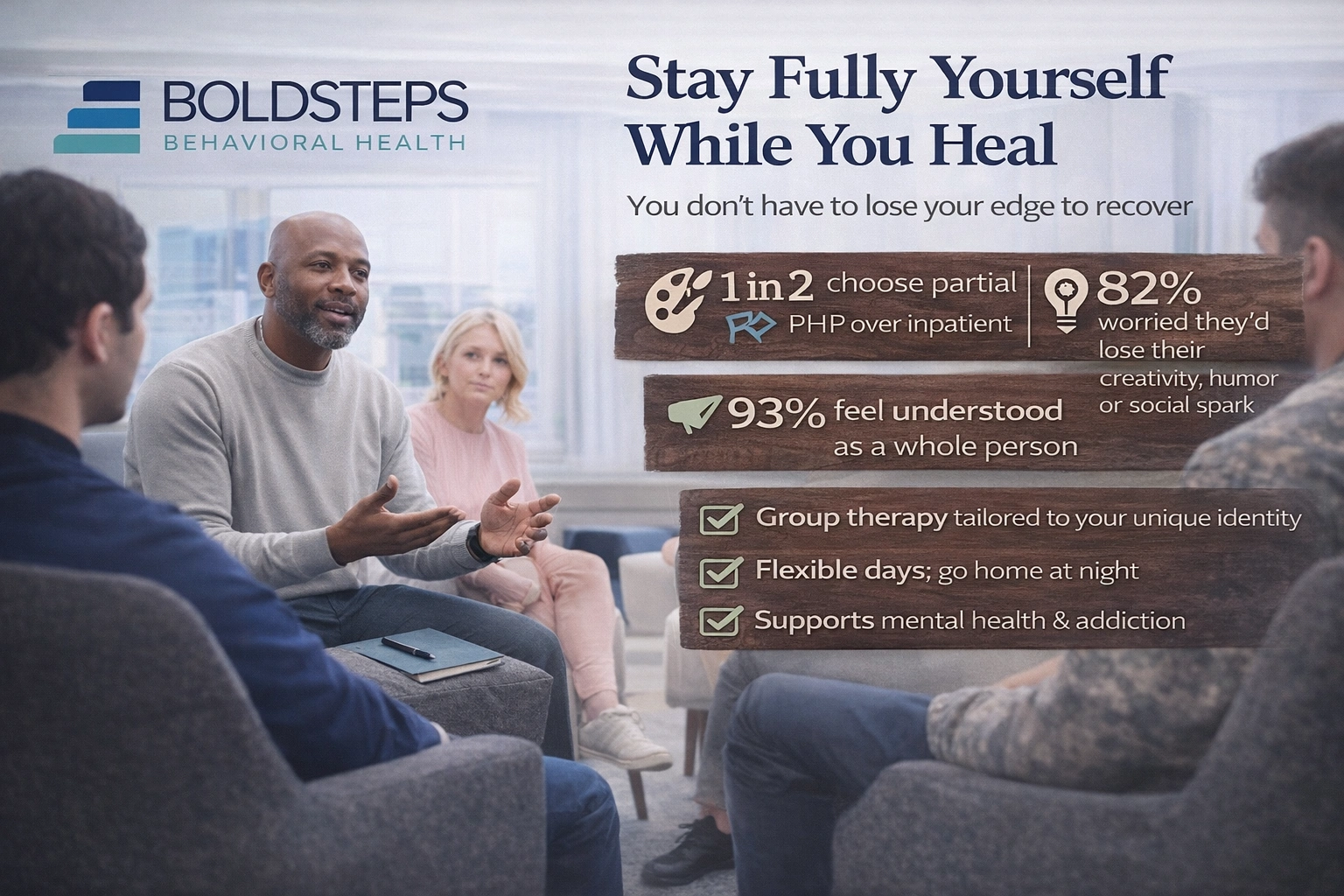
At Bold Steps, we don’t believe in flattening people for the sake of healing. Our partial hospitalization program (PHP) is built around the idea that people recover best when their strengths are honored—not erased.
Healing doesn’t mean becoming a blank slate. It means finally learning how to live with everything that makes you you—without it tearing you apart.
The Edge You’re Afraid to Lose Might Be the Part That’s Asking for Care
Let’s name the fear. Maybe your sense of humor only comes out after a few drinks. Maybe your writing flows better when you’re high. Maybe your charm, your energy, your ability to connect—feels tied to behaviors that you know, deep down, are hurting you.
That’s real. And terrifying. We’re not here to dismiss that.
But what if the edge you’re afraid to lose is actually just the surface version of something much deeper? Your creativity, your wit, your ability to feel—it doesn’t come from the substance. It comes from you. And when you have support, that part of you doesn’t go away. It gets clearer.
In our PHP, we help people reconnect with their own brilliance—without needing to burn themselves out or blur the edges to access it.
You Can Be Skeptical. We Still Want You Here.
A lot of clients walk through our doors not quite sure what they want. They don’t always identify with the word “addiction.” Some aren’t sure if they need treatment at all. But they know something isn’t working anymore.
They’re tired. Scattered. Overstimulated. Numb and too awake all at once.
That’s enough.
You don’t need to prove that you’re “bad enough” to need support. And you certainly don’t need to be ready to give up your whole identity to walk into treatment. Our partial hospitalization program meets people where they are—curious, scared, or even a little resistant. All of that is welcome.
What Is a Partial Hospitalization Program (PHP)?
A partial hospitalization program is a structured, intensive level of care for people who need more than weekly therapy—but don’t need 24/7 inpatient support.
It usually includes:
- Group therapy sessions focused on emotional processing and skill-building
- Individual therapy tailored to your needs and identity
- Psychiatric services to support stabilization and medication, if appropriate
- Life skills, mindfulness, and creative therapies (depending on the program)
- A consistent, supportive team who sees you as a whole person
The beauty of PHP is the balance. You get high-touch care during the day, and the freedom to go home at night. That rhythm supports emotional safety and real-life practice—without demanding total disconnection from your world.
If you’re in Merrimack County, Rockingham County, or Hillsborough County, our Concord-based program offers flexible, localized support rooted in the needs of our New Hampshire community.
Healing Can Feel Like Grief—That Doesn’t Mean It’s Wrong
Let’s talk honestly.
Sometimes in early recovery, you feel boring. Like the party left and forgot to invite you. Like your art dried up. Like your conversations lost their sparkle.
That’s grief. It’s not the truth.
Grieving the role a substance or a behavior played in your life—even if it caused harm—is normal. There’s no shame in missing what once felt like magic. But healing doesn’t mean giving up the magic. It means learning how to access it without a cost that’s too high.
We’ve seen people who thought their creativity was gone find it again—richer, sharper, deeper.
We’ve seen people rediscover their humor when it wasn’t tied to pain.
We’ve seen people reconnect with joy in a way that doesn’t burn them out.
That’s the kind of healing our PHP is built to support.
What If I Don’t Know Who I Am Without My Struggles?
That’s okay.
Many people feel like their personality has been shaped by their pain. And in some ways, that might be true. Survival does mold us. But healing doesn’t erase those parts. It just creates space for new ones to grow.
In PHP, you’ll explore your identity—not to replace it, but to expand it. You’re not starting from scratch. You’re building from strength.
And no, you don’t have to have it all figured out to begin.
FAQs About Our Partial Hospitalization Program
Is PHP only for people with addiction?
Not at all. Our program supports individuals dealing with substance use, mental health challenges, or both. Many clients are navigating depression, anxiety, trauma, or emotional overwhelm—not necessarily addiction.
Will I have to stop everything I love doing?
Not unless those things are actively hurting you. PHP isn’t about cutting joy out of your life—it’s about finding out what actually supports it. We work with you to set boundaries that feel aligned with who you want to be, not just who you’ve been.
What’s a typical day like in PHP?
Days usually include group sessions, one-on-one therapy, skills classes, and time to process. But it’s not rigid or robotic. We keep things human. There’s space for laughter, creativity, and honest conversations.
Can I still work or go to school while doing PHP?
Sometimes. PHP is typically a full-time commitment during the day (often 5–6 hours), but we work with clients to find a schedule that fits their needs and responsibilities.
Is this just a holding space before rehab?
Not at all. For many people, PHP is the treatment. It’s intensive enough to make meaningful change—but flexible enough to integrate with daily life. Some people start here. Others come after inpatient. Some never need higher levels of care.
What’s On the Other Side of Fear?
If you’ve made it this far, chances are part of you is curious.
Maybe you’re still unsure. Still skeptical. That’s okay. We’re not asking for certainty.
We’re asking for openness.
What would it feel like to be supported without being stifled? To be seen clearly and still accepted? To heal without losing your edge—but maybe finally learning how to wield it gently, powerfully, with more rest and less wreckage?
That’s what Bold Steps can offer.
Still you. Still here. Ready when you are.
Call (603) 915-4223 to learn more about our partial hospitalization program services in Concord, NH. We’ll meet you where you are—and help you stay fully yourself, just with less hurt.