

A few years ago, I found myself sitting in a parking lot after another appointment, staring at the steering wheel and feeling defeated.
Not because I had received bad news.
Because I was running out of explanations.
I had tried therapy.
I had tried cutting back on drinking.
I had made promises to myself more times than I could count.
And yet I kept ending up in the same place.
Depressed.
Drinking.
Starting over.
If you’ve been searching for programs that address depression and alcohol use at the same time, there’s a good chance you’re asking similar questions.
Maybe you’ve already tried getting help.
Maybe you’ve already been told to stop drinking.
Maybe you’ve already worked on your mental health.
And maybe you’re wondering why things still feel so difficult.
If that’s where you are, I want you to know something important.
Your experience is more common than you might think.
And it doesn’t automatically mean treatment failed.
Many people eventually discover that understanding when mental health and substance use collide changes the way they think about recovery altogether.
I Kept Treating One Problem While Ignoring the Other
For a long time, I was convinced alcohol was the entire issue.
If I could just stop drinking, everything would improve.
That seemed logical.
After all, drinking was creating problems.
It affected my sleep.
It affected my motivation.
It affected my relationships.
It affected how I felt physically.
So I focused on stopping.
And every time I managed to take alcohol out of the equation for a while, something uncomfortable happened.
The sadness remained.
The hopelessness remained.
The anxiety remained.
The lack of energy remained.
Without alcohol in the picture, I could no longer blame everything on drinking.
That realization forced me to look deeper.
For many people, alcohol isn’t the beginning of the story.
It’s part of the way they’ve learned to cope with a story that started much earlier.
Depression Doesn’t Always Look the Way People Expect
One reason so many people miss depression is because they are functioning.
They are going to work.
They are paying bills.
They are showing up for responsibilities.
From the outside, life appears normal.
Inside, however, it feels completely different.
Every task requires effort.
Simple decisions feel overwhelming.
Things that once brought joy feel flat.
The future feels smaller.
Many people assume depression means being unable to get out of bed.
Sometimes it does.
But many people with depression continue moving through life while carrying a tremendous amount of emotional weight.
They’re surviving.
They’re functioning.
They’re suffering.
And because they’re still functioning, they often convince themselves they don’t need help.
Drinking Can Become an Emotional Shortcut
I didn’t start drinking because I wanted to create more problems.
I drank because it seemed to solve one.
For a few hours, things felt quieter.
The stress eased.
The racing thoughts slowed down.
The emotional heaviness lifted.
That relief felt valuable.
The problem was that it never lasted.
The next day often felt worse than the day before.
The anxiety increased.
The guilt increased.
The depression deepened.
Then I wanted relief again.
So I repeated the cycle.
At first, alcohol felt like a solution.
Over time, it became part of the problem.
Many people don’t notice when that shift happens.
The transition is often gradual.
That’s one reason it can be difficult to see clearly from the inside.
The Cycle Is Stronger Than Most People Realize
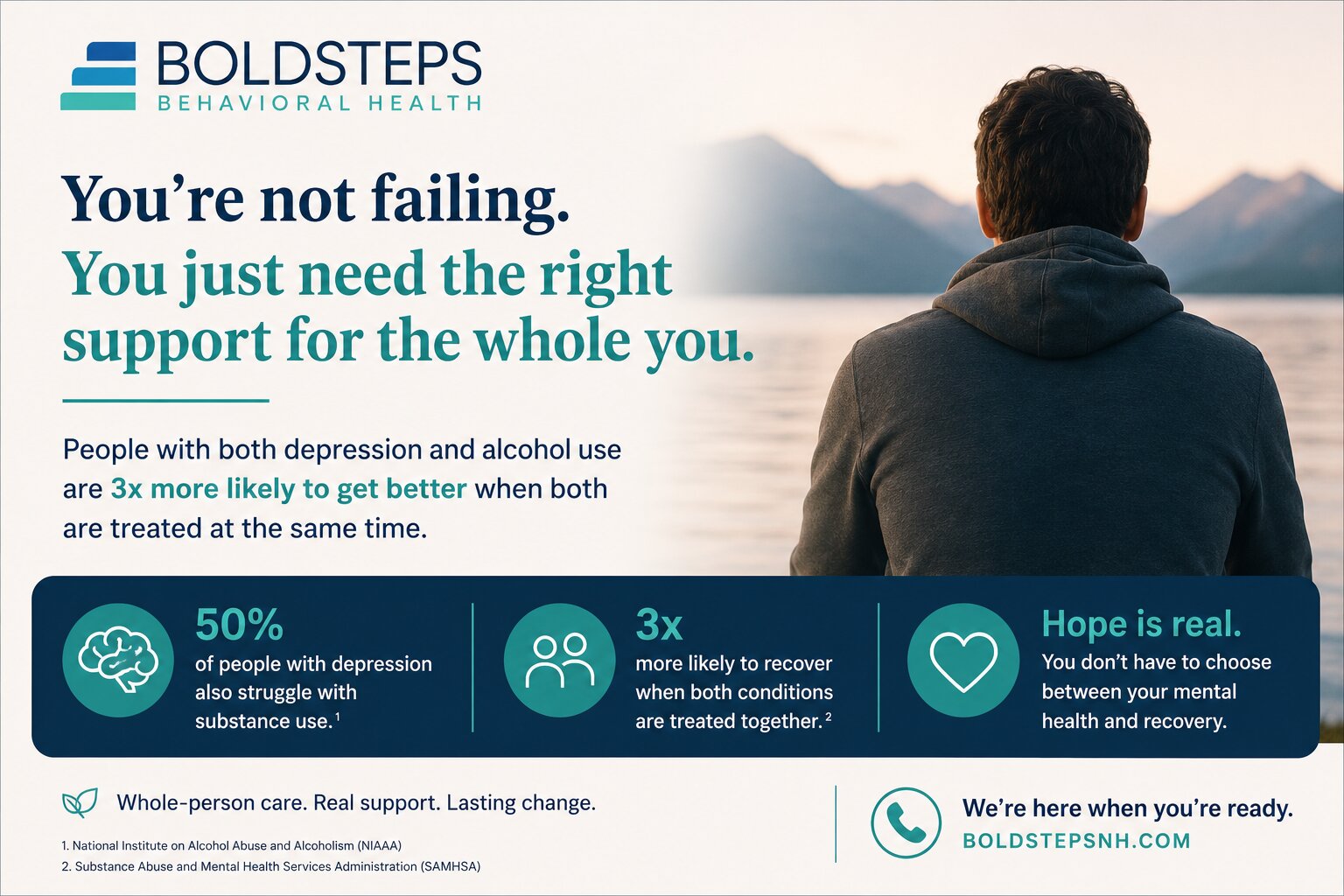
One of the biggest misconceptions about depression and drinking is that they are separate issues.
In reality, they often fuel each other.
Depression creates emotional pain.
Alcohol temporarily reduces that pain.
Alcohol then worsens mood, sleep, motivation, and emotional regulation.
Those effects contribute to more depression.
Which increases the desire to drink again.
It’s like two people standing back-to-back pushing against each other.
Each problem keeps the other standing.
That’s why focusing on only one issue sometimes feels frustrating.
You make progress in one area, but the other continues pulling you backward.
Why Previous Treatment May Have Felt Incomplete
For a long time, I told people treatment didn’t work.
Looking back, that wasn’t entirely true.
Some parts worked.
Some parts helped.
The problem was that I wasn’t always addressing everything that needed attention.
Sometimes I focused only on drinking.
Other times I focused only on depression.
But I rarely looked at both together.
Imagine trying to repair a car while only examining half the engine.
You might fix one component.
The vehicle might even run better temporarily.
But the underlying issue remains.
Many people who describe themselves as treatment skeptics aren’t actually skeptical because nothing helped.
They’re skeptical because the improvements didn’t last.
That’s a very different experience.
The Question That Changed My Perspective
A clinician once asked me a question that completely shifted how I viewed my situation.
She asked:
“When did you first start feeling depressed?”
I immediately started talking about drinking.
She stopped me.
Then she asked again.
“Before the drinking. When did the depression start?”
I sat quietly for a moment.
Then I realized the answer.
Years earlier.
Long before alcohol became a major part of my life.
That didn’t excuse the drinking.
It didn’t mean alcohol wasn’t causing harm.
But it helped me understand something important.
I wasn’t dealing with one problem disguised as two.
I was dealing with two problems that had become deeply connected.
That realization helped me stop blaming myself for not getting better faster.
Why People Often Feel Stuck
Many people searching for answers around Concord describe the same feeling.
Stuck.
Not in crisis.
Not thriving.
Just stuck.
They’re tired of repeating the same patterns.
Tired of feeling depressed.
Tired of using alcohol to cope.
Tired of promising themselves tomorrow will be different.
What often makes this especially frustrating is that these individuals are usually trying.
They’re reading articles.
They’re researching options.
They’re thinking about change.
The effort is there.
The results simply aren’t matching the effort.
When that happens, it may be worth stepping back and asking whether the entire picture is being addressed.
This is often why people begin searching for co-occurring disorders treatment Concord after realizing their emotional struggles and drinking patterns may be more connected than they initially believed.
You’re Probably Not Starting Over
One thing I wish someone had told me earlier is this:
You’re probably not starting from scratch.
If you’ve gone to therapy before, you learned something.
If you’ve stopped drinking before, you learned something.
If you’ve had setbacks, you learned something.
Even disappointing experiences provide information.
The problem is that many people only focus on what didn’t work.
They ignore everything they gained.
Recovery is rarely a straight line.
It’s more like assembling a puzzle.
Every experience adds another piece.
Sometimes the picture only becomes clear after enough pieces are collected.
Looking at Recovery Differently
Many treatment skeptics share one common belief.
They think recovery should feel obvious.
They assume that once the right solution is found, everything will suddenly click into place.
Sometimes progress is much quieter than that.
Progress might look like:
- Recognizing patterns sooner.
- Recovering more quickly from setbacks.
- Understanding triggers better.
- Feeling less shame.
- Asking for help sooner.
- Making healthier decisions more consistently.
Those changes may not feel dramatic.
But they often create the foundation for larger improvements later.
The Goal Isn’t Perfection
One reason people become discouraged is because they measure themselves against impossible standards.
They believe recovery means never struggling.
Never feeling depressed.
Never wanting a drink.
Never making mistakes.
Real life rarely works that way.
Most people who experience lasting improvement still have difficult days.
The difference is that difficult days no longer control their entire life.
They develop new ways to respond.
New ways to cope.
New ways to move forward.
That process takes time.
And that’s okay.
If You’re Skeptical, You’re Not Alone
If you’re reading this with doubts, I understand.
I had doubts too.
A lot of them.
You may wonder whether anything will actually help.
You may wonder whether you’ve already tried everything worth trying.
You may wonder whether things will ever feel different.
Those questions are understandable.
What matters is remembering that skepticism is not the same thing as hopelessness.
You don’t have to be fully convinced.
You don’t have to feel optimistic.
You only need enough curiosity to consider that there may be another explanation for why previous attempts haven’t worked the way you hoped.
For individuals seeking care in Merrimack County NH or looking for support throughout Areas We Serve, learning more about the relationship between emotional health and alcohol use can be a meaningful next step.
Sometimes the goal isn’t finding a completely new answer.
Sometimes it’s finally seeing the whole question.
Frequently Asked Questions
Can depression cause someone to drink more?
For many people, alcohol becomes a way to temporarily cope with sadness, emotional pain, stress, or hopelessness. While it may provide short-term relief, it often contributes to worsening symptoms over time.
Does drinking make depression worse?
Alcohol can affect sleep, mood regulation, energy levels, and brain chemistry. Many individuals notice that depression symptoms become more intense or more frequent when alcohol use increases.
Why didn’t previous treatment seem to work?
Sometimes only one part of the problem was being addressed. If emotional health concerns and alcohol use are influencing each other, focusing on one issue alone may leave important factors unresolved.
Is it common to struggle with both depression and drinking?
Yes. Many people experience both challenges at the same time. This is more common than many individuals realize and often contributes to feelings of frustration or confusion.
What if I’ve already tried therapy before?
Previous therapy experiences still matter. They can provide valuable insight into what was helpful, what wasn’t, and what additional support may be worth exploring.
How do I know if my drinking is connected to depression?
If alcohol is frequently used to manage sadness, stress, loneliness, anxiety, or emotional discomfort, there may be a connection worth exploring with a professional.
Is it normal to feel skeptical about treatment?
Absolutely. Many people seek help after previous disappointments. Feeling uncertain doesn’t mean you’re resistant to change—it often means you’ve been hurt by unmet expectations.
Call 603-915-4223 or visit our addiction and dual diagnosis services to learn more about our addiction, dual diagnosis services in New Hampshire.