

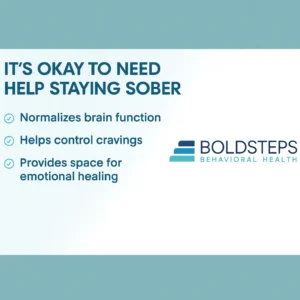
It’s Okay to Need Help Staying Sober
Early recovery is full of contradictions. You’re proud you stopped. But also scared you won’t be able to stay stopped. You finally made it out of the chaos, but now you feel… blank. Maybe even lonelier than when you were using.
That’s something most people don’t talk about enough: the ache of early sobriety.
At Bold Steps Behavioral Health in Concord, NH, we see that ache. We meet people in it every day. And one of the most powerful tools we offer for this fragile phase is medication-assisted treatment (MAT)—a science-backed way to support recovery from opioid addiction without shame or pressure.
If you’re feeling shaky, skeptical, or unsure if you’ll make it through another week sober, this might be the lifeline that helps you stay grounded.
What Is Medication-Assisted Treatment (MAT)?
MAT is the use of safe, carefully prescribed medications along with therapy and support to help treat opioid addiction.
It’s not a shortcut, and it’s not cheating. It’s a tool—a medically supported way to reduce cravings, prevent withdrawal symptoms, and stabilize your brain chemistry so you can focus on recovery.
There’s no magic fix for addiction, but MAT gives your body and mind the breathing room to start healing without being constantly hijacked by cravings or fear.
Why MAT Exists (and Why It Matters)
When you stop using opioids, your brain doesn’t just snap back into balance. It’s spent months—or years—dependent on external chemicals to function. Removing those suddenly can trigger overwhelming physical and emotional responses.
For many people, this is where relapse happens—not because they don’t care, but because their system is in panic mode.
MAT helps calm that storm. The medications used (like Suboxone, methadone, or naltrexone) don’t make you high. They help your brain normalize, reduce withdrawal, and allow space for real emotional work to begin.
At Bold Steps, we see MAT not as a crutch—but as scaffolding. It doesn’t do the building for you. It holds you up while you do the work.
Isn’t This Just Replacing One Drug With Another?
We hear this question a lot, and it makes sense. When you’ve worked hard to get clean, the idea of taking a daily medication might feel like a step backward. But here’s the truth:
MAT isn’t replacing one addiction with another. It’s treating the disease of addiction with the same respect we give other chronic conditions.
The medications used in MAT are tightly regulated, clinically proven, and carefully dosed. They don’t create a euphoric high. They stabilize the system, not sedate it.
Recovery isn’t about punishing yourself by doing things the hardest way possible. It’s about giving yourself every chance to succeed. And MAT is one of those chances.
What Does MAT Actually Do?
Here’s what medication-assisted treatment can help with:
- Reduces cravings: You’re not fighting every minute of every day just to stay clean.
- Prevents withdrawal: So you’re not sick, sweating, or stuck in a loop of trying to feel normal.
- Supports brain chemistry: Helping restore natural balance so you can feel like yourself again—slowly, but surely.
- Gives time to heal emotionally: You can focus on therapy, life skills, rebuilding relationships—not just survival.
When combined with a strong outpatient program, MAT becomes part of a full-spectrum opioid addiction treatment plan—and that’s what we offer here in Concord.
Do I Have to Be On MAT Forever?
Not at all. This is one of the most misunderstood parts of MAT.
You’re not signing up for a lifetime medication plan. You’re working with a care team to figure out what you need now, and how to taper or adjust later if that becomes the right next step.
At Bold Steps, we don’t do one-size-fits-all recovery. You’ll work with medical and therapeutic staff to find the right medication (if any), at the right dose, for the right amount of time.
Some people use MAT for a few months during high-risk periods. Others stay on longer and taper slowly. The goal isn’t to “get off everything.” The goal is to live well and stay sober.
What If I Feel Like I Should Just Be Stronger?
We hear this often—from people who are exhausted, ashamed, and scared to admit they’re struggling. There’s this voice in your head that says, “If I really wanted it, I wouldn’t need help.”
That voice is lying.
Recovery isn’t about proving how strong you are. It’s about finding what works. And sometimes, strength looks like letting go of the idea that suffering = success.
“I thought MAT meant I wasn’t doing it ‘right.’ But once I stopped listening to that voice and started listening to my body—I found some peace. I stopped obsessing every hour about whether I’d make it through the day.”
– Client, 2024
You don’t have to do this the hard way to deserve recovery. You already deserve it.
Is MAT Offered in Concord or Nearby Counties?
Yes. Bold Steps provides MAT as part of our outpatient opioid addiction treatment in Concord, NH—and we serve surrounding regions like:
Whether you live down the road or a few towns over, you can access care that meets you with kindness—not judgment.
Will MAT Show Up on a Drug Test?
No—not in the way that matters.
If you’re in treatment and using medications prescribed as part of your MAT plan, you’re not doing anything wrong. In fact, MAT is often a protected part of medical care and does not show up as misuse on treatment-based drug screens.
Our team helps you manage any paperwork or concerns—whether it’s for court, work, or another program—so you feel safe and supported.
Can I Start MAT If I Just Got Sober?
Yes. Early recovery is actually one of the most common and important times to begin MAT.
That early window—when your cravings are high, your system is dysregulated, and your life feels unrecognizable—is when MAT can offer the strongest safety net.
You don’t have to wait until you’re “barely holding on” to get support.
What If I Want to Try Recovery Without Medication First?
That’s okay, too.
MAT is not mandatory at Bold Steps. It’s an option—not a requirement.
Some people start recovery without it and add it later. Some try it immediately. Some never use it at all. You’re allowed to decide.
We’re here to explain your options, help you weigh them, and respect your choice—always.
What Happens If I Relapse While On MAT?
It doesn’t mean you’ve failed. It means you’re human—and something in your treatment plan may need to shift.
We don’t punish people for relapse. We help them return to care with dignity. MAT can actually reduce the severity of relapse and prevent overdose in many cases, depending on the medication used.
We’ll work with you to stay safe and supported—no matter what.
You Don’t Have to Do This Alone
Call (603) 915-4223 or visit our opioid addiction treatment program in Concord, NH to learn more about MAT and other supports available to you. We’re here for your questions, your fears, and your hope—no matter how small it feels right now.