

For a long time, I thought recovery had a finish line.
I thought eventually I’d wake up feeling fully healed. Fully grateful. Fully present. Like all the work I’d done would finally click into place and stay there permanently.
And to be fair, a lot did get better.
I stopped destroying my life. I rebuilt trust. I learned how to sit with hard emotions without imploding. I showed up consistently. I did the work people told me to do.
From the outside, things looked stable.
But internally, something still felt off.
Not dramatic. Not dangerous. Just… flat.
Like I had spent years fighting to survive, only to arrive somewhere emotionally quiet and strangely colorless. That scared me more than I expected because nobody really talks about this part out loud.
People talk about crisis.
People talk about early recovery.
People talk about relapse.
But very few people talk honestly about what happens after you’ve been “doing everything right” for a long time and still feel disconnected from yourself.
Eventually, that emotional plateau led me back toward cognitive behavioral therapy in a completely different way than before. Not because my life was falling apart again. Because I didn’t want to spend the rest of my life emotionally surviving on autopilot.
Stability and Fulfillment Are Not the Same Thing
This was hard for me to admit at first.
In early recovery, stability feels miraculous. You stop waking up in chaos. People trust you again. Your nervous system slowly settles down. You begin rebuilding basic routines and relationships.
That matters deeply.
But eventually, there comes a point where external stability no longer automatically creates internal peace.
You can be:
- Sober
- Responsible
- Productive
- Employed
- Reliable
- “High functioning”
…and still feel emotionally disconnected underneath it all.
That disconnect confused me because I thought emotional numbness meant I was failing somehow.
I kept thinking:
- “Why am I still struggling emotionally?”
- “Shouldn’t I feel happier by now?”
- “Why does everything still feel so heavy sometimes?”
The guilt made it worse.
Because when you’ve survived dark seasons, it can feel selfish to admit that simply surviving no longer feels like enough.
I Became Very Good at Looking Fine
That’s something I think a lot of long-term alumni understand quietly.
You learn how to function so well that even people close to you stop asking how you’re really doing.
And eventually, you stop asking yourself too.
I became efficient at life.
- Wake up.
- Work.
- Stay responsible.
- Keep commitments.
- Keep moving.
On paper, I was doing well.
But emotionally, I felt like someone standing in a perfectly clean apartment with no furniture inside. Everything looked stable, but nothing felt lived in anymore.
I think some people in long-term recovery become so focused on avoiding collapse that they accidentally stop pursuing connection, joy, creativity, or emotional depth altogether.
Not intentionally. Just gradually.
Like a dimmer switch turning down one click at a time until you barely notice how muted everything feels.
I Thought Feeling Stuck Meant I Was Ungrateful
This part matters because shame keeps people silent.
I knew people who never got another chance. I knew families still grieving losses. I knew how much damage addiction and mental health struggles could cause.
So when I started feeling emotionally flat, part of me immediately judged myself for it.
I’d think:
- “You should just be grateful.”
- “At least your life isn’t chaos anymore.”
- “Maybe this is just adulthood.”
- “Maybe expecting more is unrealistic.”
That mindset kept me stuck for longer than I realized.
Because underneath the numbness wasn’t entitlement.
It was exhaustion.
Years of hypervigilance. Years of monitoring myself constantly. Years of trying to stay safe emotionally.
My nervous system never fully learned how to relax. Even after life stabilized, part of me still lived like disaster was waiting around the corner.
CBT Helped Me See the Invisible Rules Running My Life
Before going back to therapy, I honestly thought I already understood my thinking patterns pretty well.
I was wrong.
CBT helped me notice how many silent rules had taken over my life without me realizing it.
Rules like:
- “Don’t be difficult.”
- “Keep functioning no matter what.”
- “If you slow down, everything will fall apart.”
- “Needing help again means you’re failing.”
- “You should be past this by now.”
None of those thoughts sounded extreme in my head at first. They just sounded normal.
That’s what made them powerful.
I wasn’t consciously choosing self-pressure every day. It had become automatic.
CBT helped me start slowing those thoughts down enough to question them instead of obeying them immediately.
And honestly, that process felt uncomfortable before it felt helpful.
Because once you start seeing your patterns clearly, you also start realizing how harshly you’ve been speaking to yourself for years.
The “Simple” Exercises Hit Harder Than I Expected
I’ll admit this openly: part of me rolled my eyes at some CBT exercises initially.
Writing thoughts down felt awkward. Structured reflections felt overly clinical. I thought I already “knew” what my problems were.
Then my therapist introduced a journaling exercise similar to a thought record worksheet, and something shifted.
Not dramatically.
Quietly.
The exercise forced me to slow down enough to actually trace my emotional reactions instead of just drowning inside them.
I started noticing patterns like:
- One bad day instantly becoming “I’m slipping.”
- Feeling emotionally tired becoming “I’m becoming weak again.”
- Conflict becoming “I ruin relationships.”
- Rest becoming “laziness.”
The speed of those mental jumps shocked me.
I realized my brain wasn’t responding to situations objectively. It was filtering everything through fear, self-surveillance, and old beliefs about worthiness.
That awareness alone changed things.
Because once you can see the pattern, it becomes harder to fully believe it automatically.
I Was Still Treating Myself Like a Crisis to Manage
That realization probably changed me the most.
Even years after stabilizing, I was still approaching myself like a potential disaster at all times.
Every emotion became something to monitor.
Every hard day became something to evaluate.
Every period of exhaustion became something to fear.
I wasn’t living with myself compassionately.
I was supervising myself constantly.
That’s exhausting.
And I think many long-term alumni quietly live this way without realizing how much energy it consumes.
You become both the employee and the security guard inside your own mind.
Always watching. Always checking. Always bracing.
CBT helped me start replacing self-surveillance with curiosity instead.
That sounds small, but emotionally it’s enormous.
Curiosity asks:
- “What’s happening here?”
- “What do I need?”
- “What story am I telling myself?”
- “Am I reacting to the present moment or an old fear?”
Self-surveillance only asks:
- “Am I failing?”
The Plateau Wasn’t Failure — It Was an Invitation
Looking back now, I don’t think the plateau meant recovery stopped working.
I think it meant I had reached the edge of one version of healing.
The tools that helped me survive early recovery were important. But eventually survival-mode coping strategies started limiting my emotional growth.
At some point, recovery has to become more than avoiding destruction.
It has to include:
- Connection
- Identity
- Creativity
- Rest
- Meaning
- Emotional honesty
- A sense of being fully alive again
And honestly? That next layer of healing can feel scarier than early recovery sometimes.
Because chaos at least gives you something obvious to fight.
Stillness forces you to actually meet yourself.
Therapy Felt Different the Second Time Around
The second time I approached therapy, I wasn’t looking for rescue.
I was looking for reconnection.
That changed everything.
The conversations became less about immediate survival and more about deeper patterns:
- Why do I tie my worth to productivity?
- Why does rest make me anxious?
- Why do I feel guilty having emotional needs?
- Why do I only feel valuable when I’m “doing well” externally?
Those questions hit deeper than I expected.
And slowly, life started feeling less mechanical.
Not perfect. Not constantly joyful. Just more emotionally real.
I laughed more naturally. I rested without panicking as much. I stopped treating every difficult emotion like an emergency.
The change was subtle at first.
Then one day I realized I no longer felt like I was holding my breath through my entire life.
You Don’t Have to Be Falling Apart to Deserve Help
I wish more people understood this part.
You do not need another crisis to justify support.
You do not need to relapse, implode, disappear, or completely burn out before reaching back toward therapy.
Sometimes people seek help because everything is collapsing.
Sometimes they seek help because they’re tired of feeling emotionally disconnected while appearing “fine” on the outside.
Both deserve care.
And honestly, there’s something incredibly brave about admitting:
“I survived. But I still want more from my life than survival.”
That sentence changed everything for me.
FAQ: Feeling Stuck in Long-Term Recovery
Is it normal to feel emotionally flat in long-term recovery?
Yes. Many people experience periods of emotional numbness, disconnection, or stagnation after the intensity of early recovery fades. Stability is important, but emotional fulfillment often requires deeper ongoing work.
Does feeling stuck mean recovery isn’t working?
Not necessarily. Sometimes it means you’ve outgrown old coping patterns and need a new level of emotional healing or self-understanding.
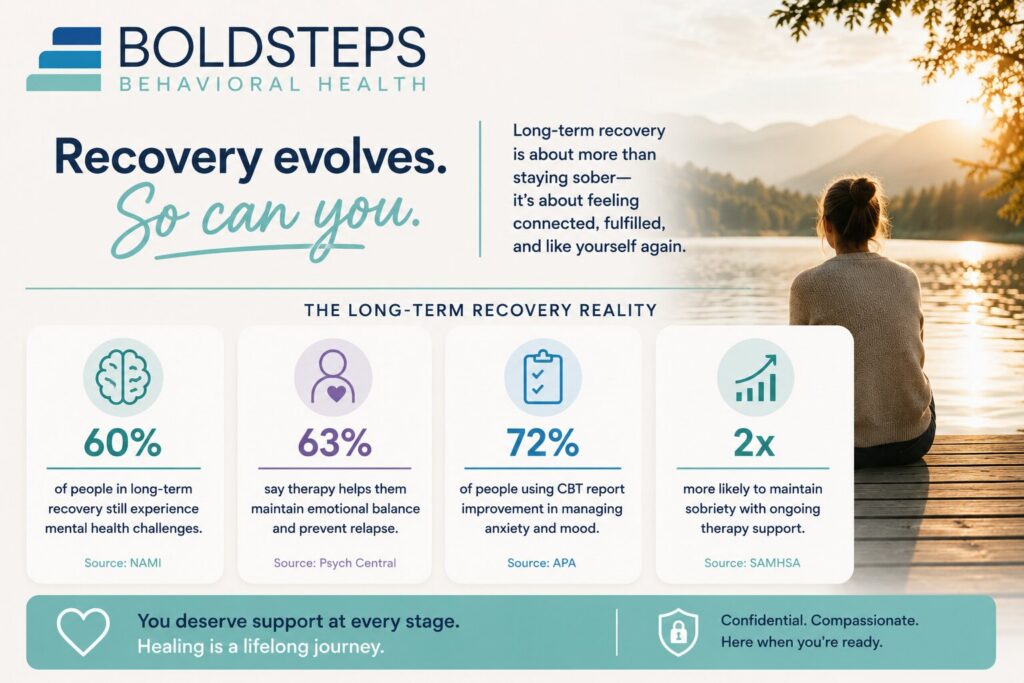
Can CBT still help years into recovery?
Absolutely. CBT is not only for crisis situations. Many long-term alumni use CBT to identify lingering thought patterns, perfectionism, anxiety, self-criticism, or emotional avoidance that continue affecting daily life.
Why do I feel guilty for struggling when my life is stable?
Many people compare their current struggles to past crises and feel they “should” be grateful all the time. But emotional pain does not become invalid simply because life looks better externally.
What is a thought record exercise used for?
Exercises similar to a thought record worksheet help people identify automatic thoughts, emotional reactions, and distorted thinking patterns. Many people find it useful for slowing down spiraling thoughts and building self-awareness.
Can therapy help if I’m not actively relapsing?
Yes. Therapy can support emotional growth, identity work, stress management, relationships, burnout, anxiety, and long-term mental wellness — not just crisis stabilization.
What if I feel disconnected but can’t explain why?
That’s more common than people realize. Emotional disconnection often develops gradually over time. Therapy can help uncover underlying beliefs, stress patterns, emotional avoidance, or unresolved fears contributing to that feeling.
Call (603)915-4223 or visit cbt services to learn more about our therapy, CBT services in Essex County, NH.