

If you’re here, you might not be in crisis—but something’s tugging at you. Maybe you’ve been feeling flat or distant lately. Maybe you’re starting to reevaluate your relationship with alcohol or other habits. Or maybe you’re just curious about what healing could look like—beyond survival mode.
Whatever brought you here, exploring depression treatment doesn’t mean something is wrong with you. It means you’re paying attention to yourself—and that’s a powerful thing.
At Bold Steps New Hampshire, we help people get clear on what support could look like—without pressure, labels, or assumptions. This blog is written for anyone who’s sober curious, mentally worn down, or quietly wondering: What if I don’t have to feel like this all the time?
Let’s walk through the different types of depression treatment—what they are, how they work, and how you can explore them at your own pace.
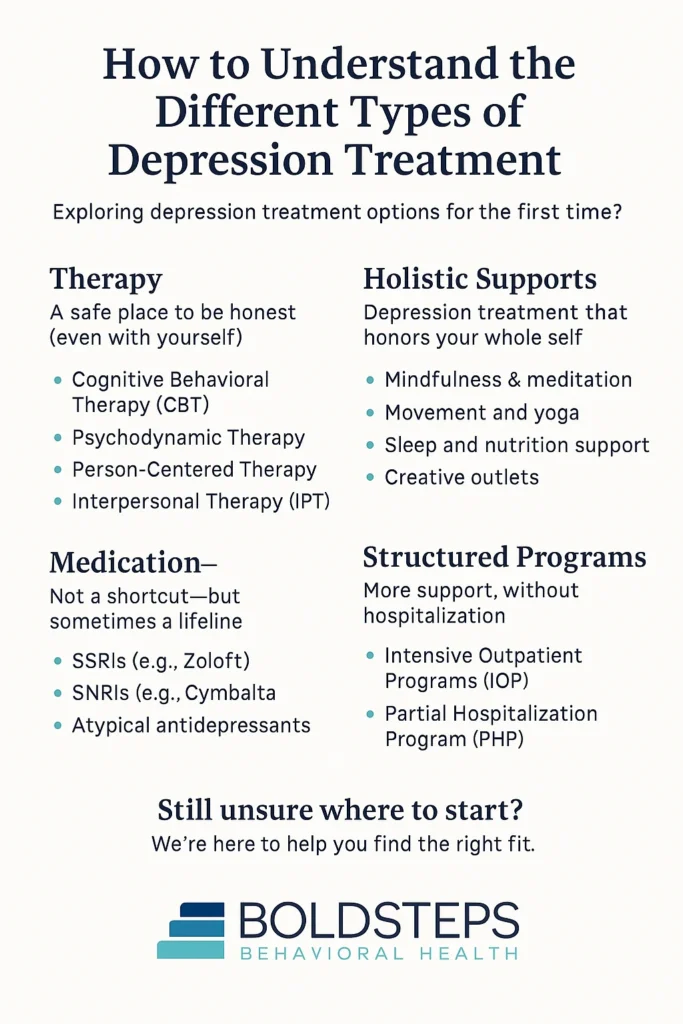
Therapy: A Safe Place to Be Honest (Even With Yourself)
If you’ve never tried therapy before, here’s the simplest way to think about it: Therapy is a space to stop pretending.
You don’t have to perform. You don’t have to fix everything at once. You get to speak the unspoken things—without someone trying to cheer you up, or tell you to “just think positive.”
Different types of therapy used in depression treatment include:
- Cognitive Behavioral Therapy (CBT): Focuses on shifting unhelpful thought patterns that feed depressive feelings.
- Psychodynamic Therapy: Explores deeper emotional wounds, often rooted in past experiences.
- Person-Centered Therapy: Offers radical acceptance and support, letting you lead the conversation at your own pace.
- Interpersonal Therapy (IPT): Helps you understand how relationships affect your mood—and vice versa.
At Bold Steps, we match clients with clinicians who listen carefully and adapt therapy to who you are—not just your symptoms.
Medication: Not a Shortcut—But Sometimes a Lifeline
Let’s be honest: a lot of people are nervous about antidepressants. Maybe you worry they’ll numb you. Or that taking them means you’ve “failed” somehow.
Here’s the truth: Medication isn’t about changing who you are. It’s about giving your brain a chance to work with you, not against you.
There are several types of antidepressants used in depression treatment:
- SSRIs (like Zoloft or Lexapro): Often first-line options with fewer side effects.
- SNRIs (like Effexor or Cymbalta): Target both serotonin and norepinephrine.
- Atypical antidepressants: May be used if others haven’t worked or caused side effects.
At Bold Steps, medication is always optional—and always discussed in a collaborative way. You’re in control. We’re here to offer clarity, not push pills.
Holistic Supports: Depression Treatment That Honors Your Whole Self
Sometimes, healing starts outside the therapy office.
Holistic depression treatment includes approaches that support your body, emotions, and nervous system—all the things that often get overlooked.
These can include:
- Mindfulness and meditation for grounding and emotional regulation
- Movement and yoga to release tension and reconnect to your body
- Sleep and nutrition support to stabilize mood naturally
- Creative outlets like journaling or art therapy
Especially for those in Concord, Rockingham, or Merrimack County, NH, these supports can be integrated into daily life and used alongside other forms of treatment.
Holistic doesn’t mean “soft”—it means complete.
Group Therapy and Peer Spaces: Because You’re Not the Only One
If individual therapy feels intimidating, or if you’re craving connection, group therapy might be a surprisingly powerful step.
Group depression treatment can include:
- Process groups for shared emotional expression
- Skill-building groups (like DBT or CBT groups)
- Peer-led or support groups that offer solidarity and belonging
Being in a room—or a Zoom—with others who’ve felt like you can shrink shame instantly. You don’t have to speak if you’re not ready. Just being there can start to shift things.
For residents of Hillsborough County, NH, we offer hybrid and in-person groups that meet people exactly where they are.
Structured Programs: More Support, Without Hospitalization
If your depression is getting in the way of daily life—but you’re not in crisis—you may benefit from Intensive Outpatient Programs (IOP) or Partial Hospitalization Programs (PHP).
These programs offer:
- Multiple therapy sessions per week
- Psychiatric support and medication management
- Group therapy, holistic services, and case management
You’re able to maintain your independence while receiving consistent, meaningful care. Many of our sober curious clients find IOP helpful because it supports both emotional clarity and behavioral shifts—without forcing a full break from life.
Finding the Right Fit: You Don’t Have to Know Exactly What You Need
Still unsure what kind of depression treatment is right for you?
That’s normal.
Here’s what we recommend:
- Start where you are. Pick the option that feels most accessible—not the one that feels “most serious.”
- Talk to a real human. A consultation with a mental health professional (like the ones at Bold Steps) can help clarify next steps.
- Stay open. You’re allowed to try something, pause, or switch directions. Healing isn’t linear—and it doesn’t have to be perfect.
Whether you’re just curious or ready to talk, there’s no wrong starting point.
Frequently Asked Questions About Depression Treatment
How do I know if I need depression treatment?
If you’ve been feeling persistently down, numb, disconnected, or exhausted—and it’s starting to affect your relationships, work, or sense of self—it may be time to explore support. You don’t need to wait for a breakdown to deserve help.
Will I have to take medication?
Not at all. Medication is one option, not a requirement. At Bold Steps, we help you explore all your options and make choices based on your values, not pressure.
Can I get help even if I’m not officially diagnosed?
Yes. You don’t need a diagnosis to begin therapy or access support. In fact, many people come to us simply feeling “off” or emotionally stuck. We meet you there.
What if I’m already in recovery from substances?
That’s great context to bring. Many of our clients are exploring sobriety or already in recovery. Our team understands how depression and substance use can overlap, and we can tailor your treatment accordingly—without judgment or assumptions.
Is this private? Will my job or family find out?
Your privacy matters. All treatment at Bold Steps is confidential under HIPAA. We don’t share information with employers or family unless you give written permission.
Wondering What Depression Treatment Could Look Like for You?
You don’t have to be sure. You just have to be curious.
Call us at (603) 915-4223 or visit our Concord, NH Depression Treatment page to learn more. Whether you’re looking for therapy, holistic care, or just a place to talk—we’re here to help.