

Some days, showing up feels possible. You’re in it. You talk. Maybe you even feel a flicker of hope.
Other days, your motivation evaporates. You feel numb. Ashamed. Overwhelmed. You cancel one session… then two… and before you know it, responding to texts feels too heavy.
You might think: Did I ruin everything? Am I even allowed back?
Let us be clear: our intensive outpatient program is still for you.
It was always for you. Especially on the days when you can’t hold motivation together but still care, even quietly. This blog is for the people who try, fall off, and try again. The ones who ghost and reappear. The ones still figuring out how to keep going.
1. Forget “Ready” — Just Come Back
Motivation isn’t the foundation of recovery. Presence is.
If you’re waiting to feel inspired, ready, or confident before you return to treatment, you might wait forever. That’s not weakness—it’s human. But the truth is simple:
Recovery isn’t about perfect strength.
It’s about showing up when you don’t feel like it.
Whether it’s been a few days or a few weeks, the door is still open. You don’t need a long explanation. You don’t need to start from scratch. You just need to take one step toward coming back.
2. Use the Structure, Even When It’s Hard
An intensive outpatient program isn’t a performance. It’s a framework that exists for real-life people with real-life inconsistency.
Think of IOP like an emotional gym:
- Some days you feel strong.
- Other days you drag yourself in.
- Both days count.
Whether you’re engaged, distracted, or silent, the structure still holds you. And over time, that structure helps you build something more stable than motivation: habit, awareness, and self-trust.
3. Name the Ghosting Without Shame
Shame thrives in silence. It says:
- “You blew it again.”
- “They’re tired of you.”
- “You shouldn’t come back unless you’re going to do it perfectly.”
That’s false. Here’s what you can say instead:
“I got overwhelmed. I want to try again.”
That’s enough.
You don’t have to explain every missed session. You don’t have to earn your way back. We care more about your next step than about your last one.
4. Work With the Program, Not Against It
If you’re skipping sessions because of schedule conflicts, family stress, or emotional burnout—talk to us.
We can help you adjust your treatment without stepping away entirely. That might mean:
- Changing session times
- Reducing the number of weekly commitments temporarily
- Adding supportive check-ins
- Reworking goals so they feel more doable
You don’t have to choose between “all in” and “completely gone.” We’re flexible, and your care plan should be too.
This applies to clients we support through our New Hampshire center—as well as those attending intensive outpatient care through our services in Essex County, MA. Wherever you’re showing up from, we’ll meet you with options, not ultimatums.
5. Treat Every Return as Progress—Not a Reset
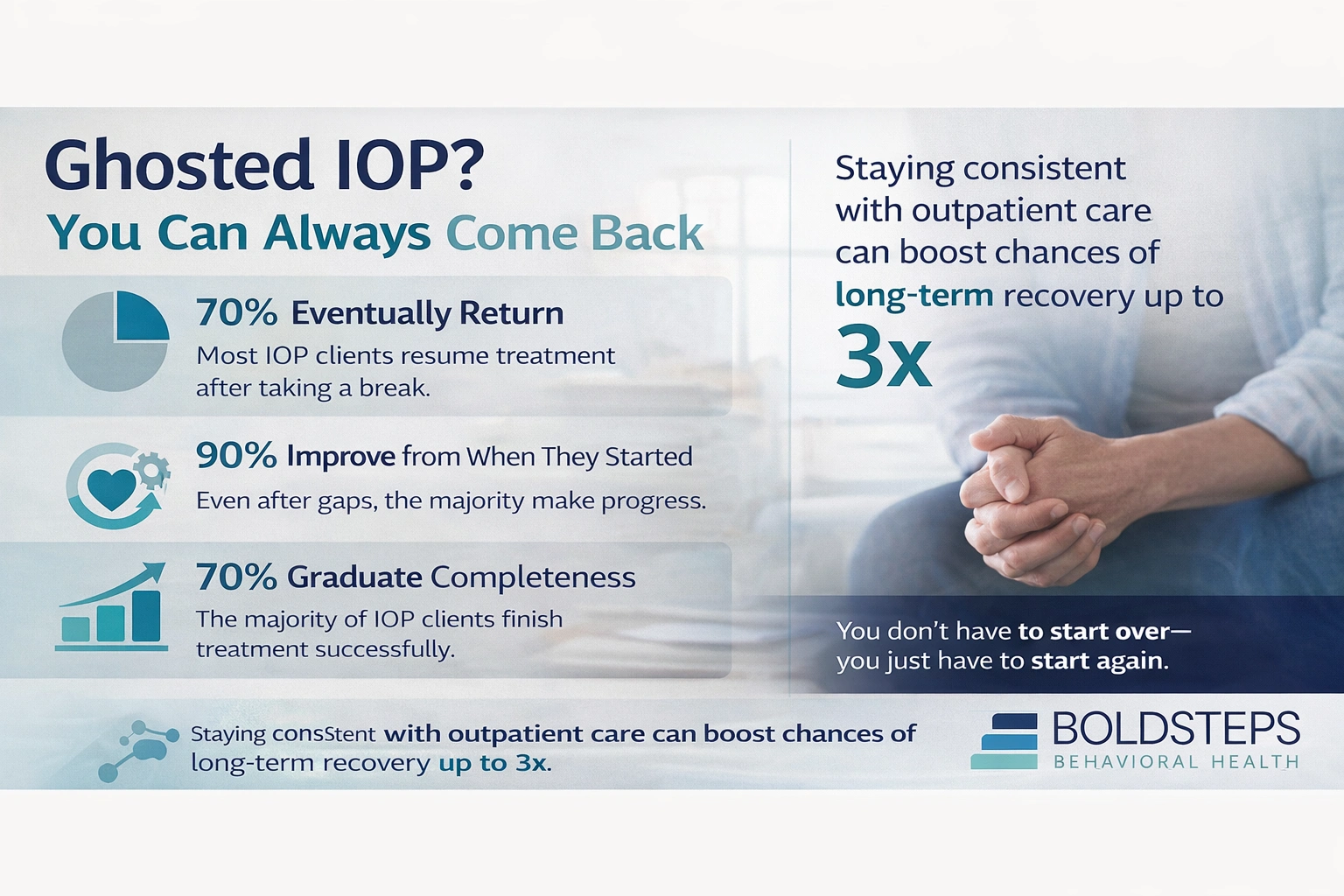
You didn’t go back to zero. You’re not starting over. You’re continuing.
Every attempt to re-engage with care is part of the work. Even if you’ve left before. Even if you relapsed. Even if you’ve said “this time will be different” more times than you can count.
Recovery isn’t a perfect line forward. It’s a series of pivots. And people who return after falling off? They’re not failures. They’re building resilience.
That counts.
6. Let IOP Carry You on the Days You Can’t Carry Yourself
Some days, you won’t have it in you to try hard. That’s okay.
IOP is designed to be the scaffolding on the days you can’t hold everything together. It’s where:
- You don’t have to fake it
- You don’t have to impress anyone
- You can show up tired, angry, or shut down—and still be supported
Healing doesn’t only happen when you’re at your best. Some of the most important shifts happen when you sit in the room even though everything in you wanted to stay home.
In Harrisburg, we see clients walk back into the program unsure if they belong. Our answer is always the same: yes. Yes, you do.
7. Know That This Is Expected—And Still Worth It
You’re not the exception. You’re not the only one who disappeared mid-treatment.
So many people struggle with staying consistent. That’s why IOP is designed for reentry. Not just entry.
We don’t expect perfection. We expect people. You can come back messy, uncertain, unmotivated, or shaky. That’s not failure—that’s honesty.
If you’ve left, you’re not off the path. You’re just paused. And you can rejoin it at any point.
FAQ: Returning to IOP After Ghosting or Dropping Out
Can I return to IOP after dropping out?
Yes. Whether it’s been days or months, you’re welcome back. There’s no reset button and no shame protocol. We’ll help you reengage at your own pace.
What if I left because I relapsed?
Relapse is not disqualification—it’s part of many recovery stories. IOP can help you process what happened and re-center your next steps with support.
Will I have to explain why I left?
Only if you want to. A simple “I’d like to return” is enough. We don’t need an apology—we need your presence.
What if I’m not sure I’ll stay consistent?
That’s okay. We’ll work with you to make the program more manageable. Your uncertainty doesn’t disqualify you—it makes you human.
You Can Always Come Back—Even Now
At Bold Steps Behavioral Health, our intensive outpatient program isn’t just for people with perfect progress. It’s for people learning to return—again and again—without shame.
Whether you’re reconnecting with care through our New Hampshire location or finding your footing again in Merrimack County, NH, the door is open. We don’t expect straight lines. We expect you—as you are.
Call (603)915-4223 to learn more about our intensive outpatient program services in New Hampshire and beyond.
You don’t have to start over. You just have to start again.