

I didn’t consider myself depressed.
I was functioning. I showed up to work. I had friends. I laughed at things.
But something felt… dull. Flat. Like I was moving through life behind glass.
I told myself I was tired. Stressed. Just in a “season.” So I poured a drink at the end of the day, then another. It became my routine. My reward. My reset button.
Until it wasn’t.
Until I started wondering—quietly at first—if I was drinking to keep something else at bay. Something darker. Something I didn’t want to admit out loud.
Maybe you’re wondering that too. Maybe you’re sober curious—not because you want to give up drinking, but because you want to know why you’re drinking in the first place.
If that’s you, this guide is for you.
You don’t have to figure everything out today. But you do deserve support, honesty, and a path that leads to real healing—not just another numbing strategy.
1. Drinking to Cope Is More Common Than You Think
If alcohol is part of how you manage stress, sadness, anxiety, or emotional exhaustion—you’re not alone.
So many people use alcohol to:
- Fall asleep
- Get through social events
- Mute the voice in their head
- Distract from a nagging feeling of emptiness
- Avoid the “crash” at the end of a day that looked fine on the outside
It doesn’t mean you’re broken. It doesn’t mean you have a drinking problem. But it might mean something deeper is going on.
That “off” feeling you’ve been pushing through? It could be a sign of depression.
2. Depression Doesn’t Always Look Like Sadness
We tend to picture depression as crying in bed, missing work, or feeling visibly low.
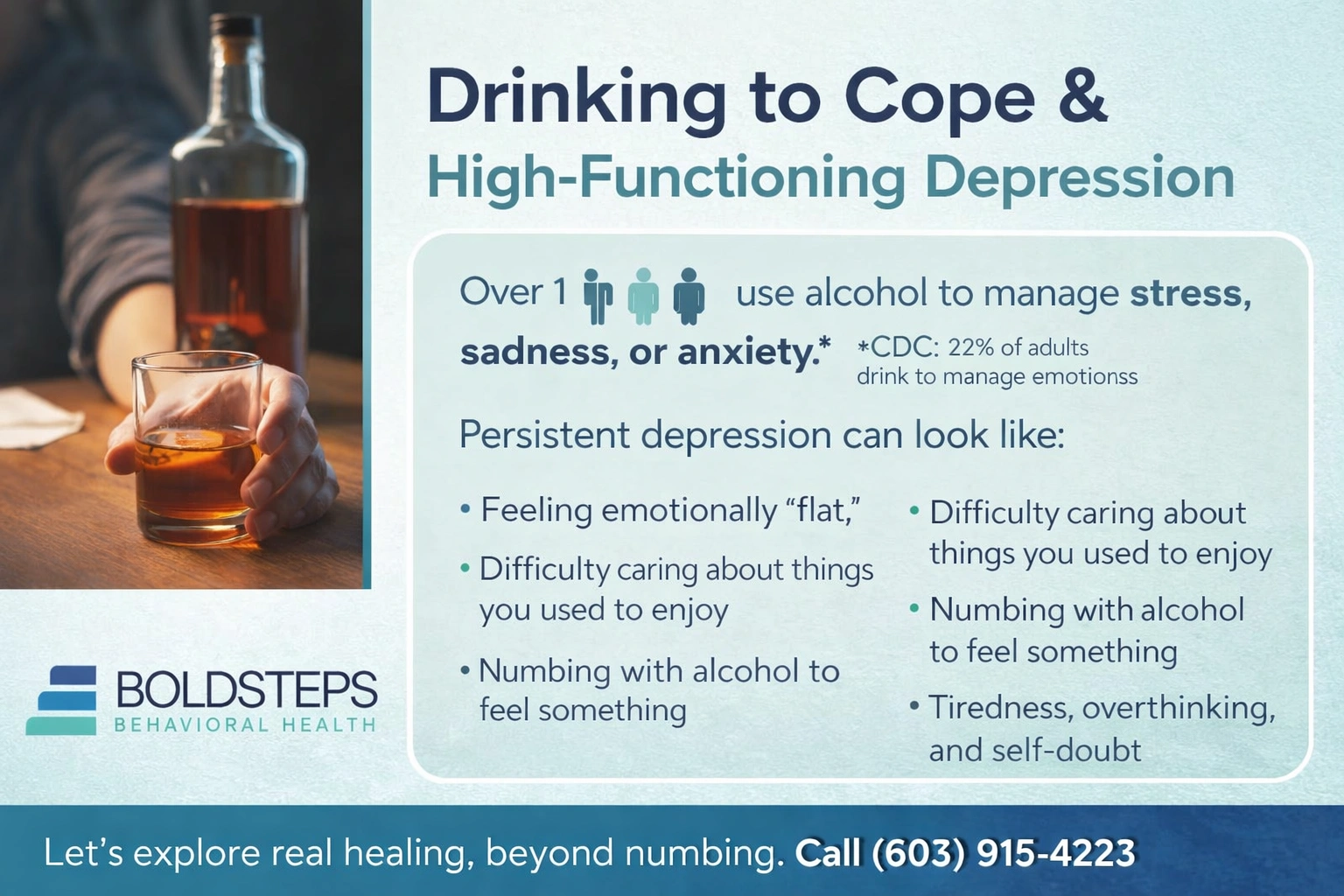
But high-functioning depression—or persistent depressive symptoms—can look like this:
- A constant sense of heaviness or fatigue
- Feeling emotionally “flat,” even when things are going well
- Going through the motions, but feeling disconnected from joy
- Difficulty making decisions or caring about things you used to enjoy
- Overthinking, self-doubt, or a subtle dread you can’t shake
Many people use alcohol not to feel “happy,” but just to feel something.
And while that might work temporarily, it usually pushes the real feelings further down.
3. Ask: Is This a Treat or a Tool?
There’s nothing wrong with having a drink now and then.
But there’s a difference between alcohol being a treat—something you enjoy—and a tool—something you use to cope.
Try asking yourself:
- Am I drinking out of habit or intention?
- Does this make me feel more connected—or more detached?
- Would I still be drinking this if I felt genuinely okay today?
- Do I notice myself reaching for alcohol when I feel especially low, lonely, or mentally tired?
If your gut says, “Yeah, this is more about numbing than enjoyment,” it might be time to explore what’s underneath.
4. You Don’t Need to “Quit Drinking First” to Seek Help
Here’s a myth that keeps people stuck:
“I need to stop drinking before I talk to someone.”
Not true.
You can explore your mental health while still drinking. You can ask questions, get evaluated, start therapy, and even begin depression treatment while your relationship with alcohol is still in progress.
For many people, healing from depression makes it easier to let go of numbing habits—not the other way around.
5. What Depression Treatment Actually Looks Like
When people picture “treatment,” they often imagine:
- Being forced into medication
- Talking about trauma before they’re ready
- Losing their autonomy
- Being judged for how they cope
At Bold Steps Behavioral Health NH, we do things differently.
Our depression treatment in Concord, NH is built on conversation, not correction. We listen first. We ask what’s hard, what’s working, and what small steps feel possible.
Depending on your needs, treatment might include:
- Individual therapy (at your pace)
- Medication management (only if helpful)
- Holistic supports like sleep, nutrition, and stress strategies
- Space to explore alcohol use without pressure
Our goal isn’t to take things away from you. It’s to help you find other ways to feel okay—ones that last longer than a buzz.
We work with clients from across the region, including Rockingham County, Merrimack County, and Hillsborough County.
6. What Happens If You Wait?
Depression is tricky.
It can mask itself with routine. It can hide behind a packed schedule, a social smile, or a functional life.
But left unaddressed, depression tends to:
- Linger
- Deepen
- Isolate
And the coping mechanisms we use to hold it off—like alcohol—often stop working as well over time. What starts as a way to manage becomes something we feel trapped by.
You don’t have to wait for things to get worse to start getting better.
7. You’re Allowed to Be Curious Without Being Certain
You don’t need to know for sure if you’re depressed. You don’t need to label yourself as an “alcoholic.” You don’t need to commit to a life overhaul today.
You can simply say: “I’m not feeling like myself. I want to understand why.”
That’s more than enough to start.
Curiosity is one of the most powerful tools in recovery—because it means you’re still open. Still reaching. Still willing to try something different.
And sometimes, that one step of curiosity is what leads you out of the fog.
FAQ: Alcohol and Depression Treatment
Do I have to quit drinking to start depression treatment?
No. You don’t need to be sober to explore your mental health. Many people begin treatment while still using alcohol to cope.
What if I’m not “depressed enough”?
There’s no threshold you have to meet. If you’re struggling, disconnected, or just tired of feeling numb—support is available.
Does depression treatment always mean medication?
Not always. Some people benefit from it, others prefer therapy or lifestyle-based approaches. We create a plan with you.
Can I talk about drinking in therapy without being judged?
Absolutely. We understand that alcohol is often a coping tool—not a moral failing. You’ll be met with compassion and honesty.
Is it worth exploring treatment if I’m still unsure?
Yes. You don’t need certainty to start. Exploring your options is a form of progress.
You Don’t Have to Keep Going Like This
If drinking has started to feel more like survival than enjoyment, it might be time to listen to that whisper inside you. The one that says:
“Something’s not right.”
“I want to feel better.”
“Maybe there’s another way.”
You don’t have to quit drinking tomorrow.
You don’t have to call yourself anything.
You just have to stop pretending that numb is enough.
We see you. And if you’re ready to take one small, curious step—we’re here for it.
Let’s explore what’s really going on—without judgment
Call (603) 915-4223 to learn more about our depression treatment services in Concord, NH. Healing doesn’t start with certainty. It starts with honesty—and you’re already there.