

You just got a diagnosis—and suddenly it feels like everything is urgent. Decisions, labels, treatment options, conversations you didn’t expect to be having yet. It can feel like your life split into a “before” and an “after” overnight.
Take a breath.
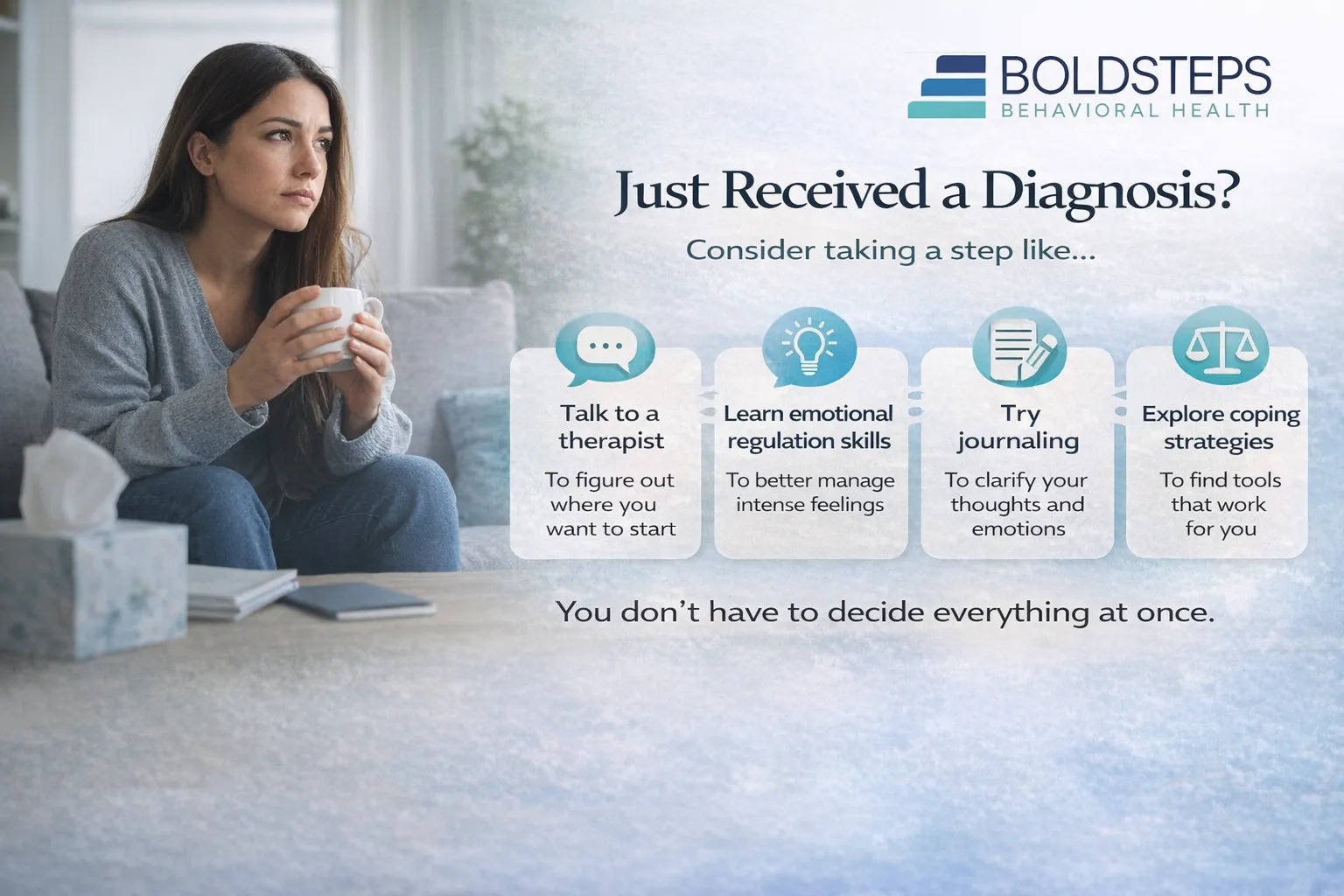
You don’t have to decide everything today.
If anything, the most important thing you can do right now is slow the moment down. Not forever. Just enough to find your footing.
If you’re looking for a place to begin without pressure, you can explore supportive therapy options that are designed to meet you exactly where you are.
It’s Okay If This Feels Bigger Than You Expected
A diagnosis can land heavy.
Even if part of you suspected something was going on, hearing it out loud can still feel like too much. Some people feel relief. Others feel fear. Most feel both at the same time.
You might be wondering:
- “What does this mean for my future?”
- “Am I going to feel like this forever?”
- “Do I have to change everything now?”
You don’t need to answer all of those today.
Right now, it’s enough to simply acknowledge: this is a lot.
You Don’t Have to Make Big Decisions All at Once
There’s often an invisible pressure that shows up after a diagnosis. It sounds like urgency:
Start medication.
Find the right therapist.
Fix everything as quickly as possible.
But healing doesn’t work well under pressure.
You are allowed to take this step by step.
You are allowed to gather information slowly.
You are allowed to say, “I’m not ready for that yet.”
There’s strength in pacing yourself. The kind of strength that doesn’t burn out.
The Fear Around Medication Deserves Respect
If you’ve been prescribed medication, you might feel conflicted.
That hesitation isn’t resistance—it’s thoughtfulness.
A lot of people worry about:
- Losing their personality
- Feeling emotionally flat
- Becoming dependent
- Not recognizing themselves anymore
Those concerns deserve space.
You’re allowed to ask questions.
You’re allowed to understand your options.
You’re allowed to move at a pace that feels safe.
For some people, starting with therapy helps them feel more grounded before making decisions about medication. There’s no single path you’re required to follow.
Therapy Can Be a Starting Place, Not a Final Decision
One of the most misunderstood parts of therapy is the idea that once you start, you’re locked in.
You’re not.
Therapy is not a contract—it’s a conversation.
It can be a place where you:
- Say things out loud for the first time
- Begin to notice patterns without judgment
- Learn how to manage overwhelming emotions
- Explore what kind of support actually works for you
You don’t have to commit to “fixing everything.”
You just have to show up once.
That’s how most people begin.
You’re Allowed to Not Fully Understand Yourself Yet
There’s a quiet expectation that after a diagnosis, clarity should follow.
But that’s rarely how it works.
If you’ve been struggling with intense mood shifts, relationship patterns, or emotional highs and lows, it can take time to untangle what’s happening. For individuals seeking BPD treatment Concord NH, this process often begins not with answers—but with curiosity.
You don’t need to have insight right away.
You don’t need to explain yourself perfectly.
You don’t need to “get it” yet.
Understanding is something you build—slowly, safely, over time.
Progress Might Look Smaller Than You Expected
There’s a version of progress we imagine—big breakthroughs, clear answers, sudden relief.
And then there’s real progress.
It often looks like:
- Getting out of bed on a hard day
- Pausing before reacting
- Noticing a feeling instead of avoiding it
- Coming back to a conversation instead of shutting down
These moments don’t always feel like victories.
But they are.
Real change is quiet at first. It grows in ways you don’t always notice right away.
You Are Not Broken—You Are Learning
It can be easy to internalize a diagnosis as something being “wrong” with you.
But what if it’s not about something being broken?
What if it’s about finally having language for what you’ve been experiencing?
You’re not starting from zero.
You’ve been coping, adapting, surviving—long before this diagnosis had a name.
This is not the beginning of something being taken away from you.
It’s the beginning of understanding yourself in a way that might actually help.
You Don’t Have to Do This Alone
One of the hardest parts of this stage is how isolating it can feel.
You might not know who to talk to.
You might not feel ready to explain.
You might worry that no one will understand.
But support doesn’t have to be overwhelming.
It can start small.
A therapist.
A single conversation.
A place where you don’t have to perform or pretend.
People across Rockingham County, New Hampshire often begin this process quietly—just exploring options, asking questions, seeing what feels right. Others in Merrimack County, New Hampshire take that same first step without having everything figured out.
There’s no one way to begin.
It’s Okay If You’re Still Scared
You can be hopeful and scared at the same time.
You can want help and still hesitate.
You can take a step forward and still feel unsure.
Fear doesn’t mean you’re doing it wrong.
It usually means you’re doing something new.
And new things take time.
What Starting Can Actually Look Like
Starting doesn’t have to be dramatic.
It can be:
- Reading something that makes you feel understood
- Looking into therapy without committing yet
- Writing down questions you want to ask
- Letting yourself consider the possibility that things could feel different
You don’t need certainty to begin.
You just need a moment where trying feels slightly more possible than staying stuck.
Frequently Asked Questions
Do I have to start medication right away after a diagnosis?
No. You have options. Medication is one possible part of treatment, but it doesn’t have to be your first step. Many people begin with therapy to better understand their symptoms and comfort level before making medication decisions.
What if I’m scared therapy won’t work for me?
That fear is more common than people admit. Therapy isn’t about instant results—it’s about building trust, understanding patterns, and learning new ways to respond over time. It’s okay to try it without expecting perfection.
How long does it take to feel better?
There’s no fixed timeline. Some people notice small shifts early on, while deeper changes take longer. Progress is often gradual and layered—not immediate or dramatic.
What if I don’t feel ready to talk about everything?
You don’t have to. Therapy moves at your pace. You can start with what feels safest and build from there. There’s no requirement to share everything at once.
Can therapy help with intense mood swings?
Yes. Many therapeutic approaches focus specifically on emotional regulation, helping you understand and manage intense feelings in a way that feels more stable and less overwhelming over time.
What if I start and then want to stop?
That’s allowed. Starting therapy doesn’t lock you into anything. You can adjust, pause, or try a different approach if something doesn’t feel right.
You don’t need to have a five-step plan.
You don’t need to feel confident.
You don’t even need to feel ready.
You just need a place to start.
Call (603)915-4223 to learn more about our Dialectical Behavior Therapy in Concord, New Hampshire.
Even being here, reading this, means something.
It means part of you is still reaching forward—
even if the rest of you feels unsure.
And that’s enough for today.
Crafted with emotionally grounded behavioral health writing standards.