

The day I got my diagnosis, I sat in my car and stared at the dashboard like it might answer back. I didn’t even cry at first. I just froze.
Then I went home and did what I thought would help: I opened my laptop and typed every clinical word the doctor had said into the search bar.
For hours, I read articles. Forums. TikToks. Every rabbit hole you can imagine. I wanted clarity. What I found was chaos.
At the time, I didn’t realize I was doing what a lot of newly diagnosed people do: trying to piece together a recovery plan with a search engine because I was too overwhelmed, too afraid, and too unsure to ask for help.
Eventually, I found something better than another blog or subreddit. I found a partial hospitalization program—and it was the first place that made me feel like healing was possible, not just theoretical.
When You Know Something’s Wrong, But Don’t Know What to Do
Before the diagnosis, things had already started falling apart. I was constantly exhausted, on edge, and second-guessing every interaction I had. I cried for no reason. I stopped sleeping. I missed work. I convinced myself I was just being “lazy” or “too sensitive,” because that felt safer than imagining something might be medically wrong.
When I finally got into an evaluation and heard the words depression and generalized anxiety, my first reaction wasn’t relief—it was fear.
I didn’t want to be labeled. I didn’t want to be “on medication forever.” I didn’t want to lose the version of myself I used to be—confident, creative, energized.
So I searched instead. For answers. For loopholes. For ways to avoid feeling broken.
What Is a Partial Hospitalization Program, Really?
I’ll admit, the name threw me off. Partial hospitalization program sounded serious—too serious for someone who hadn’t “hit rock bottom.” I wasn’t hospitalized. I wasn’t in crisis. I just felt lost.
But when I looked into it more, I realized PHP is actually for exactly that space: the in-between. It’s for people who aren’t doing well, but who want help before things fall further apart.
At Bold Steps in Concord, NH, PHP meant I could:
- Attend structured treatment during the day
- Stay in my own home at night
- Get therapy, support, and skills five days a week
- Learn how to manage my symptoms with actual tools—not just wait for meds to work
It felt like a middle path. Not inpatient. Not once-a-week outpatient. Something in between that finally met me where I was.
I Was Scared to Start. And I’m So Glad I Did Anyway.
I remember walking into the building for my intake and thinking, What if this makes it worse? What if I’m not “sick enough” to be here?
But the staff at Bold Steps didn’t treat me like a diagnosis. They treated me like a person. Nervous. Hesitant. Human.
They didn’t pressure me to “be ready.” They just welcomed me into a space where I could slow down, speak honestly, and begin sorting through what had become a very tangled mess in my head.
Within the first week, I felt something I hadn’t in months: a little bit of peace.
Learning About Myself—Without Google Telling Me Who I Was
One of the hardest parts about a new diagnosis is the identity crisis it causes. Suddenly every emotion feels suspicious. Every bad day feels like proof that you’re broken.
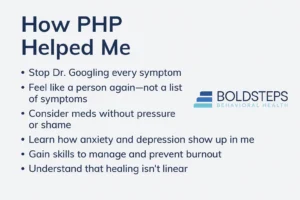
But PHP helped me start separating myself from the symptoms.
We talked about thought patterns, emotional regulation, trauma, and how brains adapt to stress. I realized I wasn’t “too sensitive”—I’d been surviving in overdrive for years.
We did grounding exercises, journaling, mindfulness, and real-life skills. Slowly, I stopped relying on WebMD and Reddit for reassurance. I started building my own understanding—backed by professionals who actually cared about nuance, not generalizations.
The Medication Conversation Wasn’t What I Feared
I need to be honest here: I was scared of medication. Terrified, actually. I thought it would dull me, change me, or make me feel out of control.
At Bold Steps, the conversation around meds wasn’t pushy or clinical. It was curious. Respectful. Optional.
I met with a provider who took time to explain how different medications worked. They listened to my fears. They validated my ambivalence. And when I did decide to try a small dose of an SSRI, I felt empowered—not cornered.
Starting medication became part of a supportive plan, not the only plan. That made all the difference.
What a Day in PHP Looked Like for Me
People assume treatment means lying on a couch and crying for six hours. It wasn’t like that.
My days included:
- Morning check-ins and intention setting
- Group therapy that was honest, but not heavy 24/7
- Psychoeducation sessions that taught me how to recognize anxiety spirals or depressive loops
- Skill-building workshops focused on things like boundaries, sleep, communication, and routines
We even laughed sometimes. I made friends. I found myself again—in bits and pieces, and in ways I didn’t expect.
Healing Isn’t a Light Switch. It’s a Series of Tiny Green Lights.
Here’s the thing: PHP didn’t “cure” me. It didn’t erase my diagnosis. But it gave me something better—agency.
I began making decisions from knowledge, not fear. I learned how to listen to my body. To notice early signs of burnout. To choose rest without guilt. To accept that needing help doesn’t mean I’m weak.
Now, when symptoms flare, I don’t reach for Google. I reach for the tools I learned. I call my therapist. I rest. I reset.
If you’re in Merrimack County, or coming from Rockingham County, Hillsborough County or Essex County, MA, and you’re scared to take that next step—I see you. I’ve been you. And I want you to know that PHP isn’t something to fear. It might be the thing that helps you come back to yourself.
FAQs About Partial Hospitalization Programs
Is a PHP only for people in crisis or with severe diagnoses?
Not at all. PHP is designed for people who need more than traditional outpatient therapy but don’t need 24/7 care. It’s for stabilization, support, and real-life skill building. Many newly diagnosed people find PHP is exactly the right level of care.
Will I have to quit my job or school to attend?
PHP is typically a full-time commitment during the week, but many people coordinate time off, adjust their schedules, or attend PHP as part of a medical leave. Bold Steps can help you navigate those conversations if needed.
What if I don’t want to take medication?
You don’t have to. Medication may be discussed as part of your treatment options, but no one will pressure you. You’ll have a chance to ask questions and explore alternatives, too.
How long does PHP usually last?
Programs vary, but many people attend for 3–6 weeks, depending on their goals and needs. The goal is to stabilize and transition into a lower level of care (like outpatient therapy) when you’re ready.
What happens when it ends?
Bold Steps helps you build a clear transition plan. That might include moving into an intensive outpatient program (IOP), regular therapy, or community support. You won’t be left alone.
You Don’t Have to Navigate This Alone
Being newly diagnosed is confusing, scary, and deeply vulnerable. You don’t need to “figure it out” by yourself. You deserve real care. Honest answers. And a team that sees you as more than a label.
Ready to stop Googling and start healing?
Call (603) 915-4223 to learn more about our partial hospitalization program services in Concord, NH. You don’t have to do this perfectly. You just have to start.