

Some people wake up in a hospital bed and decide to change.
Others wake up and realize they don’t feel awake at all.
That was me.
From the outside, I looked fine. Successful. In control. People trusted me. I handled stress the way I always had—by numbing it after hours.
But the thing about high‑functioning addiction is this:
You can be great at life while slowly losing it.
I didn’t crash. I didn’t ruin everything. I just realized that my drinking was grinding me down from the inside out. And that’s when I made a choice that changed everything — before disaster hit.
I chose an intensive outpatient program at Bold Steps Behavioral Health in Concord, NH — and not because I had to, but because I finally knew I wanted something better.
This isn’t a story about hitting rock bottom.
It’s a story about refusing to wait for one.
Life Looks Normal — Until It Doesn’t
Every morning I woke up, made coffee, and acted ready for the day.
I had meetings to lead. Emails to answer. People depending on me.
But when the business day ended?
The bottle came out.
Not because I wanted to be wasted — no — but because I was exhausted. My brain hadn’t shut off since college. Stress was a constant hum. My heart was always near the edge, even if no one else could see it.
I started kidding myself:
“I can handle it.”
“I’m not like those people.”
“I’m not out of control.”
But the truth was this:
I wasn’t okay.
I was surviving — and survival is not the same as joy.
The Myth of the Functional Addict
Everyone loves a story of someone hitting rock bottom and rising up. It’s dramatic. Inspiring. Newsworthy.
But most people don’t get that version of addiction.
Most of us just keep functioning.
We show up.
We perform.
We succeed… while sinking.
That’s high‑functioning addiction.
It’s a slow, quiet dilution of self.
And it’s sneakier than you think.
Your behavior starts to bend subtly:
You postpone dinners because “you’ll just drink there anyway.”
You avoid mornings because you know what the nights have become.
You defend your habits — not because they’re good — but because they feel necessary.
That’s not stability. That’s camouflage.
The Turning Point: Awareness Without Chaos
I didn’t lose a job.
No one yelled at me.
There was no crisis.
Just one morning — a simple, ordinary Monday — I realized I was drinking every night, and I hated it.
Not the hangovers.
Not the white flags of shame.
I hated that it had become normal.
That was enough.
Some people think you have to reach a dramatic bottom to stop.
But sometimes the hardest bottom is quiet acceptance.
I knew I needed help before my life collapsed, not after.
That’s when I started looking into intensive outpatient programs.
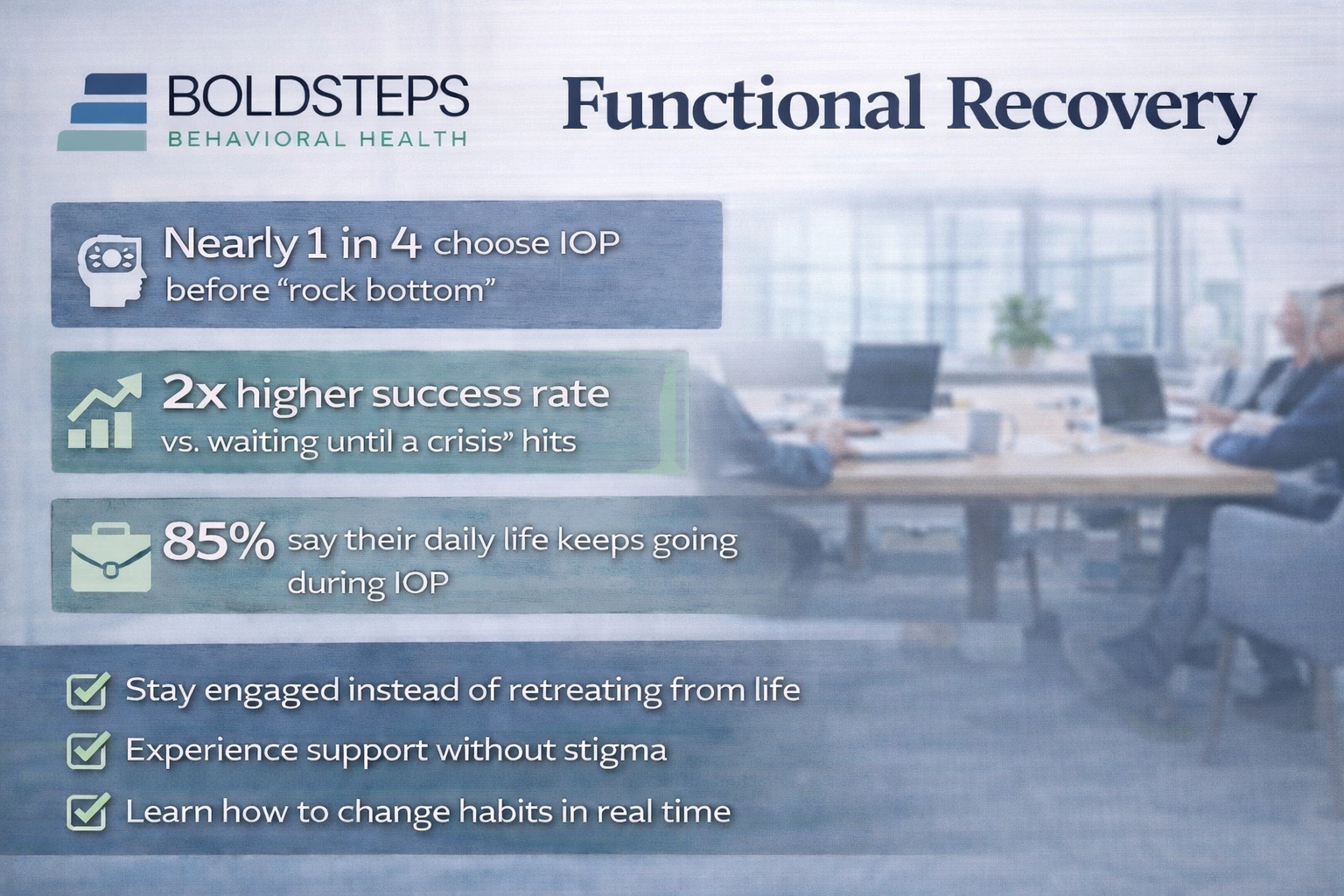
Why I Chose an Intensive Outpatient Program
I didn’t want to disappear from my life.
I didn’t want to explain a long absence at work.
I didn’t want to lose my responsibilities.
I didn’t want my world on hold.
I wanted a solution that respected my life — not erased it.
IOP gave me exactly that.
Here’s what it offered:
- Structure, not confinement: I still lived at home.
- Support, not separation: I kept my daily life.
- Reflection, not retreat: I faced my patterns honestly.
An IOP isn’t rehab in disguise. It’s rehabilitation without evacuation.
You keep your life while you fix what’s eroding it.
At Bold Steps, the program feels human — not clinical.
No judgment. No shame. Just clarity.
And that’s what high‑functioning people often need: clarity, not catastrophe.
What an Intensive Outpatient Program Looks Like Day‑to‑Day
When I first walked into IOP, I was nervous.
Am I “bad enough” for this?
Will people judge me?
Will they make me start over?
No.
My life didn’t stop. It just started becoming real again.
My schedule looked like:
- Meetings and therapy sessions several days a week
- Group discussions — honest and raw
- Individual check‑ins with clinicians
- Tools for stress, triggers, and relapse prevention
- Practical coping strategies for real life
There were no dramatics. No ridiculous “treatments.” Just real, honest support.
That’s what makes intensive outpatient programs unique:
They meet you where you live — literally and emotionally.
You Don’t Have to Hit Rock Bottom — Stop Digging
That phrase became my mantra.
I didn’t have a crisis; I had awareness.
That was enough.
Rock bottom isn’t a fixed place.
It’s a decision.
The moment you choose help — that’s your bottom.
Your worst day doesn’t have to be devastating.
It just has to be defining.
You don’t have to wait for loss to justify change.
You just have to stop digging.
The Subtle Signs You Need More Support
Some of these might sound familiar:
- You make rules about drinking — then break them.
- You start drinking earlier than planned.
- You worry about others noticing.
- You defend your habits more than you challenge them.
- You use alcohol to cope, not celebrate.
- You feel like you’re “fine” but tired of pretending.
None of these are dramatic.
But they’re real.
And they matter.
That’s why an intensive outpatient program isn’t just for “chaos.”
It’s for anyone who:
- Wants control back
- Wants honesty
- Wants peace, not just performance
This isn’t about labels.
It’s about direction.
The Intensity That Fits Your Life
One thing people misunderstand about IOP is the word “intensive.”
It sounds extreme.
But in reality, it’s focused treatment with everyday application.
Trust me — there’s a difference.
In IOP, you:
- Learn how your triggers work
- Build healthier coping skills
- Understand your emotional landscape
- Practice new habits in real time
You don’t just talk about change.
You live it — alongside your life.
For people in Hillsborough County, NH and beyond, Bold Steps offers IOP that’s serious about healing without hijacking your life.
FAQs About Intensive Outpatient Programs
What exactly is an IOP?
An intensive outpatient program is structured treatment that lets you live at home while attending therapy and support sessions multiple times per week.
Do I have to be sober to start?
No. Many people begin while still drinking. The program supports honest progress, not perfection.
Will it interrupt my work?
IOP is designed to work around life — not against it. Sessions are scheduled to preserve your responsibilities.
Is this only for “severe” addiction?
No. High‑functioning people benefit just as much — often more — because they can practice recovery in real time.
Will people judge me?
No. IOP brings people from all walks of life — professionals, caregivers, parents — all seeking healthier patterns.
How long does it take?
It varies by individual needs. Most programs are several weeks, adjusting intensity as you progress.
What Changed for Me
Nothing exploded.
Nothing dramatic happened.
But everything shifted.
I learned how to:
- Pause before pouring a drink
- Sit with discomfort without numbing it
- Communicate honestly with people who mattered
- Sleep without regrets
- Wake up with intention instead of avoidance
I didn’t lose my life to treatment.
I found my life within it.
You Don’t Need a Catastrophe to Choose Change
I know people who chose IOP before losing careers.
Before losing relationships.
Before waking up to panic attacks.
And I know others who came after pain.
Either way — they found clarity.
You don’t have to wait for a headline moment.
You don’t have to wait for tragedy.
You can choose help now.
You can stop digging now.
You can change now.
Call (603)915‑4223 to learn more about our intensive outpatient program services in Concord, NH.
You don’t have to hit rock bottom to start rising.