

There’s a point in recovery that no one warns you about.
It’s not the crisis moment, not the rock bottom. It’s what comes after—when you’ve already shown up for treatment, maybe even more than once… and still feel stuck. You’re not using. You’re attending your intensive outpatient program (IOP). You’re doing the “right” things.
But something feels off. Static. Like you’re just going through the motions.
If you’re reading this and thinking, Yeah, that’s me, you’re not alone. You’re not failing. And no, you don’t need to start over.
Sometimes, what you really need is a different frame. That’s where dual diagnosis treatment can quietly shift everything—especially inside IOP.
Feeling stuck doesn’t mean treatment failed
Here’s what we want to say clearly and upfront: plateauing is normal.
You might feel like you’re “over” the crisis that got you into treatment—but not actually better. That awkward middle can feel like a dead end. But it’s not. It’s a signal.
That stuck feeling is often where the real work starts—because it usually means there’s something deeper going on. Not a failure. Not a flaw. A flag.
And it deserves your attention, not your shame.
Standard IOPs often miss what’s under the surface
Most IOPs are built around structure, support, and sobriety milestones. And those are important. But for many people, especially those with lingering mental health symptoms, structure alone isn’t enough.
You might be going to groups, checking off boxes, staying sober—but still fighting intense anxiety, isolation, emotional numbness, or executive dysfunction.
That’s why dual diagnosis treatment exists. Because if we’re not treating the depression that undercuts your motivation—or the trauma that triggers cravings—we’re not really treating you.
Dual diagnosis care changes the conversation
In standard IOP, the focus is often:
What triggered you to use?
In dual diagnosis care, it becomes:
What patterns are you stuck in—and why?
This kind of care brings your whole self into the room: mental health, emotional needs, trauma history, neurodivergence, coping strategies—not just substance use.
The goal isn’t to pathologize you. It’s to finally see the full picture—and stop blaming yourself for not getting better with tools that were never built for your whole experience.
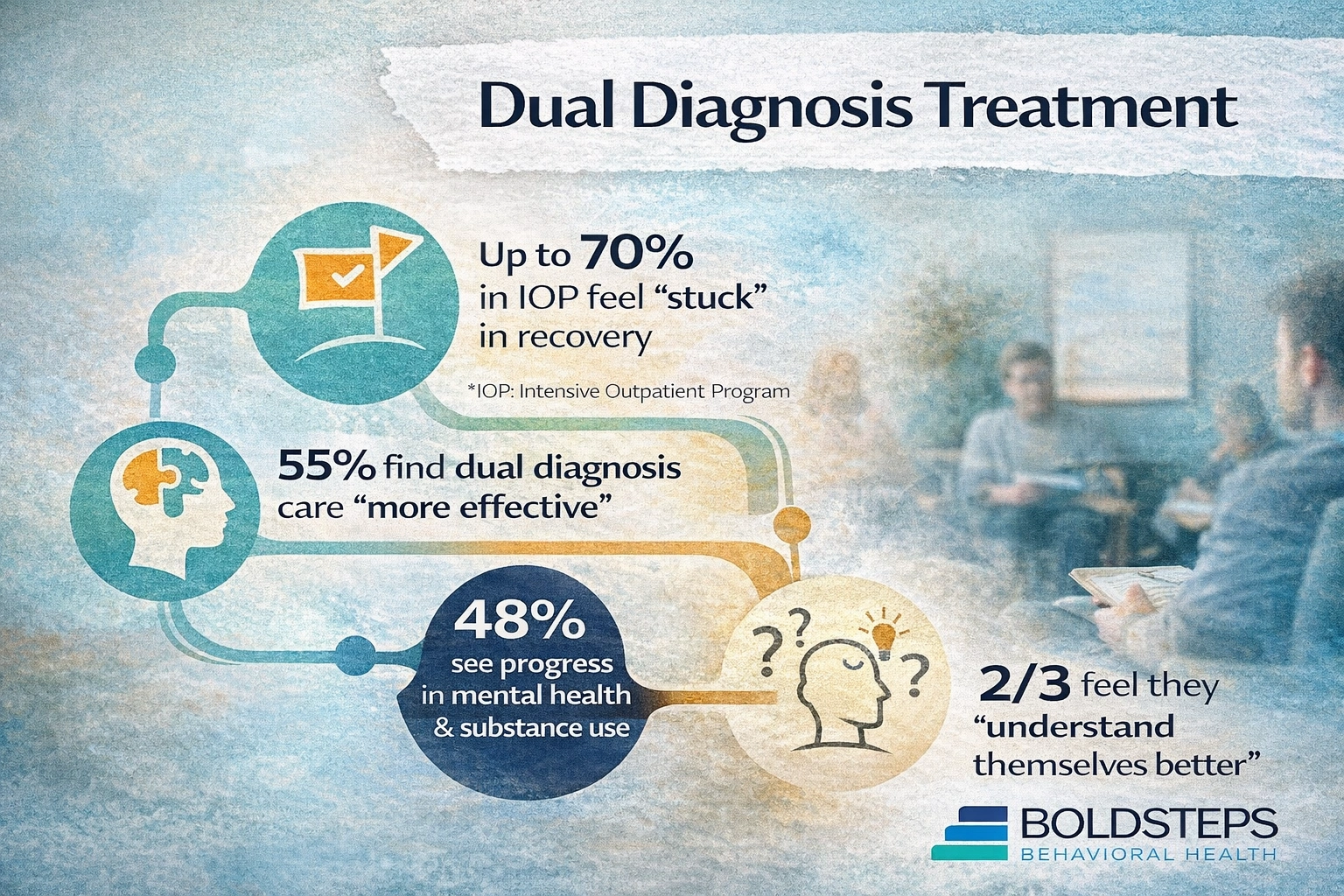
IOP becomes more than structure—it becomes a support lab
In a dual diagnosis-informed IOP, the group work doesn’t just repeat basics. It becomes a kind of living lab where you can practice real tools for emotional regulation, boundary setting, and distress tolerance—all with space to pause, not just perform.
It’s not about perfect attendance. It’s about experimenting with new ways to feel safe, supported, and connected in your body and brain.
That’s the stuff that builds momentum. Not pushing harder—but finding traction in new places.
Re-engaging doesn’t mean starting over
One of the biggest myths we hear is: “I already did IOP. It didn’t work.”
What’s usually true is: “I did an IOP that wasn’t the right fit.”
Dual diagnosis care gives you a new lens—not a reset button. If your treatment missed your anxiety, ADHD, depression, trauma, or underlying grief… it makes sense that progress stalled.
You don’t need to erase what you’ve already done. You need care that builds on it—by finally including everything you’ve been carrying.
Real change happens in the shift—not the sprint
We’ve worked with people who thought they were “treatment failures,” only to realize they’d never been given a full map.
Once we stopped focusing only on substance use and started digging into why they felt flat, disconnected, overwhelmed, or emotionally exhausted—things moved again.
It wasn’t dramatic. But it was real.
And it started with permission to name the stuckness instead of powering through it.
That’s where change lives. In honest recalibration. Not reinvention.
The right kind of support doesn’t always mean starting over
We meet a lot of people who’ve been through treatment already and still feel stuck. One person, living in Rockingham County, NH, told us they assumed the care they needed wasn’t available nearby. But what they really needed wasn’t a different zip code—it was a different kind of support. One that looked at their depression, not just their substance use. One that treated the exhaustion, not just the symptoms.
Dual diagnosis treatment made room for that. It didn’t require them to begin again—just to begin more honestly.
More people are finding traction when their full story is heard
We’ve worked with clients who came in skeptical—fully convinced they were the exception recovery couldn’t reach. One client from Merrimack County, NH had been through treatment before and thought “maybe I just don’t respond to this stuff.” But dual diagnosis care offered something different: validation of her trauma, space to explore depression, and support that went beyond behavior tracking.
Once she stopped trying to fix symptoms in isolation, her progress returned—not instantly, but steadily.
FAQs: Rebuilding Inside IOP with Dual Diagnosis Care
Do I have to leave my current program to access dual diagnosis support?
Not always. Some IOPs integrate dual diagnosis care into their structure. Others may refer you to a more specialized track. Either way, you don’t need to start from scratch.
What if I already finished IOP and don’t want to redo it?
Dual diagnosis care isn’t a redo. It’s a reframe. If your mental health hasn’t been addressed directly, this kind of support may offer something entirely new.
How does dual diagnosis treatment actually help with momentum?
It addresses the emotional, mental, and neurological blocks that can stall progress in recovery—like untreated depression, trauma, or attention issues.
Is it too late to restart treatment after a break?
Never. Taking space or stepping away is common. A dual diagnosis program will help you re-enter without shame and re-align with care that fits who you are now.
What if I’m scared it’ll be just like last time?
That fear is valid. But dual diagnosis treatment often feels different because the focus is different. It’s not about repeating what didn’t work—it’s about building something that can.
Can dual diagnosis IOP help with mental health even if I’m not using?
Yes. Many people stay sober but still feel emotionally stuck. This type of care supports ongoing mental wellness—not just crisis intervention.
If you’re sitting in IOP right now feeling like you’re just “doing the thing” and hoping something shifts—you’re not alone. You don’t need to fake progress. You don’t need to push through.
You might just need care that sees the whole picture.
Call (603)915-4223 to learn more about our dual diagnosis treatment in Concord, NH.