

You don’t have to hit bottom to want your life to feel better.
Maybe you’re still showing up—at work, for your family, for your friends. But under the surface, you’re dragging. There’s a quiet exhaustion you can’t shake. You drink or use at night, not to party—but to feel okay for a few hours. Then you wake up heavy again. Maybe you’ve started to wonder: What if this isn’t just about stress? What if I’m actually depressed?
At Bold Steps Behavioral Health in New Hampshire, we help people who are exploring these questions. You don’t need a clear label or a decision to quit using entirely. You just need the curiosity to ask: What if there’s another way to feel better?
Depression Isn’t Always Obvious
When we hear “depression,” most of us picture sadness, crying, or staying in bed all day. But for many people, it looks more like:
- Being constantly tired, no matter how much sleep you get
- Feeling numb or disconnected
- Losing interest in things you used to enjoy
- Drinking or using just to get through the day
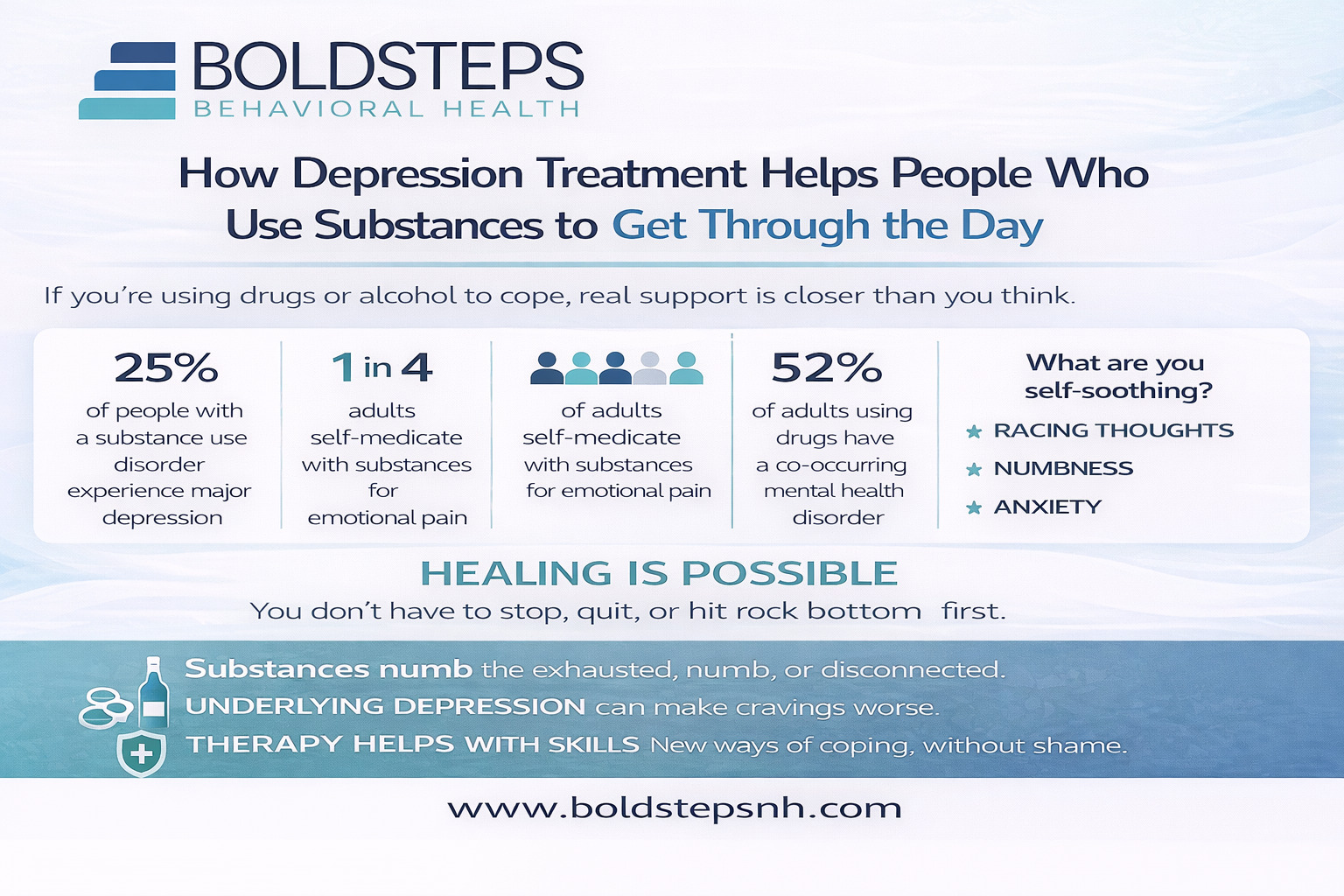
If that’s been your experience, you’re not alone. A lot of people self-medicate to manage emotional heaviness they don’t yet have words for. Depression treatment helps name what’s happening—so you don’t have to keep guessing in the dark.
Using Substances to Cope Isn’t Weakness—It’s a Survival Skill
Let’s be clear: you’ve been surviving. Maybe alcohol, weed, pills, or something else has been your go-to way to calm your mind or escape the emotional static. That doesn’t make you broken. It makes you human.
Substances often offer fast relief from things like:
- Racing thoughts
- Emotional overwhelm
- Loneliness or disconnection
- A sense of being “off” or unlike yourself
But over time, that relief tends to cost more than it gives. What used to take the edge off might now leave you feeling foggy, anxious, or more emotionally raw the next day. That’s when people start looking for something deeper—and that’s where depression treatment comes in.
Therapy Gives You Space to Explore—Without Pressure
If you’re “sober curious,” you’re not necessarily identifying as someone with an addiction. You might just feel… off. Tired of relying on a drink to unwind. Worried that your relationship to substances is shifting.
Therapy offers a non-judgmental space to explore these thoughts without jumping to labels. In our depression treatment programs, we meet you exactly where you are. Some of the questions we might explore together include:
- What are substances helping you not feel?
- What patterns show up when you’re feeling low or overwhelmed?
- What would emotional relief look like—without the crash?
You don’t need to know the answers before you start. You just need to be open to asking.
What Happens When You Treat the Underlying Depression?
Many people are surprised by this: when depression starts to lift, the pull toward substances can lessen naturally.
It’s not magic—it’s neuroscience and emotional regulation. When you get help for your mood, energy, and thought patterns, your brain and body start to stabilize. That means:
- You sleep better
- You feel emotions more clearly
- You learn ways to soothe yourself that don’t involve escape
And as the depression softens, the urgency to self-medicate often fades too. Instead of battling cravings, you’re building emotional muscle. You’re creating a life where you actually want to be present.
You’re Allowed to Want Something Better
It’s okay to want more than just “functional.” You don’t have to wait until things fall apart to get help. In fact, getting support now might help you avoid deeper struggles down the line.
Here’s what depression treatment can offer, even if you’re not in a crisis:
- Validation – You’re not imagining it. This heaviness is real.
- Skills – Learn practical ways to manage emotional stress without relying on substances.
- Support – A team who won’t shame or pressure you.
- Relief – Maybe for the first time in years.
You don’t have to explain away your coping strategies. We’re here to build new ones with you—at your pace.
Recovery Isn’t Binary—and You Don’t Have to Choose Everything Right Now
You don’t have to declare yourself “in recovery” to start healing. You don’t have to quit cold turkey. You don’t even have to know exactly what you want.
You’re allowed to explore. To ask, What if I felt better? What if I didn’t need this glass of wine every night? What if I could face my day without dread?
We work with people in all stages of change—from just starting to question things to actively working toward sobriety. If you’re curious about what’s underneath the need to numb, therapy can be the flashlight that helps you see.
Depression Treatment in New Hampshire That Meets You Where You Are
At Bold Steps, we offer outpatient depression treatment that works with real life. That means:
- No pressure to “quit everything” unless you want to
- Flexible scheduling
- Integrated support for people using substances
- Clinicians who respect your pace, your questions, and your autonomy
If you’re wondering whether this is the right time, it probably is. Not because you’re in danger—but because you’re ready for more than just coping.
Looking for support in New Hampshire?
If you’re in the area and thinking about whether depression treatment could help, we’re easy to reach and ready to listen. Whether you’re still using substances, thinking about cutting back, or just curious—this can be a safe place to land. If you’re in Rockingham, Merrimack, Hillsborough, or Essex County, our nearby centers are here to provide easy access to care.
FAQ: Depression, Substances, and Getting Support
What if I’m still drinking or using—can I still start depression treatment?
Yes. You don’t have to be sober to begin. In fact, many people use therapy to figure out their relationship with substances, not because they’ve already decided to quit.
How do I know if I’m depressed and not just stressed or burned out?
Depression and burnout can overlap. If you’re feeling persistently low, disconnected, unmotivated, or like you’re using substances more just to feel “normal,” it’s worth talking to someone. A therapist can help clarify what’s really going on.
Will I be pressured to quit using if I start therapy?
No. At Bold Steps, we don’t pressure anyone. Our goal is to understand what’s happening underneath your substance use and support you in deciding what feels right.
Is therapy confidential if I talk about substance use?
Yes. Everything you share in therapy is confidential (within standard legal and safety limits). You can talk honestly about your habits, your concerns, and your emotions—without fear.
What if I’m not ready to start, but I want to learn more?
That’s okay. You can reach out to us just to ask questions. We’ll help you understand your options without pushing you into something you’re not ready for.
📞 Ready to take the first step?
Call (603) 915-4223 or visit to learn more about our depression treatment services in New Hampshire.