

I remember the day she walked through the doors again.
Her eyes weren’t vacant — but they weren’t hopeful either.
Just tired. Tender. The weight of disappointment heavy in her voice as she said:
“I thought I was done with this.”
“I thought the treatment worked.”
“I didn’t expect the old darkness to come back.”
If these words feel familiar — either your own or those of someone you care about — I want you to hold this truth gently:
Relapse is not a sign of failure. It’s a sign of humanity. And often, the moment when healing begins again in a deeper, more authentic way.
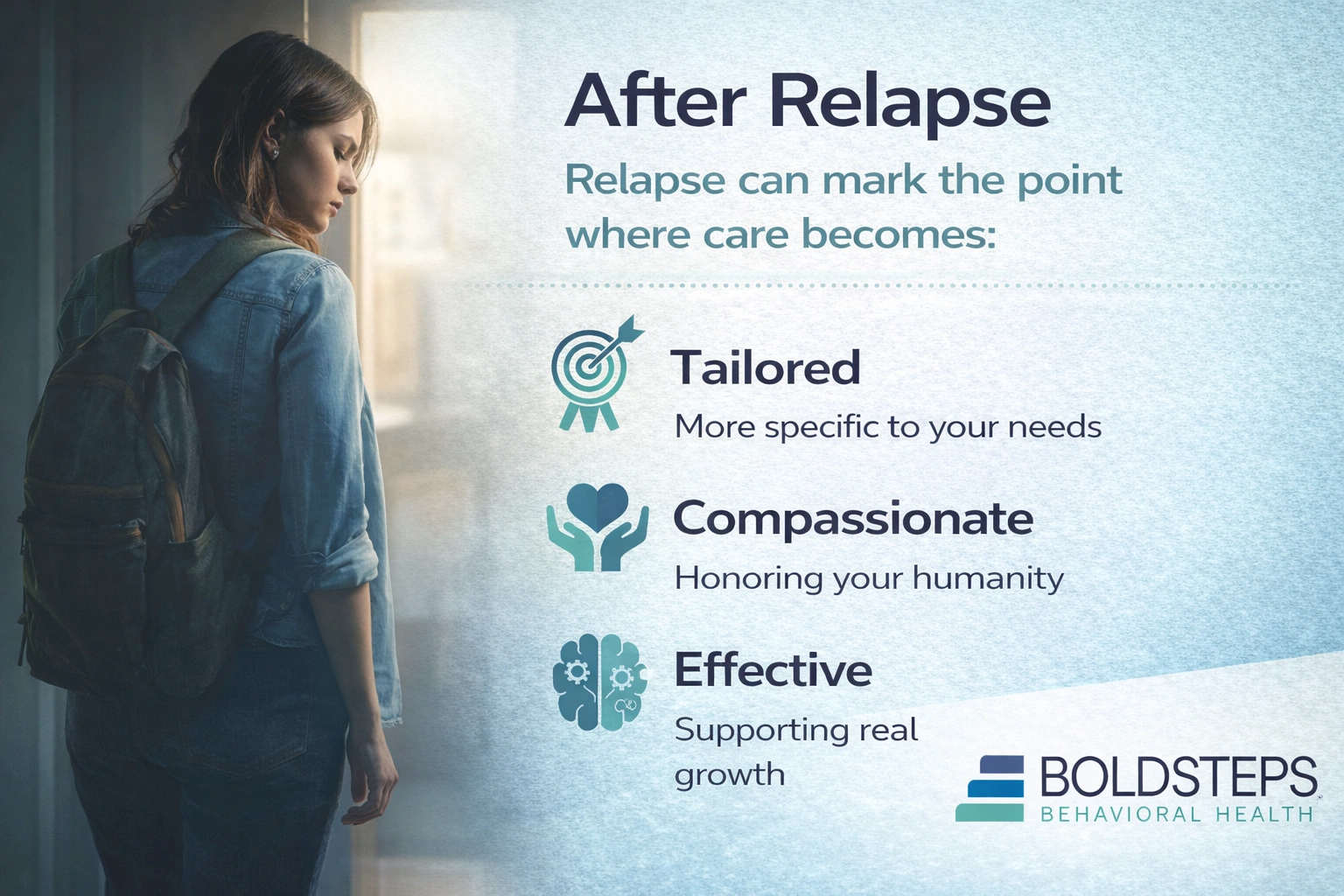
Coming back after relapse doesn’t erase the work already done. It doesn’t mean the first round of care was worthless. Instead, it often marks the point where treatment becomes more personalized, more nuanced, and more connected to the reality of someone’s experience.
In the context of depression treatment — especially for young adults — relapse tends to be a turning point, not an endpoint.
Here’s what that means, why it matters, and how compassionate care can support durable growth and resilience.
If you’ve relapsed and are wondering whether depression care can still help, or you’re a loved one watching someone struggle — you’re not alone. There is a way forward, and it often begins right here.
Relapse Doesn’t Negate Progress — It Deepens It
One of the hardest things to understand emotionally is how relapse and progress can coexist.
It doesn’t feel like progress when the mood slips again, or the old patterns come back. It feels like defeat. Like the work you poured your heart into disappeared.
But real progress isn’t linear.
It’s not a straight line from point A to point B. it’s a spiral.
Here’s what often happens:
- You learn new tools in treatment.
- You build resilience.
- Life gets stressful again — sometimes more stressful.
- Old habits return.
- You realize your coping strategies aren’t enough yet.
And that’s not regression. That’s information.
It tells clinicians what hasn’t worked long term. It tells you what needs more support. It tells the brain that a deeper conversation is needed.
Relapse is a data point — not a verdict.
You’ve built something real in your treatment already. Relapse just shows what still needs care.
Why Depression Treatment After Relapse Is Different — and Better
Treatment the first time gives you tools.
Treatment after relapse gives you skill.
Think of it like learning to cook:
- The first time you’re taught the basics: how to measure, how to mix, how to read a recipe.
- After relapse, you understand what dishes actually worked for you and why.
- You know what burned. You know what you liked.
- Your palate has changed. Your skill has deeper roots.
The second time around, treatment becomes more tailored. More specific. More real.
Your clinician isn’t starting blind. They’ve seen your patterns. They’ve seen your challenges. They can now walk with you — not just at you.
Depression treatment after relapse can:
- Strengthen coping mechanisms that were weak
- Build emotional regulation that wasn’t fully developed
- Address new life stressors that weren’t present before
- Offer more nuanced support, not a one‑size‑fits‑all approach
This kind of care often leads to lasting, sustainable recovery — not quick fixes.
When Old Feelings Return, It’s Not a Sign of Weakness
Many people equate relapse with “not trying hard enough,” or “failing.”
That belief spins shame into the story — and shame makes recovery harder.
Instead, let’s reframe relapse as:
“I tried something hard, it didn’t hold yet, and now I know what needs deeper attention.”
That’s not weakness.
That’s experience with insight.
The truth is:
- People relapse because the depression wasn’t fully resolved.
- They relapse because life stressors changed.
- They relapse because emotional energy fluctuates.
- They relapse because deeper support is needed.
Relapse doesn’t mean you never healed.
It means healing isn’t finished — yet.
And that’s okay.
Real Stories: When Relapse Becomes a Turning Point
We’ve seen this happen again and again.
One client came back after about 90 days feeling like everything was falling apart again. The first time, she’d gained insight. But she hadn’t learned how to sustain it under pressure.
When she returned, the next phase of depression treatment wasn’t a repeat of the first — it was a deepening.
Together, we:
- Explored emotional triggers she hadn’t identified before
- Restructured her support system
- Built new routines that were meaningful, not rigid
- Focused on acceptance, not performance
And within weeks, she started to say things like:
“I can feel myself thinking differently.”
“I feel more anchored — like I’m inside my own life again.”
That’s the turning point treatment can bring — not overnight miracles, but real internal shifts.
Understanding Depression as a Relapsing Condition
Some conditions in health come with ups and downs — diabetes, asthma, chronic pain. Depression is similar in that way.
You wouldn’t blame someone for wheezing again after asthma treatment if pollen season hit. You wouldn’t expect someone with a chronic pain condition to never feel discomfort again.
Depression can be similar. It isn’t a single event you treat once and forget.
It’s an emotional pattern that needs ongoing attention, support, and sometimes adjusted treatment.
Relapse is a signal — a mental health flare‑up that tells us the underlying emotional maps need revisiting.
And that revisiting is not regression — it’s progress through depth.
Looking for depression treatment in Merrimack County or nearby?
If you’re in Concord or surrounding areas like Merrimack County, NH or Rockingham County, NH and you’ve found yourself back in a place that feels familiar but overwhelming again, reaching out for care is not giving up.
It’s evolving your healing.
Bold Steps Behavioral Health NH offers depression treatment that meets you where you are — with warmth, insight, and real support grounded in your lived experience.
Relapse doesn’t erase your progress.
It shows what’s ready to grow.
When Returning to Treatment Feels Scary — That’s Normal
Coming back after relapse can stir up all kinds of feelings:
- “What if they think I should’ve done better?”
- “What if this time doesn’t work either?”
- “What if I’m just stuck?”
All of that thinking is human and understandable.
Here’s what our clinicians want you to know:
- We do not judge relapse.
- We value honesty more than perfection.
- Your story doesn’t start over — it continues.
- You don’t have to have all your answers to return.
- You just need the desire to try again.
Treatment isn’t about fixing a “broken” person. It’s about supporting a whole person — someone with struggles, strengths, fears, and resilience.
A New Phase of Care: Tailored, Not Repetitive
When you come back after relapse, depression treatment becomes:
- Individualized: built around who you are today, not who you were before.
- Insightful: informed by your history, growth, and patterns.
- Collaborative: designed with your input, not imposed on you.
- Flexible: able to evolve as your mind and life evolve.
This phase isn’t the same as the first — it’s deeper. More comprehensive. More human.
Because your experience isn’t a repeat — it’s progress with context.
Small Shifts That Make Big Differences
In deeper phases of depression care, clients learn shifts like:
- Noticing feelings early instead of waiting for overwhelm
- Naming triggers before they snowball
- Balancing empathy with boundaries
- Reconnecting with pleasure without guilt
- Distinguishing reaction from habit
These are subtle changes — but they shape how you live inside your own life.
Healing becomes less like chasing a target and more like finding a rhythm.
FAQ: When Relapse Meets Care
Is relapse a sign that the first treatment “failed”?
No. It means there’s more learning to do. Depression care isn’t one‑and‑done; it evolves with you.
Will I be judged for coming back?
No. Clinicians see return as strength, not failure. Your honesty matters more than your past outcome.
Do I have to explain everything that happened since treatment?
You share what feels relevant and safe. Treatment is a dialogue — not an interrogation.
Can treatment after relapse still make a difference?
Yes. In many cases, the second phase leads to deeper, more sustainable healing.
What if I feel scared or hopeless?
Those feelings are part of the experience — not a disqualifier. They’re what care is designed to meet.
Relapse Is a Chapter — Not the Ending
If there is a memorable line that people returning to care often tell us, it’s this:
“I didn’t come back because I was weak. I came back because I knew deep down that hiding from the struggle wasn’t the same as healing it.”
Relapse isn’t the end of your story.
It isn’t a mistake that erases your journey.
It’s a turning point — a moment where deeper care, richer insight, and more compassionate support can transform your internal world.
Depression treatment after relapse isn’t about erasing pain.
It’s about learning to live with courage, clarity, and trust in your own resilience.
You’ve already walked this far.
That’s not accidental — it’s evidence of your strength.
And we’re here when you’re ready to take the next honest step.
If you’re ready to explore compassionate depression care that meets you where you are:
Call (603) 915‑4223 to learn more about our depression treatment services in Concord, NH.
Relapse isn’t the end. It’s often the beginning of a deeper, more authentic healing.