

You’ve done everything you were supposed to do.
You cleaned up your messes.
You got back on track.
You’re “the one people count on now.”
And still—there’s a heaviness that doesn’t go away.
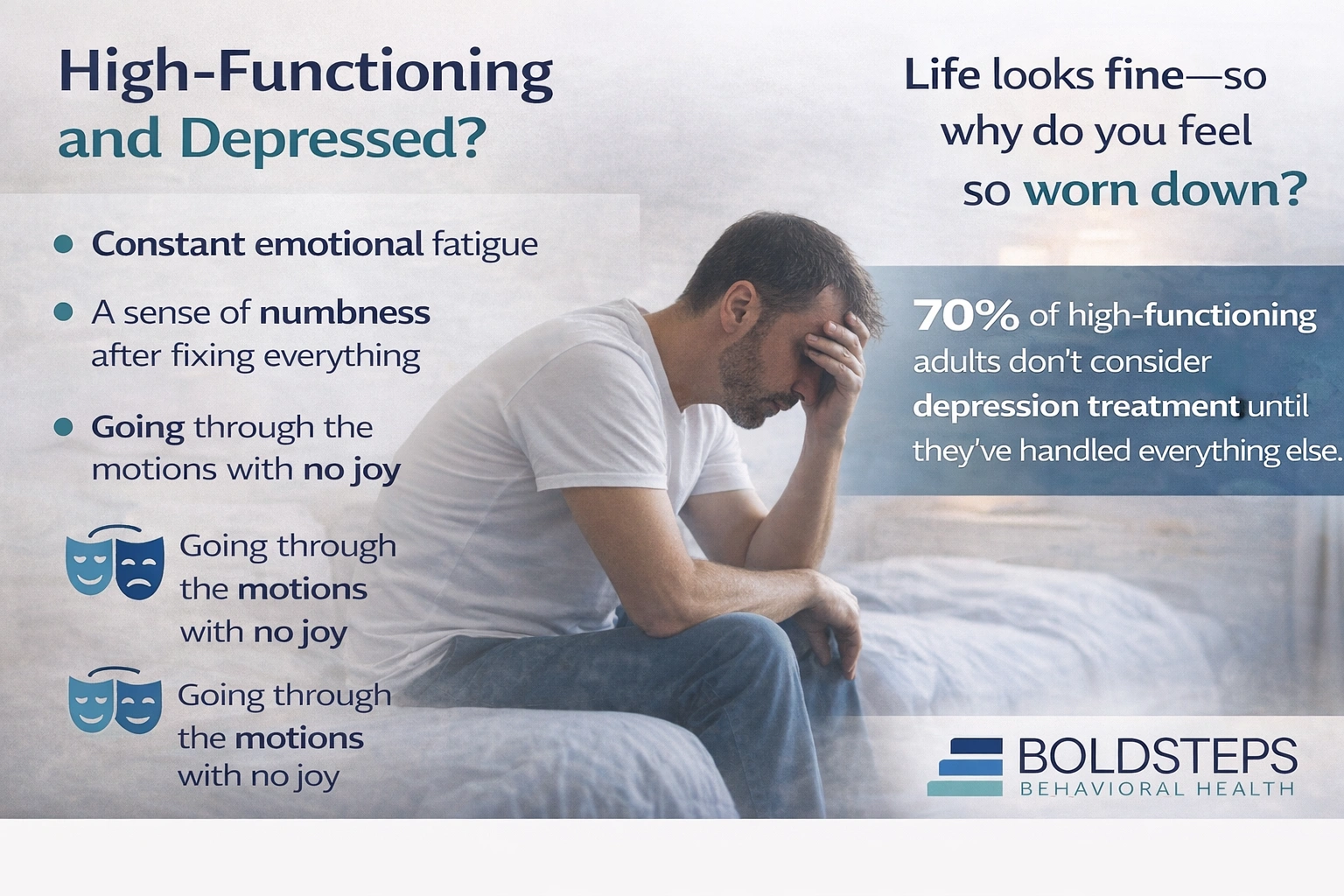
If that sounds familiar, you’re not alone. Many high-functioning adults don’t consider depression treatment until they’ve run out of things to fix. They enter care not because their life is falling apart—but because it finally stopped distracting them from how they feel.
And what they feel? Is numb. Exhausted. Quietly off.
You Handled the Tangible First—Because That’s What You Know
High-functioning people aren’t avoiders. They’re problem-solvers.
When life got chaotic, you cleaned it up.
When your career slipped, you rebuilt it.
When you struggled with addiction, you tackled it like a project.
But depression isn’t a problem with a checklist.
It’s invisible. Slippery. It doesn’t care how productive you are or how hard you try. And it rarely shows up as dramatic breakdowns. More often, it creeps in through:
- Constant emotional fatigue
- Flatness during moments that should feel good
- A sense that you’re succeeding but not living
People in Rockingham County, NH often walk into our offices having “held it together” for years. They didn’t fall apart. They just… wore down. Quietly. Slowly. Consistently.
Depression Doesn’t Erase Function—It Steals Feeling
You don’t have to look depressed to be depressed.
Many of our clients show up showered, employed, and making it to the gym. They’re leading teams, raising families, organizing lives. But inside?
They’re gone.
Depression in high-functioning adults often shows up as:
- Going through the motions with no sense of joy
- Performing socially while feeling disconnected
- Crushing goals but wondering what the point is
It’s not crisis. It’s erosion.
And the longer you ignore it, the deeper it sets in.
High Performance Becomes a Mask You Forget You’re Wearing
Maybe you’ve been running on autopilot so long that slowing down feels dangerous.
You’ve built your identity around reliability, strength, competence, discipline. You’ve learned how to push through discomfort. How to “fake it till you make it.” How to never be the one who needs help.
But now you’ve made it.
And the feelings you postponed are still waiting.
In Merrimack County, NH, we often hear, “I don’t even know who I am when I’m not fixing something.” That question doesn’t mean something’s wrong with you. It means you’re ready to ask deeper questions than performance can answer.
When There’s Nothing Left to Fix, You Finally Feel the Weight
This is usually when people reach out.
Not because their life is falling apart—but because everything is technically okay, and they still feel like they’re drowning in silence.
- You repaired the marriage
- You stayed sober
- You made partner
- You checked every box that was supposed to deliver happiness
But instead of peace, there’s just… stillness. And not the good kind.
The kind that makes you wonder if maybe the problem isn’t outside anymore.
You Thought the Feeling Would Catch Up—It Didn’t
There’s often this hope that once you fix your habits, your emotions will follow.
So you tried:
- Journaling
- Gratitude
- Mindfulness apps
- Better sleep
- Supplements
- Rigorous morning routines
And when none of that made the heaviness go away, you started thinking maybe this is just how it is.
It’s not.
When everything else is in order and the depression remains, that’s not a failure—it’s a signal. That what you’re dealing with isn’t a mindset problem. It’s a mental health issue. And it’s treatable.
What Depression Treatment Does That Your Strategies Can’t
This is where real treatment steps in—not just coping, but healing.
When clients in Essex County, MA finally enter depression treatment, they’re not looking for someone to fix them. They’re looking for relief from the internal disconnect no achievement could touch.
Treatment helps you:
- Untangle suppressed emotions you didn’t have time to deal with
- Understand how perfectionism masks pain
- Learn how to feel without shutting down
- Reclaim your capacity for joy—not just function
Depression treatment isn’t about managing symptoms—it’s about helping you remember who you are underneath all the coping.
You Didn’t Wait Too Long—You Got Here When You Were Ready
There’s a myth that you should’ve asked for help sooner. But here’s the truth:
You came when you had space to listen.
You came when your survival brain finally quieted.
You came when your systems stopped working.
You didn’t wait too long. You waited until avoidance wasn’t working.
That’s not failure—that’s timing.
We hear this all the time in New Hampshire: “I kept hoping the feeling would catch up to the life I built.”
And when it didn’t, you showed up.
That takes courage.
FAQ: High-Functioning Adults and Depression Treatment
Do I have to be in crisis to start treatment?
No. Most of our high-functioning clients are not in acute crisis. They’re still getting through the day—but they’re tired of just getting through it. Depression doesn’t always look like collapse. It often looks like quiet endurance.
What if I already tried therapy before and it didn’t help?
That’s common. Not all therapy digs into high-functioning depression. At Bold Steps, we tailor depression treatment to address the specific ways it hides behind competence, performance, and emotional suppression.
Will I have to take medication?
Not necessarily. Depression treatment may involve therapy alone or a combination of approaches. Medication is discussed only if it aligns with your goals and comfort level—and always with transparency and consent.
What makes depression treatment at Bold Steps different?
We understand high performers. We know how hard it is to drop the mask, even in a clinical setting. Our approach is honest, supportive, and built to help people who feel stuck—even after they’ve “fixed everything else.”
You Deserve to Feel Like Yourself Again
Depression doesn’t always scream. Sometimes it sighs quietly in the background of your biggest wins.
At Bold Steps Behavioral Health in New Hampshire, we specialize in depression treatment for high-functioning adults who are finally ready to feel better—not just function better.
Call (603)915-4223 to learn more about our depression treatment services in New Hampshire.
You didn’t come late. You came right on time.