

I didn’t mean to leave.
I told myself I’d miss just one day, then maybe two.
But then I stopped replying to texts. I avoided the building. And the longer I was gone, the louder the shame got.
I thought they’d be mad. I thought I’d have to explain myself. I thought I blew it.
But I didn’t.
Because when I finally called back, my intensive outpatient program didn’t shame me. They welcomed me.
They helped me start again—without starting from scratch.
If you’ve ghosted your program and don’t know how to come back, I’ve been there. This is what I learned.
(And if you’re ready to read more about how IOP works at Bold Steps, you can start here: intensive outpatient program.)
IOP Didn’t Slam the Door—They Opened It Wider
Let’s get one thing straight: IOP isn’t like high school.
You don’t get detention for missing a few days. No one lectures you for “not trying hard enough.”
They know people ghost. It happens.
When I finally called Bold Steps, bracing for a guilt trip, I got:
“Hey, we’re glad you reached out. Want to talk about what you need right now?”
No drama. No rehashing what I did wrong. Just forward motion.
That moment gave me something I didn’t realize I’d lost: permission to return.
Why I Disappeared (And Why You Might Have, Too)
People leave mid-treatment for all kinds of reasons. Mine wasn’t dramatic.
I was overwhelmed. I felt like I was behind everyone else. I didn’t want to admit I was struggling.
Others might:
- Slip back into old habits and feel too ashamed to show up
- Have family or job stress that pulls focus
- Hit an emotional wall in group and freeze
None of these reasons make you a failure. They make you human.
The worst thing you can do is assume you’re disqualified.
What Happened When I Came Back
I imagined I’d have to grovel. Start over. Be “the dropout.”
What actually happened?
- We had a check-in call to see where I was at
- We revisited my goals and talked about what needed to change
- I rejoined group that same week—with a plan that made more sense for me
Nobody made me explain why I left.
They just focused on how to help me stay this time.
Coming Back Isn’t Weak—It’s One of the Strongest Things You’ll Do
Look, I know what your brain might be telling you:
- “They won’t want me back.”
- “I’ll look stupid walking in again.”
- “Everyone will judge me.”
Mine said the same things.
Here’s what’s true:
Coming back shows courage. It says, “I’m still in this fight.”
And most people in the room? They’ve been there, too.
You’re not weak for needing a second start. You’re strong for reaching toward it.
What Helped Me Stick Around This Time
This round of IOP felt different. Not because I magically got better.
But because I stopped pretending I didn’t need help.
Here’s what made the difference:
- Honesty from the start. I told them I was scared I’d leave again. They helped me build safety nets.
- Small, doable goals. Not “fix everything”—just “show up on Tuesday.”
- Flexibility. My therapist worked with my schedule and helped me set boundaries outside group.
- Owning my seat. I stopped apologizing for being there. I remembered: this space is for people like me.
“I felt like I burned a bridge when I ghosted. Turns out, they just left the light on for me.”
— IOP Client, 2023
You’re Allowed to Try Again (Even If You’re Using Again)
This part matters:
If you’re back in your old patterns, that doesn’t mean you’re not ready.
It means you’re hurting. It means you need support.
And that’s what IOP is for.
There’s no quiz to pass to get back in. No need to prove you’re “serious this time.”
All you have to do is show up.
Still Not Sure If You Can Come Back? Read This
It might feel awkward. Vulnerable. Embarrassing, even.
But Bold Steps—and programs like it—don’t just accept returns. They expect them.
Because real recovery isn’t linear.
It’s a messy, winding path with more rest stops than anyone likes to admit.
You’re not starting over.
You’re starting again—with more information, more self-awareness, and more strength than you had the first time.
FAQ: Coming Back to IOP After Dropping Out
Do I have to start from scratch if I come back to IOP?
Not usually. Most programs will reassess your needs and adjust your plan—without making you redo everything. Bold Steps focuses on meeting you where you are now, not where you were when you left.
Will they judge me for leaving or using again?
Nope. That’s not how recovery programs work—especially not at Bold Steps. There’s a deep understanding that people return at different stages and with different needs.
What if I feel ashamed or awkward calling?
Totally normal. But remember: you’re not calling to explain yourself. You’re calling to reconnect. Even just saying, “I want to come back, but I’m nervous,” is enough.
Can I adjust my schedule or treatment plan this time?
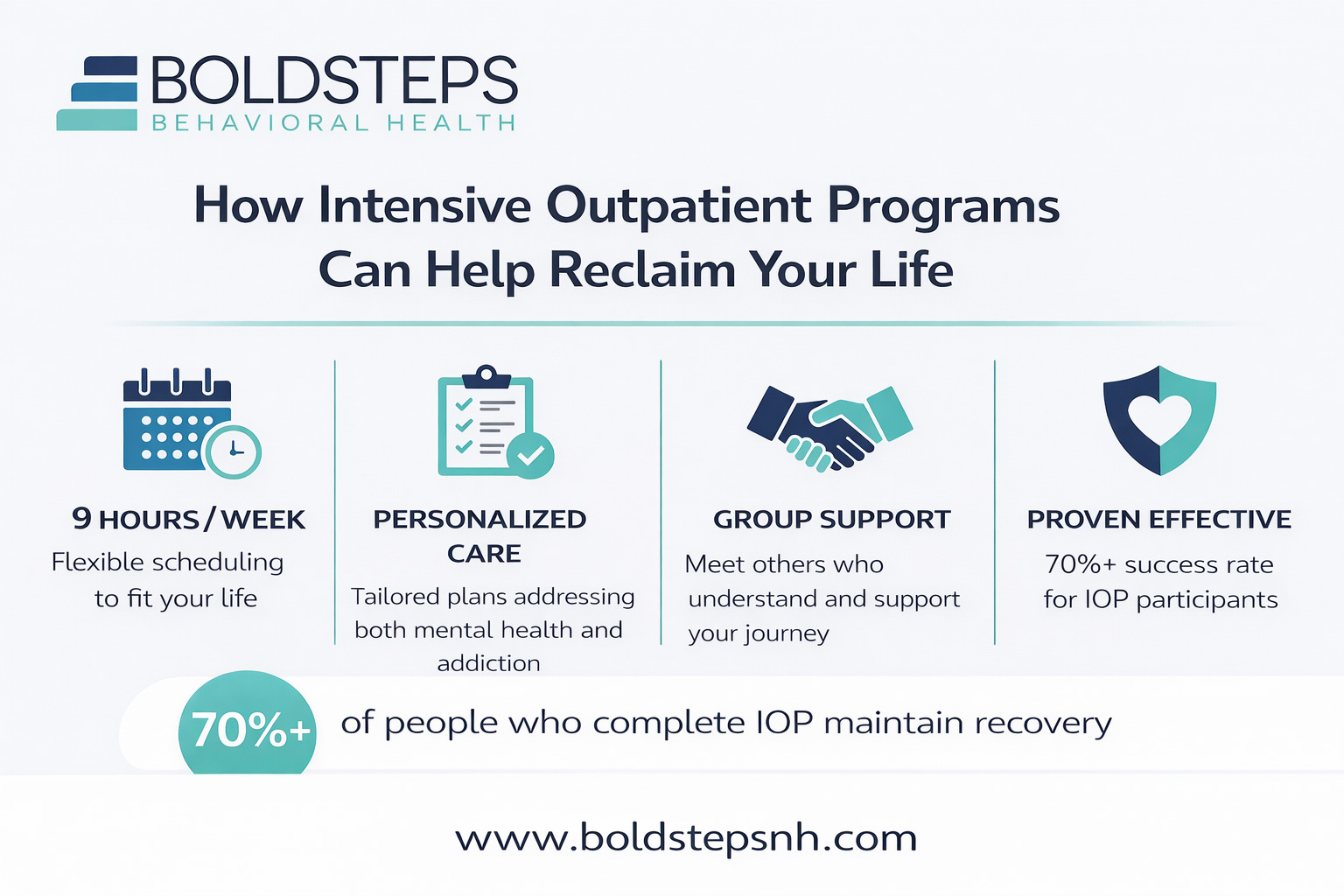
Yes. One of the best parts of intensive outpatient programs is flexibility. Bold Steps can work with you to build a plan that feels manageable and realistic.
Is it okay to come back if I’m actively using again?
Yes. Absolutely. IOP is built to support people wherever they are—including those still using. You don’t have to be “clean” to come back. You just have to be willing.
Ready to Take the First Step (Again)?
You don’t have to explain yourself.
You don’t have to be perfect.
You just have to reach out.
📞 Call (603)915-4223 or visit to learn more about our intensive outpatient program services in New Hampshire.
We’ll meet you with compassion, flexibility, and a place that still has room for you. And for those in Rockingham County, Merrimack County, Hillsborough County, or Essex County, we have nearby locations to make care accessible.
Because no matter how long you’ve been gone—the door is still open.