

The holidays are supposed to bring joy. But when your child is drinking again, everything feels off. The lights are up, the tree is decorated—but there’s a sadness under it all. If this isn’t the Christmas you imagined, take a breath. You’re not alone—and it’s not too late to find a different path forward.
At Bold Steps Behavioral Health, we work with parents across Concord and surrounding towns who are walking through the same heartbreak: loving a child who’s caught in alcohol addiction. And wondering how to hold the family together while they do.
The Holidays Bring Everything to the Surface
It’s not just the decorations or the traditions—it’s the weight of what’s missing. Laughter that feels forced. Conversations that dodge the real issues. A child who avoids eye contact. And a parent who’s exhausted trying to act like everything’s fine.
For some, this holiday season might be the first time you’re seeing just how serious things are. Maybe your son or daughter moved back home from college. Maybe you caught them sneaking alcohol again, or noticed that the mood swings and silence have gotten worse.
You might be thinking, “I thought we were past this. I thought treatment worked. I don’t know what to do anymore.”
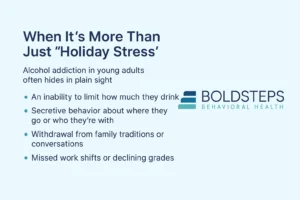
When It’s More Than Just “Holiday Stress”
Young adults are masters at minimizing. “I’m just stressed.” “Everyone drinks this time of year.” But when the stress fades and the drinking doesn’t—when it begins interfering with school, work, sleep, or relationships—it’s no longer about the holidays. It’s about addiction.
Alcohol addiction in young adults often hides in plain sight. It’s easy to write off as partying, experimentation, or growing pains. But when alcohol becomes a way to escape every feeling or function through daily life, it’s a warning sign that can’t be ignored.
You may be seeing:
- An inability to limit how much they drink
- Secretive behavior about where they go or who they’re with
- Withdrawal from family traditions or conversations
- Missed work shifts or declining grades
- Angry, defensive responses when questioned
This isn’t your fault. And it doesn’t mean you’ve failed.
Treatment Is Not a Last Resort—It’s a Lifeline
Parents often wait to reach out for help because they don’t want to overreact. They want to believe their child will grow out of it. That if they just say the right thing—or show enough love—they can pull them back.
But here’s the truth: addiction is not about love or effort. It’s a medical condition that alters how the brain makes decisions, handles stress, and seeks reward. And it needs more than parental support to heal.
That’s where alcohol addiction treatment comes in—not as a punishment, but as a structured, compassionate space for your child to begin again.
What Alcohol Addiction Treatment Offers (That Families Can’t Do Alone)
Even the strongest, most loving families can’t treat addiction on their own. And they shouldn’t have to. Quality alcohol treatment provides:
1. Structured Support
At Bold Steps, our programs offer consistency, accountability, and skilled guidance—things that often get lost in the emotional whirlwind of family life.
2. Evidence-Based Care
Our clinical team uses proven therapeutic approaches like CBT, motivational interviewing, and relapse prevention to help young adults understand their patterns and make lasting change.
3. Emotional Processing
Addiction doesn’t start in a vacuum. Therapy gives your child a place to explore trauma, grief, or identity questions that might be fueling their drinking.
4. Family Integration
We offer opportunities for parents and loved ones to be part of the healing process—because you deserve support, too.
Why Concord Families Trust Bold Steps
Located in Concord, NH, Bold Steps Behavioral Health serves families throughout Merrimack County, and surrounding areas like Rockingham County and Hillsborough County. We understand the needs of New Hampshire families—and we meet them with both clinical skill and deep compassion.
We know how hard it is to make this call. We’ve walked beside hundreds of families who thought their situation was too complicated, or too far gone. And we’ve seen what happens when the right help meets the right moment.
Rebuilding Trust: How Treatment Can Heal Families
Addiction takes a toll not just on the person drinking, but on everyone around them. Trust erodes. Communication breaks down. Parents find themselves walking on eggshells—never sure when to step in, and when to let go.
Treatment helps change that dynamic. Through individual and group therapy, your child starts to take responsibility for their behavior. And through family education and support, you gain tools to set healthy boundaries without cutting off connection.
It’s not instant. And it’s not easy. But it is possible.
“I learned I couldn’t love the addiction out of my son. But I could love him while he learned to love himself again.”
– Parent of a Bold Steps client
What If They’ve Already Been to Treatment?
This may not be your first rodeo. Maybe your child completed a program last year and seemed to be doing well—until they weren’t. Maybe you’re wondering if treatment “even works.”
Relapse does not mean failure. In fact, it’s part of the recovery process for many young adults. What matters is helping them re-engage with care in a way that’s compassionate, clear, and realistic.
At Bold Steps, we support clients who have been through other programs, who’ve dropped out, or who are hesitant to try again. We don’t shame. We rebuild.
If You’re Wondering If It’s Time—It Probably Is
There’s rarely a “perfect moment” to seek treatment. And waiting for things to get worse usually means… they do.
If your gut says something is wrong—listen to it. You don’t need to have all the answers. You don’t need to wait for your child to hit rock bottom. You just need to reach out.
Frequently Asked Questions About Alcohol Addiction Treatment
How do I know if my child really needs treatment?
If alcohol is impacting your child’s daily functioning—school, work, relationships, mental health—it’s time to explore support. You don’t need a formal diagnosis to start a conversation with a treatment provider.
What does alcohol treatment actually involve?
Treatment typically includes individual therapy, group therapy, life skills development, and relapse prevention strategies. At Bold Steps, we offer outpatient options that allow young adults to get care while still living at home or maintaining responsibilities.
Will my child be forced to go?
Treatment is most effective when the individual participates willingly. However, many people enter treatment ambivalently—and still find it transformative. We help clients explore motivation and commitment without pressure or shame.
Can families be involved in the process?
Absolutely. We offer family education, therapy sessions, and regular communication (with client consent) to ensure you’re supported and included.
How do I talk to my child about this without pushing them away?
Start with love, not lectures. Let them know you’re concerned because you care. Avoid accusations and stick to what you’ve noticed. Example: “I’ve seen how much you’ve been drinking lately, and I’m worried. I want to help you feel better—do you think we could talk to someone together?”
You Deserve a Different Kind of Holiday
If this Christmas feels heavy, that doesn’t mean joy is gone for good. It might just mean it’s time to shift what “togetherness” looks like.
You’ve done everything you know how to do. Now let us help with what comes next.
Ready to talk?
Call (603) 915-4223 to learn more about our alcohol addiction treatment services in Concord, NH. You are not alone. And you do not have to carry this alone.