

You’re getting everything done.
That’s the part people notice.
Deadlines met. Responsibilities handled. Conversations managed.
From the outside, you look steady—maybe even impressive.
But inside, it’s a different story.
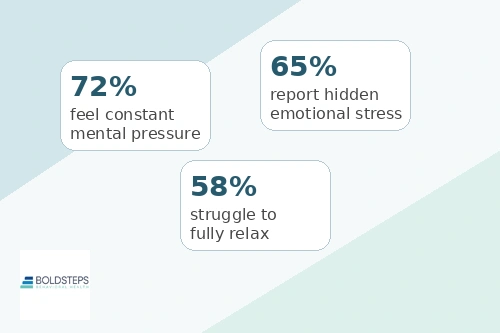
It’s constant pressure.
It’s mental noise that never fully shuts off.
It’s the feeling that if you stop pushing, everything might fall apart.
If that feels familiar, you’re not alone—and more importantly, you’re not “fine” just because you’re functioning.
If you’ve been quietly considering something like structured support for emotional regulation, it’s not because you’re weak.
It’s because something in you knows this isn’t sustainable.
High-Functioning Is Often Just Well-Hidden Struggle
Let’s be honest about what “high-functioning” usually means.
It doesn’t mean you’re okay.
It means you’ve learned how to keep going while not being okay.
You’ve learned to:
- Show up even when you’re overwhelmed
- Stay productive even when your mind is racing
- Keep conversations normal while your thoughts spiral internally
You’ve built a version of yourself that can perform under pressure.
But performance is not the same as peace.
And eventually, the gap between those two starts to wear on you.
The Exhaustion You Can’t Explain to Anyone
Most people in your life don’t see it.
They see capability.
They see reliability.
They see someone who “has it together.”
What they don’t see is what it takes to maintain that image.
The overthinking.
The emotional spikes you hide.
The way your body never fully relaxes.
And especially the crash.
That moment at the end of the day when everything you’ve been holding in finally hits—and you don’t even know how to process it.
This is where a lot of high-functioning people quietly unravel.
Not publicly.
But internally, where no one can interrupt it.
You’ve Adapted So Well That It Feels Normal
Here’s the tricky part.
You may not even recognize how much you’re carrying—because you’ve been carrying it for so long.
You’ve normalized:
- Constant internal tension
- Pushing through emotional discomfort
- Ignoring what you feel in order to stay productive
It just feels like life.
But adaptation doesn’t mean it’s healthy.
It just means you’ve gotten used to it.
And that’s why the exhaustion can feel confusing—you don’t have anything obvious to point to.
You’re just… tired.
What Actually Changes When You Learn Regulation
There’s a difference between coping and regulating.
Coping says: get through it.
Regulating says: understand it, respond to it, and recover from it.
When people begin learning real emotional regulation skills, the shift isn’t dramatic at first—but it’s noticeable.
They start to:
- Catch themselves earlier in emotional spirals
- Pause before reacting
- Feel emotions without immediately trying to escape them
- Recover faster after stress
In environments like an emotion regulation class Concord, this work becomes practical.
It’s not just talking about why you feel the way you feel.
It’s learning what to do when those feelings show up in real time.
And that’s where things begin to change.
A Story That Might Feel Uncomfortably Familiar
I worked with someone—let’s call him Jason.
From the outside, Jason was exactly what people would describe as “high-functioning.”
Career on track. Socially capable. Always dependable.
But in our first session, he said something that stuck:
“I don’t fall apart. I just never feel okay.”
That’s the part people don’t talk about.
Jason wasn’t struggling in ways that disrupted his life externally.
But internally?
- He replayed conversations constantly
- He felt on edge most of the day
- He crashed hard at night, mentally and emotionally
He didn’t need to be “fixed.”
He needed relief.
As he started learning regulation skills, the changes were subtle but powerful:
- He stopped reacting instantly to stress
- He noticed patterns he’d never seen before
- He allowed himself to experience emotions without judging them
A few months in, he said:
“It’s not that my life changed. It’s that I’m not fighting myself all day anymore.”
That’s the shift.
Why High-Functioning Keeps You Stuck Longer Than You Think
Here’s the uncomfortable truth.
Being high-functioning can delay getting real help.
Because you can still perform, you convince yourself:
- “It’s not that bad.”
- “Other people have it worse.”
- “I should be able to handle this.”
So you wait.
And while you wait, the internal strain keeps building.
Not always in obvious ways—but in quiet ones:
- Increased irritability
- Emotional numbness
- Mental fatigue that doesn’t go away
You don’t need to hit a breaking point to justify support.
The fact that it feels hard is enough.
This Isn’t About Losing Control—It’s About Finally Having It
A lot of high-functioning people are afraid of one thing:
“If I stop holding everything together, I’ll fall apart.”
But that’s not what this work does.
You’re not being asked to let go of control.
You’re learning a different kind of control.
The kind that doesn’t rely on suppression or force.
Real control looks like:
- Staying present during stress instead of escaping it
- Responding thoughtfully instead of reacting instantly
- Not needing to shut down at the end of the day
It’s steadier.
Quieter.
And a lot less exhausting.
You Don’t Have to Keep Proving You’re “Fine”
There’s a quiet pressure that comes with being high-functioning.
You feel like you have to maintain it.
To keep showing people that you’re okay.
To keep meeting expectations.
To keep everything running smoothly.
But here’s something worth considering:
Who are you doing that for?
And what is it costing you?
People across Hillsborough County, New Hampshire often reach a point where managing stops feeling sustainable—even if everything still “looks fine” on the outside. Others in Nashua, New Hampshire come to the same realization after years of pushing through without real relief.
The common thread isn’t failure.
It’s awareness.
What People Realize After They Start
There’s a moment that happens for many people once they begin this work.
It’s not dramatic.
It’s not a breakthrough.
It’s quieter than that.
They realize:
“I don’t have to live like this.”
Not in the sense that everything becomes easy.
But in the sense that:
- The intensity softens
- The constant tension eases
- The need to constantly perform fades
And in its place, something else shows up.
Space.
Room to think.
Room to feel.
Room to just exist without pushing so hard.
Frequently Asked Questions
If I’m functioning, do I really need help?
Functioning doesn’t mean you’re not struggling. Many people who appear “fine” are dealing with significant internal stress. Support is about improving your quality of life—not just maintaining it.
What if I’m used to handling things on my own?
That’s common. But handling everything alone doesn’t mean it’s working—it just means it’s familiar. Learning new skills can reduce the pressure you’ve been carrying.
Will this make me less productive?
No. In many cases, people become more focused and effective because they’re no longer drained by constant internal stress.
How long does it take to notice a difference?
Some people notice small shifts within weeks—especially in how they respond to stress. Larger changes build gradually over time.
What if I don’t feel “bad enough” for therapy?
There’s no threshold you have to meet. If something feels off, exhausting, or unsustainable, that’s enough reason to explore support.
Is this about changing who I am?
Not at all. It’s about helping you feel more stable, more present, and less overwhelmed—not becoming someone different.
You don’t have to keep managing at this level just to prove you can.
You don’t have to wait until it gets worse.
And you don’t have to do it alone.
Call (603)915-4223 to learn more about our Dialectical Behavior Therapy in Concord, New Hampshire.
If this felt familiar, it’s not random.
It means something in you is ready for a different way of living—
one that doesn’t require constant effort just to feel okay.
And that’s a strong place to start.