

You see it happen almost like a pattern now.
The day starts tense… builds… and then everything crashes.
And you’re left standing there, wondering what just happened—and how to help the next time it does.
If you’ve been searching for answers, trying to understand why your child’s emotions feel so intense and unpredictable, you’re not alone. Many parents quietly carry this same confusion and fear. And there is a way to begin making sense of it.
If you want to understand one of the most effective approaches used in these situations, you can explore therapy options designed for emotional regulation that focus on helping your child stabilize—not suppress—what they’re feeling.
The Emotional Swings You’re Seeing Are Real—and They’re Exhausting
There’s a specific kind of exhaustion that comes from watching someone you love struggle like this.
It’s not just the intensity—it’s the unpredictability.
One moment they’re okay.
The next, something small sets everything off.
And by the end of the day, they’re completely depleted—or completely overwhelmed.
Parents often describe it as emotional whiplash. You try to adjust, to stay steady, to respond the “right” way—but it keeps changing.
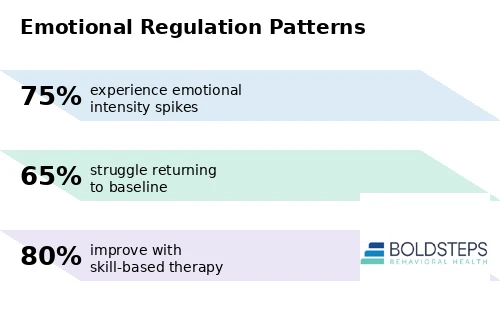
When someone experiences emotional dysregulation symptoms adults, their internal system has a harder time returning to baseline. Emotions rise quickly, hit hard, and take longer to come back down.
This isn’t something they’re choosing.
It’s something they’re struggling to manage.
It’s Not Defiance—It’s a System That’s Overloaded
From the outside, it can look like:
- Overreacting
- Shutting down
- Pushing people away
- Escalating small situations
But underneath that behavior is something much more human.
Overload.
Your child may not have the internal tools to slow things down once they start building. Their brain is reacting quickly, intensely, and without a reliable “pause” button.
That’s why reasoning doesn’t always work in the moment.
That’s why conversations spiral.
That’s why things feel so out of control—for both of you.
This isn’t about discipline.
It’s about capacity.
Why Traditional Conversations Sometimes Fall Short
You’ve probably tried talking it through.
Explaining.
Encouraging.
Trying to help them “see it differently.”
And sometimes, it just doesn’t land.
That’s not because you’re saying the wrong things.
It’s because when emotions are this intense, logic often comes too late. By the time you’re trying to talk things through, your child’s system is already flooded.
Think of it like trying to teach someone to swim while they’re actively drowning.
They don’t need a lecture.
They need something to hold onto.
This Is Where Skill-Based Therapy Changes the Direction
There’s a type of therapy that focuses less on talking about emotions—and more on learning how to handle them.
Instead of asking your child to “just calm down,” it teaches:
- How to recognize early emotional signals
- How to interrupt escalation before it peaks
- How to tolerate distress without making things worse
- How to come back down safely after emotional spikes
These are practical, real-time skills.
Not theories.
Not abstract ideas.
Tools they can actually use in the moment things start to unravel.
And that shift—from reacting to responding—can change everything over time.
Why This Approach Is Often Recommended in Crisis Moments
When things feel urgent, parents often look for something that works quickly.
But what’s actually needed is something that works consistently.
This approach is often recommended because:
- It gives structure when everything feels chaotic
- It focuses on real-life situations, not just insight
- It builds skills that can be practiced daily
- It creates a sense of stability over time
It doesn’t promise overnight change.
But it does offer something more important: direction.
A way forward that doesn’t rely on guesswork.
You’re Carrying More Than Anyone Sees
There’s something else that often goes unspoken.
The emotional toll this takes on you.
You’re trying to stay calm while everything feels unstable.
You’re trying to say the right thing while second-guessing yourself.
You’re trying to help without making things worse.
And underneath all of that is fear.
Fear for their future.
Fear of saying the wrong thing.
Fear that you’re somehow missing something.
You’re not.
You’re responding the best you can in a situation that doesn’t come with a clear manual.
You Don’t Have to Be the Only Support System
One of the biggest shifts for parents is realizing:
You don’t have to hold all of this alone.
Support doesn’t replace you—it supports you too.
It gives your child:
- A neutral space to learn and practice
- Guidance from someone trained in emotional regulation
- Consistency outside of family dynamics
And it gives you:
- Breathing room
- Clarity
- A sense that you’re not the only one trying to hold things together
Families in Hillsborough County, New Hampshire often begin this process quietly—just exploring options, asking questions, and trying to understand what might actually help. Others in Essex County, Massachusetts take that same step after reaching a point where guessing no longer feels sustainable.
No one starts this process feeling fully ready.
They just start.
What Improvement Actually Looks Like (And Why It’s Easy to Miss)
It’s important to reset expectations here.
Progress isn’t dramatic.
It doesn’t look like everything suddenly becoming calm and predictable.
Instead, it often looks like:
- A shorter emotional outburst
- A pause before reacting
- A moment of awareness during escalation
- A slightly faster recovery afterward
These are small shifts—but they matter.
They’re signs that something is starting to stabilize.
Think of it like building muscle. You don’t see it after one workout—but over time, strength develops.
That’s what’s happening here.
The Goal Isn’t to Change Who They Are
This matters more than most people realize.
The goal is not to make your child less emotional.
It’s not to flatten their personality.
It’s not to “fix” who they are.
The goal is to help them:
- Feel emotions without being overwhelmed by them
- Stay connected instead of shutting down
- Respond in ways that don’t create more pain
It’s about building regulation—not removing emotion.
And that’s a very different thing.
Starting Doesn’t Mean Committing to Everything
You don’t have to map out a long-term plan today.
You don’t have to decide everything about treatment.
You can start with:
- A conversation
- A consultation
- Learning more about what support looks like
That’s enough.
Because once you take one step, the next one becomes clearer.
Frequently Asked Questions
Is this something my child will grow out of?
Sometimes emotional intensity shifts with time, but when patterns are persistent and disruptive, support can make a significant difference. Waiting without guidance can often prolong the struggle.
What if my child refuses help?
This is very common. Starting with small steps—like education, consultation, or even parent support—can still create movement. Change doesn’t always start where you expect.
How quickly does this type of therapy work?
There’s no instant fix. However, many families begin to notice small but meaningful changes within weeks—especially in how situations are handled.
Will this change my child’s personality?
No. The goal is not to change who they are, but to help them manage emotions in a way that feels more stable and less overwhelming.
What can I do at home in the meantime?
Focus on consistency, calm responses, and reducing escalation where possible. You don’t need perfect responses—you need steady ones.
Is it normal to feel this overwhelmed as a parent?
Yes. Completely. This is an incredibly difficult position to be in, and most parents feel exactly what you’re feeling—fear, confusion, and exhaustion.
You don’t need to have all the answers right now.
You just need a place to start.
Call (603)915-4223 to learn more about our Dialectical Behavior Therapy in Concord, New Hampshire.
You’re trying to help someone you love through something that feels bigger than both of you.
That’s not failure.
That’s care.
And care—steady, persistent care—is where change begins.