

“Are people going to think I’m in a psych ward?”
It’s not a silly question. It’s a smart one—born from fear, and from the fact that no one really explains what structured treatment actually looks like unless you’re already deep in the mental health world. For high-functioning adults—those who look fine, work fine, smile fine—being recommended for a higher level of support can feel like being handed a diagnosis stamped in all caps: BROKEN.
If that’s where your mind went, let’s pause for a second.
You are not broken. You are overloaded.
And this recommendation? It’s not a sentence—it’s a lifeline.
What People Think This Level of Care Looks Like
Here’s what people often imagine:
Psych ward. Locked doors. People screaming. You in a hospital gown, monitored around the clock, cut off from your life, your people, your routine.
What It Actually Looks Like
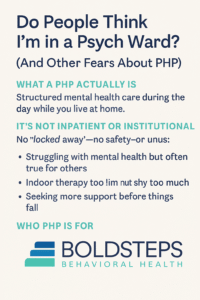
A Partial Hospitalization Program (PHP) offers structured, daytime mental health support—while allowing you to return home each evening.
You don’t sleep at the clinic. You don’t lose your phone. You don’t vanish from your life.
Instead, you spend several hours a day in therapy, skill-building, and support, then return to your own space to rest and reset.
When “Fine” Stops Being Enough
Some of the people who enter PHP have spent years perfecting their masks. They’ve pushed through panic attacks by calling them “bad days.” They’ve called emotional shutdown “just needing space.” They’ve told their bosses they’re fine when they’re losing sleep every night and crying in the car between meetings.
So when they hear “partial hospitalization program,” what they actually hear is:
“You weren’t holding it together as well as you thought.”
But here’s what it really means:
You’ve been carrying too much, for too long, in silence—and now there’s a place where you can finally set it down.
You don’t need to hit rock bottom to ask for more help. You just have to stop pretending you’re not tired.
Why PHP Doesn’t Mean You’ve “Failed Out” of Therapy
Let’s talk about another fear: that PHP is something you get “sent to” when therapy doesn’t work. Like it’s punishment for not improving fast enough.
It’s not.
Weekly therapy is important. But for people dealing with major depression, anxiety, trauma, or other persistent mental health challenges—it’s like tossing a life jacket to someone in a storm. Helpful, yes. But not enough to get them to shore.
PHP is the rescue boat.
It gives you multiple hours of care per day, several days a week, with a team that actually sees and supports your whole picture—not just the version of you that shows up for 50 minutes and smiles through the tears.
What You Keep When You Enter PHP (Spoiler: It’s Everything)
People worry they’ll lose their job. Their role as a parent. Their sense of identity.
But here’s what most clients find instead:
They get more of their life back. More clarity. More capacity. More energy to actually show up instead of just survive.
And no, you don’t have to tell your job you’re in a “hospital program.” If needed, we can help you talk about it in ways that respect your privacy—whether that’s through FMLA, flexible scheduling, or simple scripts you can use to inform HR without sharing every detail.
“What If People Judge Me?”
Let’s be honest: someone might. Maybe a friend who doesn’t get it. Maybe a coworker who thinks mental health treatment is “too much.” Maybe even a part of you that still buys into the stigma.
But those voices? They aren’t living your life. They aren’t the ones waking up exhausted, snapping at your partner, or silently panicking in the grocery store.
You are.
And you deserve a space where you’re allowed to be messy, human, and healing.
PHP doesn’t make you weak. It makes you willing.
PHP Isn’t a Psych Ward. It’s a Reset Button.
People walk into our Concord partial hospitalization program scared, skeptical, or convinced it won’t help.
They walk out with language for what they’re feeling. A treatment plan that fits. A team that sees them clearly.
And often—relief.
We’ve watched people go from barely functioning to laughing again. Making decisions again. Wanting to wake up again.
Is it always easy? No. But it’s real care. The kind that actually meets you where you are—and helps you move.
FAQ: What You Might Still Be Wondering About PHP
Is a partial hospitalization program the same as being hospitalized?
No. PHP is outpatient care, which means you live at home and come in during the day for structured support. It’s not inpatient, and it’s not a locked facility.
How long is a typical PHP stay?
It varies. Most programs last between 2 to 6 weeks, depending on your needs. Some people transition to a lower level of care like IOP (intensive outpatient) after that.
Can I keep working while in PHP?
Many clients do, especially with flexible or part-time jobs. We can also help with documentation for medical leave if needed.
Will I have to explain this to people?
Only if you want to. Some clients say they’re “in a recovery program,” “taking a mental health leave,” or simply “handling health stuff.” We can help you decide what feels right.
What if I start and it’s too much?
That’s okay. We adjust your plan based on how you’re doing. PHP is designed to be supportive—not overwhelming.
Take the Step That Scares You (It’s Usually the Right One)
If you’re here, reading this, you already know something needs to change. That doesn’t make you weak. It makes you awake.
You don’t have to hide how heavy things feel anymore.
You don’t have to downplay your pain.
And you don’t have to disappear into a facility to get better.
📞 Call (603) 915-4223 or visit our partial hospitalization program page to learn more about how PHP can meet you where you are—without locking you away.