

It’s okay to wonder if help will really help.
When you’re already drained, stuck, or barely making it through the day, it’s normal to ask yourself, “What if treatment doesn’t work for me?”
At Bold Steps Behavioral Health in Concord, NH, we hear this question often—and not from people in denial. We hear it from people who want help, who are trying to believe in change, but still carry doubt like a weight in their chest.
If that’s you, this blog is for you. Not to convince you with a sales pitch, but to offer something quieter and more important: evidence, honesty, and hope.
What Does the Research Say About Depression Treatment?
First, yes—depression treatment is effective.
Multiple large-scale studies have shown that structured treatment can significantly reduce depression symptoms for most people. This includes:
- Therapy: Especially cognitive behavioral therapy (CBT), which helps people reframe negative thought patterns and practice new ways of responding to distress.
- Medication: Antidepressants such as SSRIs or SNRIs can help regulate brain chemistry and ease persistent symptoms.
- Combination treatment: For moderate to severe depression, using both therapy and medication often leads to better outcomes than using one alone.
But here’s something the research also tells us: the most effective treatments are those tailored to the person—not the diagnosis.
That’s where real clinical experience comes in.
Real Healing Isn’t Instant—But It’s Real
In our experience working with clients from Merrimack County, Essex County, MA and surrounding areas, recovery often doesn’t look like a breakthrough moment. It looks like a quiet shift that builds over time.
You might not even notice it at first.
- One week, you’re just trying to show up.
- The next, you’re getting out of bed without that same pit in your stomach.
- A month later, you laugh—genuinely—for the first time in a while.
- And slowly, you start feeling like a person again.
There’s no set timeline. No guaranteed path. But we’ve seen it work—for people who were deeply skeptical, and for people who thought they’d tried everything.
If You’ve Tried Treatment Before and It Didn’t Help—You’re Not Alone
One of the hardest things about seeking help again is the fear that this time will feel like last time.
Maybe you saw a therapist who felt distant or didn’t get you.
Maybe a medication made you feel worse, not better.
Maybe you couldn’t stick with it because life got in the way.
None of that means treatment “doesn’t work.” It means your experience of treatment didn’t work—and that distinction matters.
At Bold Steps, we take that seriously. Before we offer a plan, we listen. We don’t push strategies that don’t match your personality or needs. We don’t assume anything based on your diagnosis. You’re not a checklist—you’re a person.
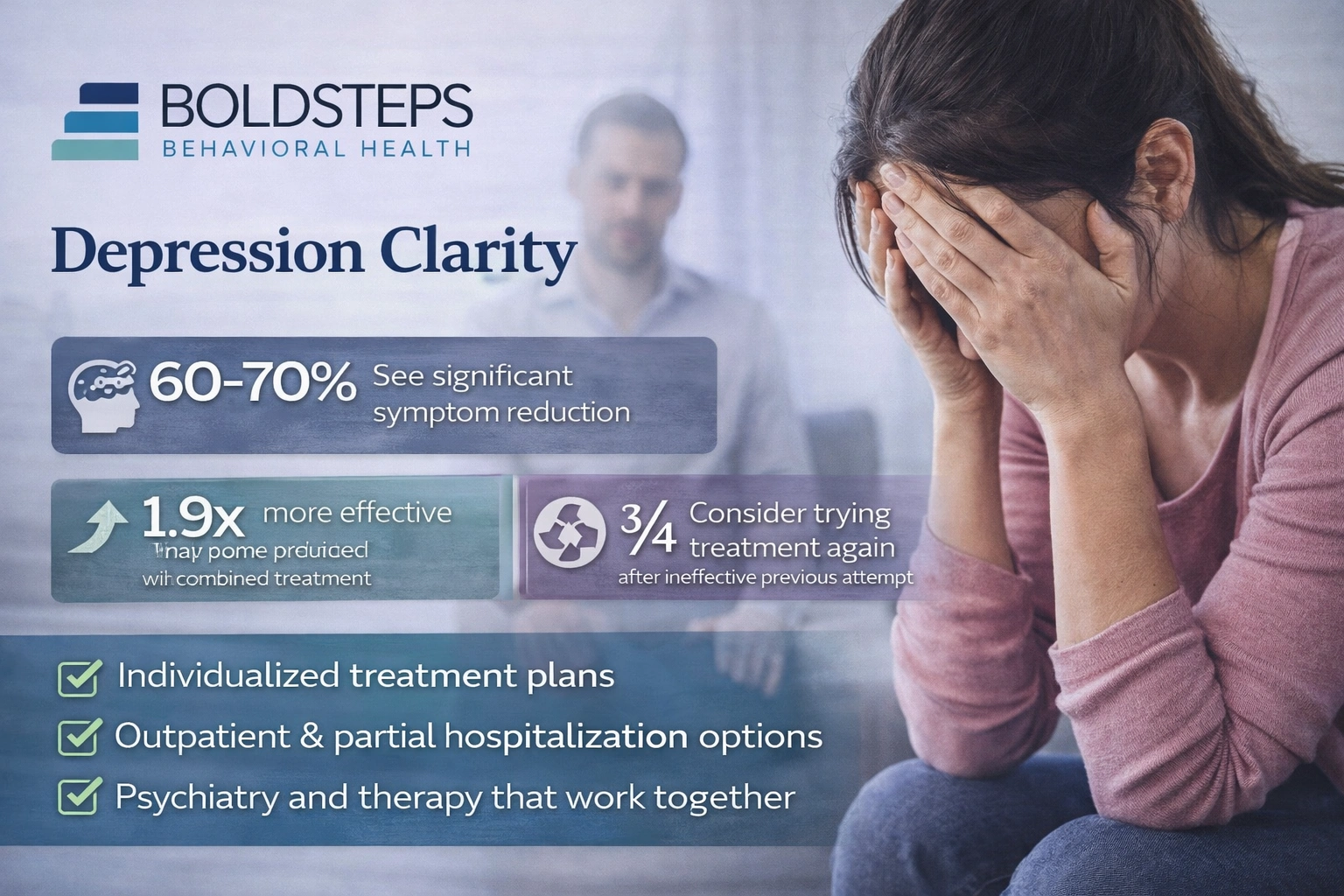
Depression Affects More Than Just Your Mood
Effective depression treatment isn’t just about managing emotions. It’s about addressing the real-world ways that depression takes hold:
- Energy levels drop.
- Sleep gets disrupted.
- Appetite shifts or disappears.
- Responsibilities pile up.
- Motivation evaporates.
- Shame and guilt creep in.
And underneath it all, there’s often this quiet voice whispering, “You should be able to fix this.”
We want to be clear: depression isn’t a moral failure or a lack of willpower. It’s a real mental health condition that deserves real care—and you don’t have to go through it alone.
Looking for depression treatment in Rockingham County, NH? Our Concord location offers support for people across Southern New Hampshire.
The Bold Steps Approach to Depression Treatment
Our depression treatment program in Concord, NH offers multiple levels of care so that we can meet you where you are:
- Outpatient therapy for those starting to explore help or continuing long-term care
- Partial hospitalization (PHP) for those needing structured daytime support while still living at home
- Psychiatric support and medication management when appropriate
- Group therapy to help reduce isolation and build connection
- Evidence-based and trauma-informed therapy that respects your pace, your needs, and your voice
Whether you’re just starting or returning to care, our goal is the same: to help you feel like yourself again—without pressure, shame, or pretense.
What Getting Better Actually Looks Like
Let’s be honest. The word “better” can feel out of reach when you’re deep in depression. But we’ve seen it happen. And it doesn’t always look dramatic—it often looks beautifully ordinary.
“Better” might look like:
- Opening your curtains before noon
- Answering a text from a friend
- Cooking a meal instead of skipping dinner
- Not believing the voice in your head that says you’re worthless
- Feeling neutral instead of hopeless—and then, maybe, a little bit hopeful
Every step counts. And no step is too small to celebrate.
You Don’t Have to Be Fully “Ready” to Start
So many people wait to reach out until they’re in crisis. But here’s the truth: you don’t have to wait that long.
You can come to us with uncertainty.
You can come with doubts.
You can come with one tiny spark of curiosity that something else might be possible.
That’s enough. We’ll help you build from there.
FAQs About Depression Treatment at Bold Steps
How long does depression treatment take?
It depends on the severity of your symptoms, the type of treatment, and your goals. Some clients see improvement in weeks; others may need longer-term support. Healing isn’t a race—it’s a process.
Do I have to take medication?
No. We believe in collaborative care. Medication can be helpful, especially for moderate to severe depression, but we’ll never force it. We work with you to find the right path.
Is therapy just talking about feelings?
Not at all. While emotional expression is part of it, modern therapy includes practical skills, problem-solving tools, and even creativity or movement-based approaches, depending on your needs.
What’s the difference between PHP and regular therapy?
PHP (partial hospitalization program) is more intensive. You attend structured sessions several hours a day, several days a week. It’s ideal when weekly therapy isn’t enough, but you don’t need 24/7 inpatient care.
What if I don’t know how to start?
You don’t need to. Call us, and we’ll walk you through it step by step. No pressure, no judgment—just clarity and support.
You don’t have to carry this alone.
Call (603) 915-4223 to learn more about our depression treatment services in Concord, NH. Whether you’re ready to begin or just need someone to talk to, we’re here.