

A lot of people delay getting help for depression because they believe there are only two options:
Keep struggling quietly… or completely disappear from normal life.
That belief traps people in suffering far longer than they need to stay there.
We speak with people every week who are still going to work, answering texts, caring for children, attending classes, and technically “functioning” — while privately feeling emotionally exhausted almost all the time.
Some describe it as numbness.
Others describe it as heaviness.
Some say they feel disconnected from themselves completely.
And many are scared that asking for help means life will suddenly become unrecognizable.
The reality is more nuanced than that.
For many people, support begins through flexible care options like depression treatment options that allow them to receive structured help while remaining connected to everyday life.
Step 1: Stop Measuring Your Pain Against Other People
This is one of the biggest reasons people wait too long.
They compare themselves constantly:
- “Other people have it worse.”
- “I’m still getting things done.”
- “I’m not staying in bed all day.”
- “I’m functioning.”
- “I should be able to handle this.”
But depression does not always look dramatic.
Sometimes it looks like:
- Smiling through exhaustion
- Cancelling plans because socializing feels impossible
- Feeling emotionally flat all the time
- Struggling to focus
- Sleeping too much or not enough
- Feeling disconnected from your own life
- Moving through each day like your brain is wrapped in wet cement
A lot of people become so focused on appearing functional that they stop noticing how much pain they’re carrying internally.
You do not need to completely fall apart before you deserve support.
That idea has harmed a lot of people.
Step 2: Pay Attention to How Long You’ve Been Surviving Instead of Living
Many people searching for help aren’t in immediate crisis.
They’re exhausted.
There’s a difference.
Sometimes depression develops quietly over time:
- Motivation slowly fades
- Joy becomes harder to access
- Everyday tasks start requiring enormous effort
- Isolation increases
- Emotional resilience shrinks
- Anxiety grows underneath everything
And because these changes happen gradually, many people normalize them.
They convince themselves:
“This is just stress.”
“This is adulthood.”
“I’m just burned out.”
Meanwhile months pass.
Sometimes years.
One thing we hear often is:
“I didn’t realize how bad I felt until I had one slightly better day.”
That sentence says a lot.
Depression can slowly narrow a person’s world without them fully noticing it happening.
Step 3: Understand That Treatment Does Not Always Mean Pressing Pause on Your Entire Life
This is where many people feel relief.
Not everyone needs live-in care or round-the-clock support.
Some individuals benefit from weekly therapy.
Others need more structure and consistency because symptoms are interfering with daily life more significantly.
That’s where options like multi-day weekly treatment sometimes become helpful.
People exploring an IOP for low mood Concord option are often looking for support that feels more intensive than occasional therapy — but still allows them to remain connected to work, family, or everyday responsibilities.
For many people, this level of care offers:
- Consistent emotional support
- Multiple therapy sessions weekly
- Coping skill development
- Accountability
- Group connection
- More structure during difficult periods
And importantly, it often helps people stabilize before life becomes completely unmanageable.
Step 4: Be Honest About What “Functioning” Is Costing You
A lot of high-functioning depression hides behind productivity.
Someone may still:
- Show up to work
- Meet deadlines
- Care for family
- Attend social events
- Look “fine” externally
Meanwhile internally:
- They feel numb
- They dread mornings
- They cry privately
- They feel emotionally detached
- Their nervous system never fully relaxes
- Everything feels harder than it should
Some people are surviving by using every ounce of available energy just to appear normal.
That level of emotional strain is not sustainable forever.
Like carrying grocery bags that cut deeper into your hands every block, eventually the weight becomes impossible to ignore.
And honestly, many people don’t seek help because they suddenly became weak.
They seek help because they’re tired of white-knuckling their way through life.
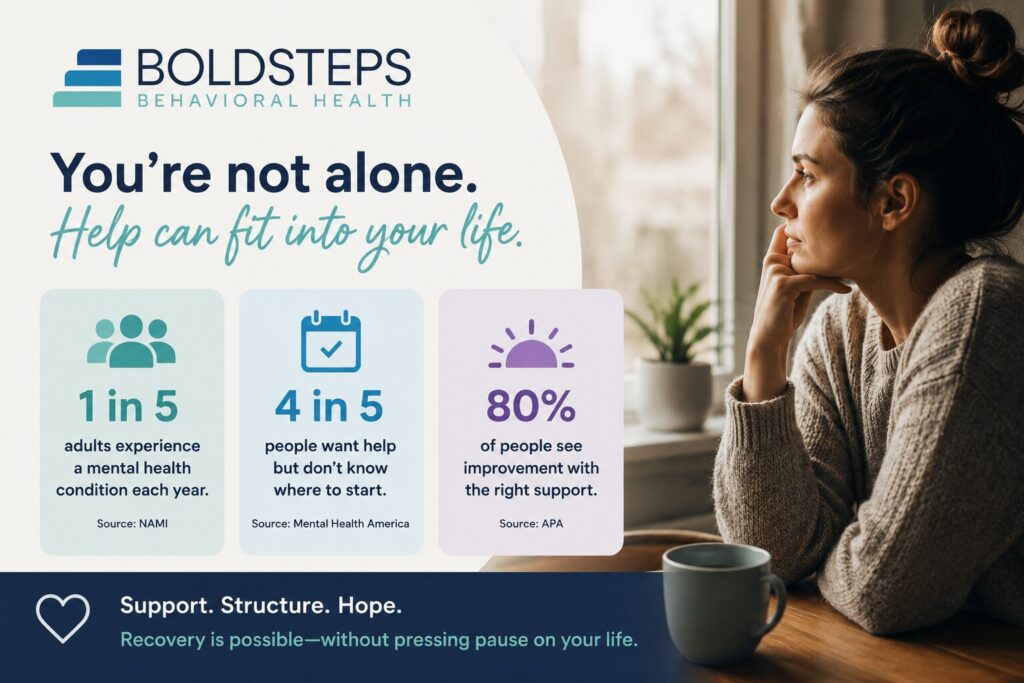
Step 5: Let Go of the Fear That Needing Support Means You Failed
This fear keeps many people stuck.
Especially people who are used to being:
- Independent
- Reliable
- Responsible
- Productive
- “The strong one”
Depression can feel deeply personal in those situations.
People start believing:
“I should be able to fix this myself.”
But mental health support is not a punishment for failing.
It’s support for being human.
Sometimes people need additional structure because their coping system is overloaded.
Sometimes stress, isolation, anxiety, burnout, trauma, or emotional exhaustion reach a point where more consistent support becomes necessary.
That does not make someone broken.
In fact, some of the strongest people we meet are the ones finally willing to say:
“I don’t want to keep living like this.”
That honesty can become the beginning of real change.
Step 6: Don’t Wait for Motivation to Magically Return Before Reaching Out
This is important.
A lot of people believe they need to “feel ready” before seeking help.
But depression often affects motivation itself.
Waiting to suddenly feel energized enough to fix everything can become part of the cycle.
Sometimes healing begins before hope fully returns.
Sometimes the first step is simply:
- Making the phone call
- Scheduling an assessment
- Asking questions
- Admitting things feel difficult
- Allowing another person to help carry the weight
You do not need complete certainty before reaching out.
You do not need a perfect explanation for your feelings.
And you do not need to justify your pain by making it worse first.
Step 7: Build a Version of Recovery That Fits Real Life
This matters more than people realize.
The goal of depression treatment is not simply temporary symptom reduction.
The goal is helping someone build a life that feels emotionally sustainable.
That may involve:
- Learning healthier coping tools
- Processing chronic stress
- Improving emotional regulation
- Building routine and structure
- Addressing isolation
- Developing self-awareness
- Creating better boundaries
- Reconnecting with relationships
- Feeling emotionally present again
Not every person needs the same path.
Some need more intensive support temporarily.
Others need flexible therapeutic structure while maintaining daily responsibilities.
The important thing is that support exists in more forms than many people realize.
Sometimes Depression Doesn’t Feel Sad — It Feels Empty
This surprises people often.
Depression is not always constant crying or visible despair.
For many individuals, it feels more like:
- Numbness
- Detachment
- Irritability
- Brain fog
- Emotional exhaustion
- Difficulty caring about things
- Feeling disconnected from joy
- Existing on autopilot
That emotional flattening can become frightening over time.
Especially for people who remember feeling more alive before.
One person described it this way:
“I didn’t want to die. I just stopped feeling fully present inside my own life.”
That distinction matters.
And it’s often one of the reasons people begin seeking more support.
Healing Often Starts Smaller Than People Expect
A lot of people imagine treatment as one dramatic breakthrough moment.
Usually it’s quieter than that.
Someone sleeps through the night for the first time in months.
Someone notices they laughed naturally again.
Someone realizes they made it through a stressful day without emotionally collapsing afterward.
Someone feels understood instead of judged.
Those moments matter.
Because depression recovery is rarely about becoming a completely different person overnight.
It’s about slowly feeling connected to yourself again.
FAQ: Getting Help for Depression Without Full-Time Treatment
Do I have to leave work to get treatment for depression?
Not always. Many people receive structured mental health support while continuing to work, attend school, or manage family responsibilities.
What if I’m still functioning normally?
Many individuals with depression continue functioning outwardly while struggling internally. Functioning does not mean you aren’t suffering.
How do I know if I need more than weekly therapy?
If symptoms are consistently affecting motivation, emotional stability, relationships, work performance, sleep, or daily functioning, more structured support may help.
What does outpatient depression treatment usually involve?
Programs often include individual therapy, group therapy, coping skill development, emotional regulation work, and structured mental health support several times weekly.
Is depression treatment only for severe situations?
No. Many people seek support before reaching a crisis point. Early support can help prevent symptoms from worsening over time.
What if I feel nervous about reaching out?
That’s extremely common. Many people feel uncertain, ashamed, overwhelmed, or afraid of being judged. Often the first step is simply having a conversation about what’s been going on.
Can treatment help if I mostly feel emotionally numb?
Yes. Emotional numbness, detachment, burnout, and loss of motivation are all common depression symptoms that treatment can help address.
Is it possible to improve without stepping away from normal life completely?
For many people, yes. Treatment plans can often be tailored based on symptoms, responsibilities, stability, and personal needs.
What if I don’t know whether my depression is “serious enough”?
You do not need to prove your suffering before asking for support. If life consistently feels heavy, emotionally exhausting, or unsustainable, that matters.
Call (603)915-4223 or visit conditions, depression services to learn more about our conditions, depression services in Rockingham County, NH.