

You tell yourself you’ll handle things differently next time.
You mean it when you say it.
But then the moment comes—and something automatic takes over.
Same thoughts. Same reactions. Same outcome.
It doesn’t feel like a choice anymore. It feels like a loop.
If that’s where you are right now—curious, a little frustrated, maybe even a little tired of your own patterns—you’re not stuck. You’re just running a system you haven’t been shown how to interrupt yet.
If you’re open to trying something different, you can start by exploring practical therapy that helps shift thought patterns. Not by forcing yourself to change—but by understanding what’s actually happening underneath the surface.
Step 1: Recognize That Habits Start Before the Behavior
Most people think the problem is what they do.
But the real starting point is earlier than that.
There’s always a thought—quick, automatic, and easy to miss—that shows up first.
It might sound like:
- “I’ll deal with this later.”
- “I deserve a break.”
- “This will help me feel better.”
That thought is the spark.
And once it shows up, the rest of the pattern follows almost automatically.
The first shift isn’t stopping the behavior.
It’s learning to notice that spark.
Step 2: Catch the Thought While It Still Feels Small
By the time a habit is in motion, it feels hard to stop.
That’s because it’s already built momentum.
But earlier in the process, there’s a window—small, but real—where things are still flexible.
This is where cognitive behavioral techniques anxiety become useful in a practical way.
You begin to recognize:
- “This is that same thought again.”
- “I’ve followed this before—I know where it goes.”
And instead of getting pulled in automatically, you start to observe it.
Not perfectly. Not every time.
But enough to begin changing the pattern.
Step 3: Interrupt the Automatic Reaction
You don’t need to completely stop the pattern.
That’s where people get overwhelmed.
Instead, you interrupt it.
That might look like:
- Pausing instead of acting immediately
- Taking a breath before responding
- Letting the urge sit for a moment
It sounds simple—but it’s not easy.
Because your brain is used to moving fast.
Interrupting that speed is what creates choice.
Even a few seconds can change the direction of what happens next.
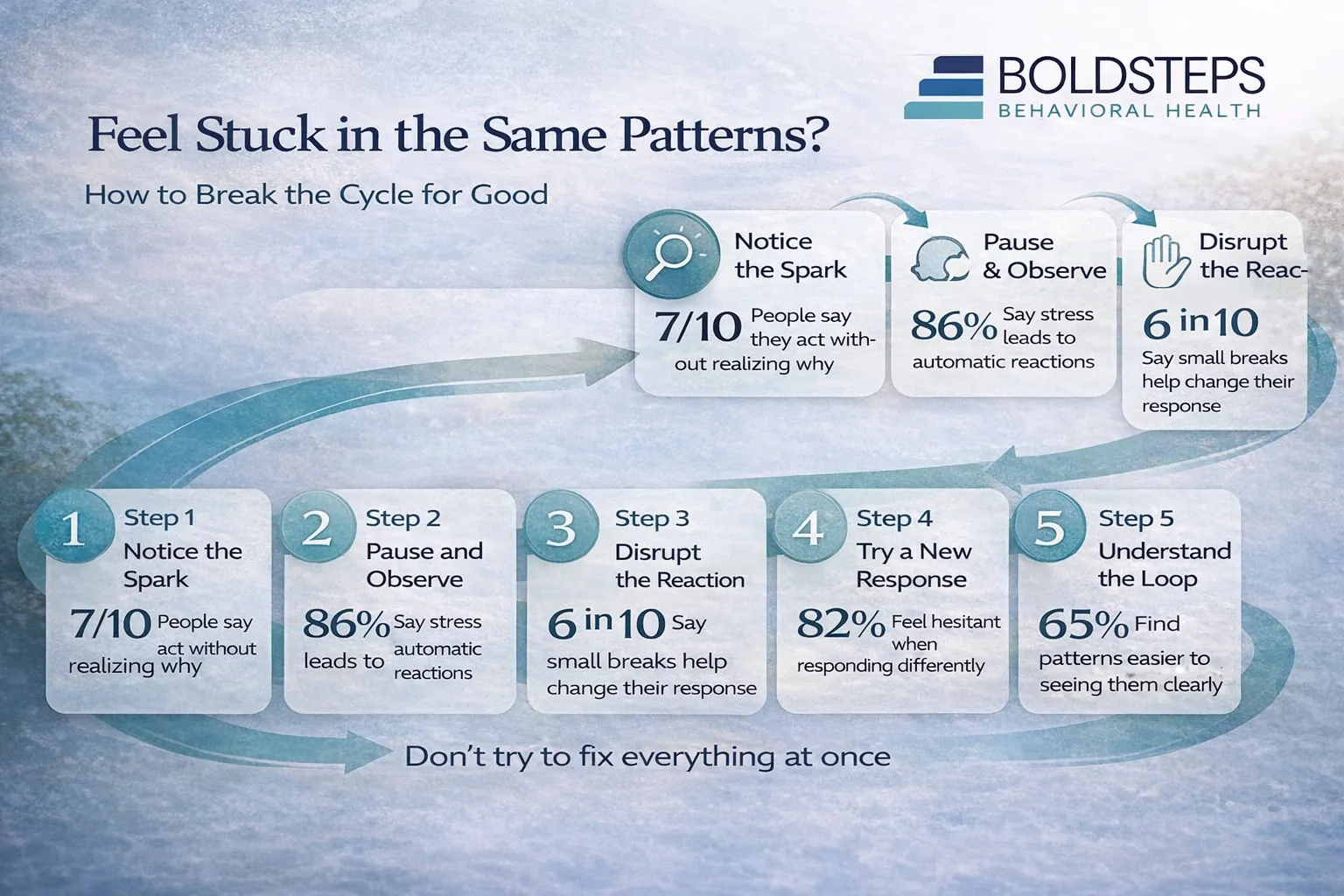
Step 4: Try a Different Response (Even If It Feels Off)
Here’s where things get uncomfortable.
Because when you respond differently, it won’t feel natural at first.
It might feel forced.
It might feel ineffective.
It might even feel wrong.
That’s normal.
You’re not doing it wrong—you’re doing something new.
That might mean:
- Sitting with discomfort instead of escaping it
- Letting a thought pass without engaging it
- Choosing a response that feels slower, calmer, more intentional
It’s not about perfection.
It’s about practicing something different long enough for it to become familiar.
Step 5: Understand the Loop You’ve Been Living In
Most patterns follow the same structure:
Trigger → Thought → Action → Outcome → Reinforcement
Once you see this clearly, something shifts.
You stop blaming yourself.
And you start seeing how your brain has been trying to help—even if the method isn’t working anymore.
For example:
- Trigger: Stress or boredom
- Thought: “I need relief”
- Action: привычный coping behavior
- Outcome: Short-term comfort
- Reinforcement: Brain learns this pattern works
That loop becomes automatic.
Not because you lack discipline—but because your brain is efficient.
It repeats what feels effective.
Step 6: Replace the Pattern Instead of Just Removing It
Here’s where many people get stuck.
They try to stop a habit without replacing it.
But your brain doesn’t like empty space.
If you remove a pattern without giving it something new, the old one usually comes back.
Instead, you build a replacement.
That might look like:
- A different way to respond to stress
- A new way to sit with discomfort
- A healthier way to create relief
It doesn’t have to be perfect.
It just has to be different enough to interrupt the cycle.
Step 7: Focus on One Pattern—Not Your Entire Life
Trying to fix everything at once almost always leads to burnout.
Real change is smaller than that.
It’s more focused. More specific.
Instead of:
“I need to change everything.”
Try:
“What’s one pattern I want to understand better?”
People in Hillsborough County, New Hampshire often come to this realization after feeling overwhelmed by trying to “fix it all.” Others in Nashua, New Hampshire notice that once they focus on one loop at a time, change feels more manageable—and more real.
You don’t need to do everything.
You just need to start somewhere.
What This Process Actually Feels Like Over Time
At first, it feels like effort.
You’re paying attention more.
You’re catching thoughts you used to miss.
Then it starts to feel like awareness.
You notice patterns earlier.
You feel less pulled by them.
And eventually, it becomes something else:
Choice.
You’re not automatically reacting anymore.
You have space between the thought and the action.
And that space?
That’s where your life starts to change.
Why This Works Even If Nothing Else Has
If you’ve tried to change before and felt stuck, it doesn’t mean you failed.
It usually means you were trying to change behavior without understanding the system behind it.
This approach works differently.
It doesn’t rely on motivation.
It doesn’t expect perfection.
It doesn’t assume willpower is enough.
It gives you something more reliable:
Awareness + interruption + repetition.
That’s what creates lasting change.
Frequently Asked Questions
What if I keep falling back into old habits?
That’s part of the process—not a sign that it’s not working. Every time you notice the pattern, even after the fact, you’re building awareness. That awareness leads to earlier interruptions over time.
How long does it take to see real change?
Some people notice small shifts quickly—like catching thoughts sooner or pausing before reacting. Larger changes build gradually through repetition.
Do I need to completely eliminate the habit?
No. The goal isn’t perfection. It’s reducing how automatic the pattern is and increasing your ability to choose a different response.
What if I don’t feel “ready” to change?
You don’t need to feel ready. Curiosity is enough. Change often starts before confidence shows up.
Can this help even if I’ve been stuck for years?
Yes. These are learned patterns, which means they can also be unlearned and replaced—no matter how long they’ve been there.
Is this something I can do on my own?
You can start noticing patterns on your own, but structured support often makes the process clearer, faster, and more consistent.
You don’t have to keep repeating the same patterns just because they’re familiar.
You don’t have to rely on willpower alone.
And you don’t have to figure this out by yourself.
Call (603)915-4223 to learn more about our Cognitive Behavioral Therapy in Concord, New Hampshire.
If this felt familiar, that matters.
It means you’re starting to see the pattern.
And once you see it—
you can change it.