

You had a good stretch. Ninety days? More? You were finally breathing easier, sleeping better, laughing without wondering when the other shoe would drop.
And then the holidays showed up. Full of cheer and chaos. Lights and landmines. People smiling with drinks in hand, family dynamics that crack the skin open, loneliness disguised as celebration.
You told yourself, “I’ve got this.”
You told others, “I’m good.”
You meant it. Until you didn’t.
And then it happened. A slip. A full relapse. A quiet return to something you swore you were done with.
Here’s what I want you to hear—gently but clearly: Relapse happens. Especially during the holidays. It doesn’t erase your progress. And it doesn’t define your future.
At Bold Steps Behavioral Health, we built our Partial Hospitalization Program (PHP) in Concord, NH for moments like this. Not to shame you. Not to make you start over. But to catch you mid-fall—before the damage gets deeper.
Why the Holidays Hit Harder Than People Think
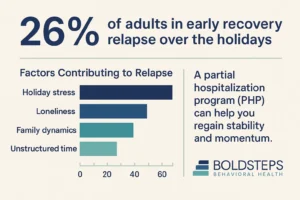
The holidays carry a particular kind of weight in recovery. It’s not just nostalgia or temptation—it’s pressure. Unrelenting, subtle pressure to be “better by now,” to perform recovery like it’s something smooth and linear.
Here’s what you’re really up against:
- Old wounds that get reopened by family, loss, or absence
- Unstructured time that disrupts your daily routines
- Social triggers (drinks at every event, comments about “just one”)
- Emotional inflation—feeling like every moment is supposed to be joyful
You’re not weak for being impacted. You’re human.
In fact, research shows relapse rates increase during the holiday season, especially for those under six months sober. But nobody puts that on a card, do they?
You Are Not “Back at Zero”
Let’s dismantle that lie first.
Relapse is a disruption—not a reset. You don’t lose the insight, growth, or skills you’ve built. You don’t go back to being “a mess.” You just need support that matches this new terrain.
The real danger isn’t the relapse. It’s the shame that follows.
Shame tells you to hide. To isolate. To prove you’re fine on your own. And that’s exactly what keeps people stuck. That’s what turns a lapse into a spiral.
But walking back through the door? That’s power. That’s ownership. That’s your brain remembering recovery is still an option.
Why a Partial Hospitalization Program Works After a Relapse
PHP is a level of care built for people in the middle. Not in full crisis. Not quite stable. Just… off-balance. It’s where you go when you know something’s slipping and you want to stop it before it crashes.
At Bold Steps, our Partial Hospitalization Program offers:
- Structured treatment five days a week
- Group therapy that speaks to the real-life mess of relapse—not just theories
- Individual therapy to unpack what led to the slip and what can be rebuilt
- Psychiatric support if medications need adjusting
- Emotional safety without babying or blaming
It’s not a hospital. It’s not a punishment. It’s a container—something sturdy enough to hold you while you recalibrate.
PHP Is the Recovery Booster You Didn’t Know You Needed
A lot of alumni think returning to treatment means failure. But here’s what actually happens in PHP:
- You rebuild momentum, fast
- You plug back into support, without needing to explain every detail
- You get clarity, not just coping skills
- You see that relapse is part of some people’s stories—not the end of them
Whether you’re local to Hillsborough County, NH or searching for a Partial Hospitalization Program in Merrimack County, NH, our Concord-based team will meet you right where you are—without pressure or pretense.
Coming Back Takes More Strength Than Staying Away
Let’s be real: relapse is one thing. Coming back after it? That’s a whole different mountain.
The voice in your head says:
- “You should’ve known better.”
- “You’re wasting everyone’s time.”
- “They won’t want you back.”
But that voice isn’t telling the truth. We do want you back. We know what relapse feels like—not just on paper, but in your bones. And we know that returning is not weakness. It’s proof you haven’t given up.
Every day you don’t return is another day shame gets louder. You can change that—starting now.
What to Expect in Your First Week Back
Day one might feel like a blur. That’s normal.
Here’s what happens:
- A compassionate re-entry session, not a cross-examination
- A fresh treatment plan, based on where you are now, not where you were 90 days ago
- Introduction (or reintroduction) to the group setting, where relapse is treated like what it is—common, painful, and recoverable
You’ll get honest care, flexible options, and space to breathe.
You’ll also get a team that’s ready to talk about the real stuff—shame, fear, guilt, and the part of you that still wants to use.
Signs PHP Might Be the Right Fit Right Now
You might need more support than you think if:
- You’ve relapsed and feel emotionally unstable or unsafe
- You’ve stopped showing up to therapy or support groups
- Your sleep, appetite, or mood has crashed
- You’re feeling numb, isolated, or flat
- You’ve started lying to people you love again
PHP can catch you before the fall gets deeper. It can hold you steady while you find your footing. You don’t have to wait until it gets worse.
You Can Still End the Year With Integrity
Relapse doesn’t have to define this season.
You can still finish the year in motion. In honesty. In care.
A Partial Hospitalization Program might be the handrail you need to steady yourself—and the jumpstart that gets your recovery back online.
FAQs About PHP After a Holiday Relapse
Do I have to start completely over?
No. PHP builds on your past progress. You’re not treated like a first-timer. Your treatment is personalized based on where you are now.
What if I’ve relapsed more than once?
That’s okay. Many people relapse multiple times before finding long-term stability. We focus on moving forward—not counting missteps.
Will I be judged or lectured?
Never. Bold Steps clinicians are trained to meet relapse with compassion and clarity. You’ll be supported, not shamed.
How long is the Partial Hospitalization Program?
Most PHP tracks last 2–4 weeks, depending on your needs. You and your care team will decide the length together.
Is PHP only for addiction? What if I’m struggling with depression or anxiety too?
Our PHP supports co-occurring conditions. We provide integrated mental health support alongside relapse recovery.
Relapsed over the holidays? Let us help steady you.
Call (603) 915-4223 to learn more about our Partial Hospitalization Program in Concord, NH.
You haven’t lost your progress. You’re just at a moment where more support makes sense. We’re here for it. And for you.