

You left IOP. Maybe quietly. Maybe suddenly. Maybe with every intention to come back—but never did. And now the question hangs in the air:
Can I return?
Do they even want me to?
Can I trust myself again?
The answer to all three: Yes. And it starts here—with honesty, patience, and small steps forward.
At Bold Steps Behavioral Health in Concord, NH, our Intensive Outpatient Program sees this all the time. Clients leave, pause, struggle, hide. And when they’re ready, they return. No shame. No lectures. Just support.
Here’s how you can rebuild trust—with the program, with your people, and most of all, with yourself.
Start With This: You Are Not the Only One
It’s easy to feel like the only person who ever ghosted a group. Like you’ve committed some unspoken betrayal by walking away.
But the truth is, you are not alone.
Treatment dropout happens more often than people talk about. Sometimes life gets overwhelming. Sometimes shame creeps in. Sometimes the emotional work just hits too deep, too fast. Sometimes we’re scared we’re doing it wrong—and leaving feels easier than failing.
You are not broken. You are human. And just the fact that you’re still thinking about recovery means something inside you still believes change is possible.
Reach Out—Even if It’s Messy
One of the hardest parts of coming back is making that first call, text, or email.
What do you say?
How do you explain?
What if they’re mad?
Here’s the truth from someone who’s done it: It doesn’t have to be perfect.
You don’t need a grand apology. You don’t need to justify every decision. You just need to reach out with honesty.
Even something as simple as:
- “Is it okay to come back?”
- “I left, but I’m still struggling.”
- “I don’t know where to start, but I think I want to try again.”
That’s enough. That’s brave. That’s more than most people ever do. And it can open a door you thought you’d closed for good.
Be Honest About What Made You Leave
You’re allowed to have had a hard time. You’re allowed to name what didn’t work for you the first time around. Maybe the group felt too intense. Maybe you were overwhelmed by life outside of treatment. Maybe something personal happened that pulled you away.
Whatever it was, your story is valid.
Being honest about it doesn’t make you weak—it makes you trustworthy. And it helps your care team understand how to support you better this time.
The goal isn’t to shame you for leaving. It’s to co-create something that works now, based on where you really are—not where you thought you should be.
Take One Small Step at a Time
It’s tempting to feel like you need to leap back in, guns blazing. Full schedule. All the groups. Make up for lost time.
But that pressure can backfire fast.
Instead, let your return be slow and steady. Ask for a check-in. Start with one group per week. Reconnect with your clinician. Test the water instead of diving in.
The point isn’t to race ahead—it’s to stay present long enough for real healing to take root.
And if you’re local to Hillsborough, NH or Essex County, MA, Bold Steps can help you build a schedule that matches your real life—not your imagined ideal.
Rebuilding Trust With the Group (If That Feels Hard)
This is a big one.
Maybe you’re worried what the group will say. Maybe you fear they’ll judge you for leaving. Maybe you’re scared to walk into that room again and feel like a stranger.
Here’s what you should know:
Group members get it. They’ve been there—maybe not the same story, but the same feeling. The shame. The fear. The doubt. And more often than not, they’re just glad you came back.
You don’t have to explain everything. You can walk in, sit down, and say, “It’s good to be back.” That’s enough. Let your presence speak louder than your absence.
Give Yourself Credit for Coming Back
Coming back is one of the hardest things you’ll ever do in recovery.
It takes courage. Humility. Self-awareness. And a willingness to be seen again—not as perfect, but as someone who still wants more for their life.
That matters. That counts.
Don’t wait for other people to validate it. Give yourself credit now. You came back. You’re still trying. That’s proof of your strength—not a lack of it.
Rebuild Trust With Yourself Gently
Leaving treatment can shatter your confidence. You might wonder:
- “Can I really follow through?”
- “What if I leave again?”
- “How do I know I’m serious this time?”
These are normal thoughts. But they don’t mean you’re doomed.
Start small. Show up once. Be honest in session. Reach out when you’re struggling instead of ghosting again. Every time you keep a promise to yourself—even a tiny one—you rebuild the bridge.
Trust isn’t built in declarations. It’s built in quiet follow-through.
Shift From Guilt to Curiosity
Guilt will say, “You messed this up.”
Curiosity will ask, “What do you need this time?”
That shift is everything.
Instead of spiraling in shame, get curious:
- What boundaries do I need in place?
- What did I learn from my first round?
- What does support look like now—not last time?
You’re allowed to adjust. Recovery is dynamic. Your treatment can be, too.
Remember: You Never Have to Be “Fixed” to Be Welcome
You might feel like you don’t belong anymore. Like you’ve forfeited your spot by stepping away.
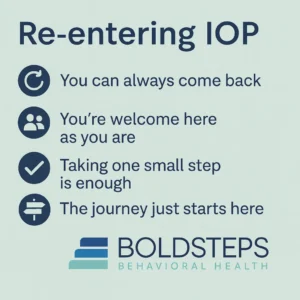
But at Bold Steps—and in any good IOP—you are welcome as you are. Messy. Unsure. In progress.
There is no finish line you have to cross to deserve care. You’re not a project that needs to be “fixed.” You’re a person who’s still trying. That’s enough.
FAQs About Returning After Leaving IOP
Do I have to explain why I left?
Only if you want to. Clinicians may ask gentle questions to understand your needs, but there’s no demand for a detailed story.
Will I have to restart the whole program?
Not always. It depends on how long you’ve been away and what feels right. You may pick up where you left off or re-enter with a new plan.
Can I request a different group or schedule?
Absolutely. If your needs have changed, we’ll adapt the plan. That’s part of meeting you where you are now—not where you were before.
What if I relapsed while I was gone?
Relapse doesn’t mean you failed—it means you’re still in process. We’ll help you stabilize and move forward with no shame.
Do people judge return clients?
No. In fact, many group members respect the courage it takes to come back. Returning shows strength, not weakness.
How long do IOP programs usually last after restarting?
It varies by person. You and your clinician will set goals and pace that match your current reality—not a fixed timeline.
Ready to try again—without pressure, without shame?
Call (603) 915-4223 to talk about restarting an Intensive Outpatient Program in Concord, NH.
No matter how long you’ve been away, the door is still open. And there’s still a place for you inside.