

You wake up, handle your responsibilities, show up for others, and even get compliments for how “together” you seem. But inside, it doesn’t feel like you’re thriving. It feels like you’re surviving—quietly, efficiently, and alone.
Maybe there’s alcohol in the picture. Maybe something else. Maybe it’s not even about the substance anymore, but the way you use it—to numb, to sleep, to avoid the shame spiral that’s becoming harder to ignore.
If any of this sounds familiar, here’s what I want you to know: You don’t have to lose everything to get help. And you don’t have to wait until things fall apart to qualify for support.
At Bold Steps Behavioral Health, our Intensive Outpatient Program in Concord, NH was built for people like you—high-functioning, quietly struggling, and ready to stop pretending that “fine” is good enough.
The Hidden Struggle of High-Functioning Substance Use
The idea that addiction always looks like chaos is misleading. Some people maintain jobs, relationships, even social calendars while quietly using daily. They don’t show up late. They don’t raise red flags. But that doesn’t mean they’re okay.
The truth is, high-functioning clients are often the most emotionally exhausted. They carry the weight of being perceived as strong while internally battling guilt, shame, or fear they don’t dare speak aloud.
Here’s what we see often:
- A glass (or two) every night that’s no longer optional
- Justification after justification: “I need to unwind,” “Everyone drinks,” “It’s not a problem if I handle it”
- Mental gymnastics to avoid admitting the loss of control
- A growing fear: “What if I can’t stop?”
It’s not drama. It’s slow erosion. And it doesn’t have to end in collapse to deserve care.
Why High-Functioning Clients Avoid Treatment
There are patterns we see when high-functioning clients first reach out:
- They’ve researched everything before they call.
- They minimize—“It’s not that bad, I just want to get ahead of it.”
- They fear exposure, especially in small communities like Concord or Merrimack County, NH.
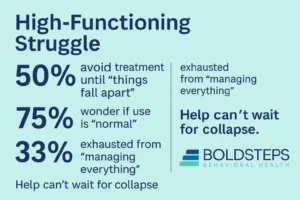
- They believe treatment is for people who’ve hit bottom, and they don’t see themselves that way.
And yet, they’re the ones who benefit most from a structured, supportive, non-judgmental environment. Because once the mask drops—just for a moment—it’s a relief to be real.
What Makes Intensive Outpatient Programs So Effective?
An Intensive Outpatient Program offers a unique middle ground between residential treatment and standard outpatient therapy. It’s highly structured—but flexible enough for people who still need to work, parent, or maintain parts of their daily routine.
At Bold Steps, our IOP includes:
- 3 to 5 treatment days per week, depending on your needs
- Group therapy that reduces isolation and helps dismantle shame
- Individual counseling to address the deeper patterns and trauma
- Evidence-based tools for navigating stress, relapse risk, and emotional overwhelm
- Support without judgment, so you can show up as you are
For many high-achieving professionals, parents, and caregivers, it’s the first time in years they’ve had space to be honest.
Real Recovery for People Who Don’t “Look the Part”
You don’t have to wait for an arrest, an intervention, or a health scare to begin healing.
Our clients often say things like:
“I kept waiting for it to get bad enough to justify getting help. But it was already bad—just quiet.”
“I was afraid to tell anyone how often I used. When I finally did, nobody was shocked. They were relieved.”
We’ve worked with lawyers, teachers, nurses, mechanics, bartenders, stay-at-home parents—people from every background. The substance is often different. The story sounds different. But the emotional truth underneath is strikingly similar.
The Emotional Wear of Performing “Fine”
There’s a loneliness to high-functioning substance use that’s hard to describe unless you’ve lived it.
You’re not in denial—you’re in performance mode. You know the patterns. You’ve seen the signs. You might even have Googled “Am I an alcoholic?” at 2am and closed the tab in panic.
The hard part isn’t recognizing something’s wrong. The hard part is admitting it while you still look okay on paper.
But the cost of waiting?
- Constant internal tension
- Mounting shame
- Emotional distance from people you love
- Health issues that sneak up slowly
- That quiet voice whispering: “This isn’t sustainable”
It’s okay to want more. Not just sobriety—but freedom. Rest. A way of living that doesn’t involve hiding.
What Happens When You Start IOP?
Stepping into an IOP doesn’t mean you have to declare yourself an addict. It means you’re curious about doing life differently. It means you’re brave enough to explore what honesty could feel like.
Here’s what to expect in our Concord, NH program:
- Warm, confidential intake process with clinicians who understand high-functioning patterns
- Tailored treatment plan—we don’t assume anything about your story
- Connection with peers—yes, even if you’re scared you won’t relate
- Real progress—not just behavior change, but emotional healing
We work with clients from all over Southern New Hampshire, including those looking for Intensive Outpatient Programs in Rockingham County and Hillsborough County. Our location in Concord makes care accessible without the intensity of inpatient programs.
Signs You Might Be Hiding in High-Functioning Mode
You might be dealing with high-functioning substance use if:
- You make “rules” around your use (“Only after 5pm,” “Only on weekends,” etc.)
- You feel defensive or anxious when you skip a drink or dose
- You’re exhausted from keeping up appearances
- You drink or use to feel normal—not to celebrate
- You’ve tried to cut back, but it didn’t stick
These aren’t moral failings. They’re red flags. And you’re allowed to act on them before things get worse.
You Don’t Have to Choose Between Treatment and Your Life
One of the biggest barriers we see? Fear of disruption. Of having to leave work, lose income, or explain yourself to people who “won’t get it.”
But that’s exactly why IOP works.
You attend during the day or evening, based on your schedule. You maintain your home life. You stay present in your job. And you start to build something new—something rooted in honesty, capacity, and strength that doesn’t require you to be perfect.
Frequently Asked Questions: Intensive Outpatient Program (IOP)
Do I have to call myself an addict to join IOP?
No. You don’t need to adopt any label to access care. Many of our clients come in unsure how to define their relationship with substances. We meet you where you are.
Can I keep working while attending IOP?
Yes. Our program is designed for working adults. We offer flexible scheduling options, including evening groups, to help you maintain employment while getting support.
What’s the difference between IOP and regular therapy?
IOP is more intensive than weekly therapy. You’ll participate in several sessions per week, including group and individual therapy. It offers deeper structure, more support, and targeted strategies that go beyond talk therapy alone.
Will people find out I’m in treatment?
Your privacy is protected. We understand the concerns high-functioning individuals have about confidentiality. We operate with discretion and professionalism—and no one is notified unless you choose to share.
How long is the IOP program?
Most clients participate for 6–10 weeks, depending on individual needs. Some transition into weekly aftercare or continue therapy once IOP ends. We customize treatment timelines to what’s clinically appropriate and sustainable.
You’re Not Too High-Functioning for Help
You’ve spent years performing. Proving. Holding things together. But healing doesn’t happen through perfection—it starts with honesty.
If you’ve been wondering whether it’s time, it probably is.
Let’s talk about what comes next—without pressure, without shame.
Call (603) 915-4223 to learn more about our Intensive Outpatient Program services in Concord, NH.