

“You were doing so well.”
Sometimes that’s the most painful thing someone can say to you. Not because it’s untrue—but because you already know.
At Bold Steps Behavioral Health in Concord, NH, we’ve worked with many long-term alumni who return to treatment. Not because they relapsed. Not because they’re falling apart. But because they’re tired. Disconnected. Numb.
Recovery doesn’t always look like fireworks and milestones. Sometimes, it looks like showing up—again—because something feels off and you don’t want to ignore it.
This is a story we’ve seen again and again. And if it sounds familiar, maybe it’s your story too.
The Hidden Middle of Recovery: You’re Sober, But Are You Okay?
A lot changes after that first year. Early recovery is full of energy—group sessions, new habits, the high of doing something hard. But once that initial urgency fades, a new challenge shows up:
How do I keep going when everything feels… flat?
This phase is rarely talked about. It doesn’t come with crisis hotlines or slogans. It’s the quiet middle, where you’re not using, not falling—but not thriving either.
You might wake up on time. Go to work. Say all the right things. But something’s missing.
And maybe you’re afraid to say it out loud because it sounds ungrateful. But let us say it for you: you are allowed to want more from your life than just not drinking.
Numbness Is More Than a Mood—It’s a Signal
We’re taught to watch out for cravings. To worry about relapse triggers. But what about the slow fade of feeling?
What about when you stop reaching out to your sponsor—not out of defiance, but because you don’t have the energy? What about when you avoid meetings, not because you’re using, but because you can’t stand the thought of pretending you’re doing great?
That’s not laziness. That’s not failure. That’s emotional detachment. And it deserves care.
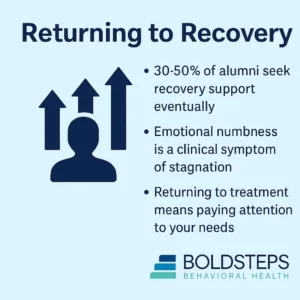
At Bold Steps, we see that kind of emotional flatness as a clinical symptom—just as real and important as the cravings you may have had in your first 90 days. And we treat it with the same seriousness and compassion.
Why Returning to Alcohol Addiction Rehab Isn’t a Setback
Here’s something we wish more people understood: coming back to treatment doesn’t mean you’re back at square one.
It means you’re listening to yourself.
In fact, alumni who return to care often bring deeper insight, better self-awareness, and more motivation than they did the first time around. They’re not coming in wide-eyed or uncertain. They’re coming in knowing exactly what emotional disconnection feels like—and wanting something different.
If anything, it’s a sign of growth.
Coming back to alcohol addiction rehab doesn’t mean you failed. It means you’re paying attention.
What Coming Back Might Look Like
Returning doesn’t always mean a full-blown restart. Sometimes it means showing up for outpatient groups a few times a week. Sometimes it means reconnecting with a therapist, revisiting trauma work, or finding meaning again through creative or spiritual practices.
Other times, it means building new structure around old routines. Refining what recovery looks like now, with the life you’ve built since your last stay.
At Bold Steps, we tailor support based on your lived experience. If you’ve already done the basics, we don’t make you start from scratch. Instead, we meet you where you are and help you move toward where you want to be.
You’re Not Alone—Even If It Feels That Way
This phase—emotional flatness, disconnection, burnout—can feel deeply isolating. Especially because it doesn’t come with obvious warning signs.
You may not be drinking. But maybe you’re:
- Avoiding people who care
- Feeling spiritually disconnected
- Bored with everything that used to help
- Wondering if this is all sobriety has to offer
If you’re in Merrimack County, Rockingham County, or Hillsborough County, you’re not the only one in this boat. We’ve walked with others who’ve said:
“I thought once I got past the worst of it, I’d feel more alive. But lately, I just feel like I’m going through the motions.”
– Returning Alumni, 2024
Your feelings are valid. They’re not selfish. And they don’t make you a bad example of sobriety. They make you human.
There’s More Work to Do—And That’s Okay
Here’s the uncomfortable truth about recovery: it’s not a one-time clean-up job. It’s a layered process.
You might have cleared the first layer—stopping drinking, healing your body, restoring your relationships. But underneath that? There’s often grief. Loneliness. Regret. Questions about who you are without the alcohol. And sometimes, those layers don’t surface until you’re stable enough to handle them.
That’s why returning to treatment can be incredibly powerful. It’s not about redoing old work. It’s about going deeper.
Think of it this way: you’re not starting over. You’re starting from experience. That’s a completely different road.
What Returning Clients Get at Bold Steps
When alumni return to our Concord, NH facility, we do things differently. Because you’ve grown. You’ve changed. And so should the care you receive.
Here’s what returning support might include:
- One-on-one therapy that digs deeper into trauma, relationships, or identity
- Small group work focused on emotional intimacy and connection
- Spiritual or creative recovery pathways
- Career, life purpose, and relationship support
- Flexible outpatient options that don’t disrupt your life
And more than anything? You get to be honest. No pretending. No pressure to be the “model alum.” Just real talk, real care, and a path forward that fits this phase of your life.
Frequently Asked Questions for Returning Alumni
Do I have to relapse to come back to treatment?
No. Many alumni return for support long before a relapse happens. Emotional detachment, mental health struggles, or a simple desire for reconnection are valid reasons to return.
Will I have to start over from the beginning?
No. Your previous progress matters. We meet you where you are now. Care plans are adapted based on what you’ve already done and what you need next.
Will people judge me for coming back?
Not here. Our team honors the courage it takes to return. There’s no shame, no lectures—just understanding, flexibility, and a space to be human again.
How long would I need to be in treatment again?
It varies. Some clients return for a few weeks of outpatient care. Others stay longer or engage in therapy and group work part-time. We co-create your plan based on your current goals and needs.
Can I get support if I live outside Concord?
Yes. We serve clients throughout Rockingham County, Merrimack County, and in Essex County, and offer virtual options when appropriate. Call us to talk through logistics.
There’s No Shame in Needing More
We’ll leave you with this:
Growth is not a ladder. It’s a spiral staircase. You pass the same truths again and again—but each time, from a different height. A different perspective. A different strength.
If you’re feeling disconnected, flat, or unsure of what’s next, it doesn’t mean you’re lost. It means you’re ready for the next layer of healing.
Want to talk with someone who gets it?
Call (603) 915-4223 to learn more about our Alcohol Addiction Rehab services in Concord, NH. You don’t have to do this part alone.